Hans Christian Garmann Johnsen – författare
657 kr
Skickas inom 10-15 vardagar
682 kr
Läs direkt efter köp
The book is an attempt to bring together what are often seen as incommensurable scientific and philosophical positions. Its core argument is that a main reason for the divisions about what constitutes scientific knowledge relates to disagreements on philosophical issues. The book explores what these disagreements are about, and discusses whether they can be overcome.
Taking a historical perspective, the book traces the divides in science back to three main philosophical traditions: realism, idealism, and scepticism. It maps how these have inspired three main current positions in science: logical empiricism, phenomenology, and sociology of scientific knowledge.
The book is intended for a general audience concerned with today’s debates on scientific knowledge and society. It will be useful for students and researchers studying philosophy of science, sociology of scientific knowledge, realism, phenomenology, positivism, logical empiricism, analytical philosophy, and sustainable scientific knowledge.
682 kr
Läs direkt efter köp
The book is an attempt to bring together what are often seen as incommensurable scientific and philosophical positions. Its core argument is that a main reason for the divisions about what constitutes scientific knowledge relates to disagreements on philosophical issues. The book explores what these disagreements are about, and discusses whether they can be overcome.
Taking a historical perspective, the book traces the divides in science back to three main philosophical traditions: realism, idealism, and scepticism. It maps how these have inspired three main current positions in science: logical empiricism, phenomenology, and sociology of scientific knowledge.
The book is intended for a general audience concerned with today’s debates on scientific knowledge and society. It will be useful for students and researchers studying philosophy of science, sociology of scientific knowledge, realism, phenomenology, positivism, logical empiricism, analytical philosophy, and sustainable scientific knowledge.
2 042 kr
Skickas inom 10-15 vardagar
596 kr
Skickas inom 10-15 vardagar
730 kr
Skickas inom 10-15 vardagar
751 kr
Skickas inom 10-15 vardagar
2 247 kr
Skickas inom 10-15 vardagar
614 kr
Skickas inom 10-15 vardagar
702 kr
Läs direkt efter köp
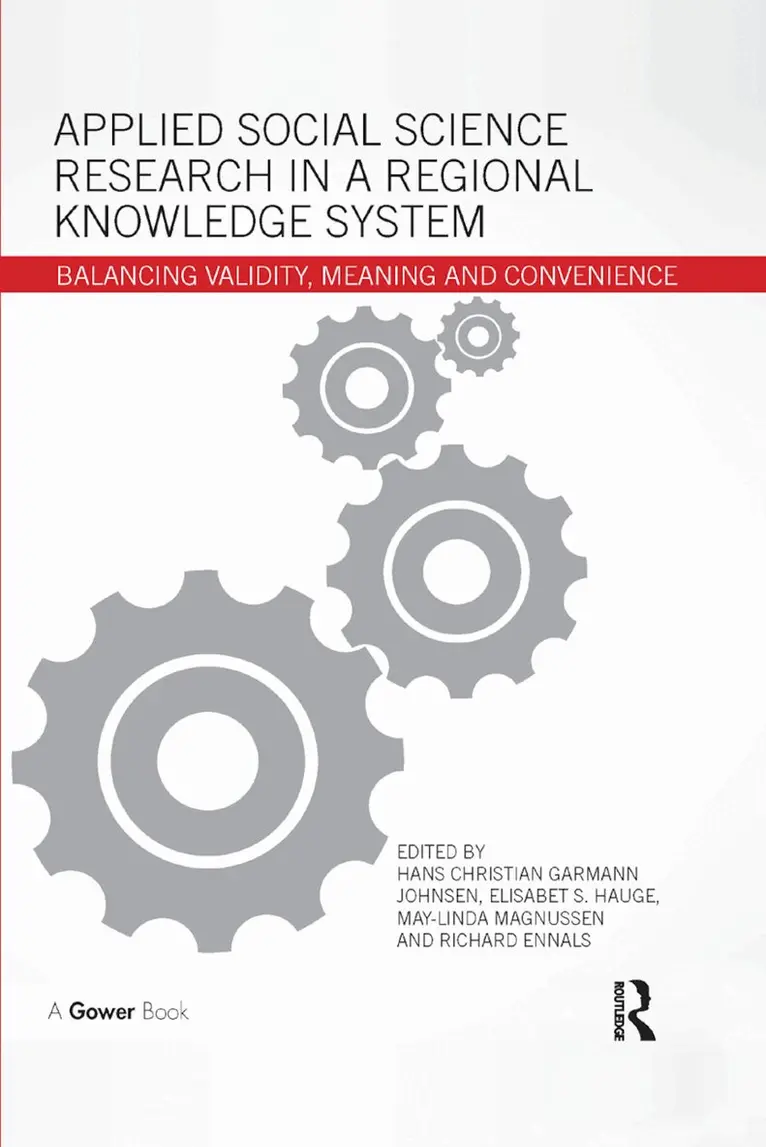
This book illustrates how applied social scientists and their research are integrated with stakeholders and practitioners in a local/regional setting, and how knowledge development is a mutual concern, made in, and dependent on, ongoing dialogue. Focusing on the Agder region, the southernmost region in Norway, researchers and contributors question what impact the changing economic environment will have on applied researchers around the world. Applied research is seen as a vital part of the infrastructure for economic and social development, in the Agder region and beyond. The chapters are divided into four parts:
the spatial dimension of knowledge development;
understanding regional practice;
explaining regional practice;
influencing regional social practice.
A useful resource for both policy makers and researchers, the book helps readers reflect on the type of mutual competence building that applied social science research implies, and depends on, in a regional knowledge development process. It represents a voice on how to understand the development of the knowledge society at regional and global levels.
702 kr
Läs direkt efter köp
This book illustrates how applied social scientists and their research are integrated with stakeholders and practitioners in a local/regional setting, and how knowledge development is a mutual concern, made in, and dependent on, ongoing dialogue. Focusing on the Agder region, the southernmost region in Norway, researchers and contributors question what impact the changing economic environment will have on applied researchers around the world. Applied research is seen as a vital part of the infrastructure for economic and social development, in the Agder region and beyond. The chapters are divided into four parts:
the spatial dimension of knowledge development;
understanding regional practice;
explaining regional practice;
influencing regional social practice.
A useful resource for both policy makers and researchers, the book helps readers reflect on the type of mutual competence building that applied social science research implies, and depends on, in a regional knowledge development process. It represents a voice on how to understand the development of the knowledge society at regional and global levels.
860 kr
Läs direkt efter köp
860 kr
Läs direkt efter köp
836 kr
Läs direkt efter köp
836 kr
Läs direkt efter köp
668 kr
Läs direkt efter köp
Coping with the Future has been written in response to widespread international awareness that the future is not predictable. In political and economic terms, we are in unknown territory, with daily developments around Brexit and the Trump Presidency, and "Kodak moments" in business. On the other hand, business leaders demand certainty, which is not available.
This book redefines the nature of modern business. In contrast to recent trends, it has a focus on human-centred manufacturing and on decision-making which goes beyond a focus on short-term profit. The liberal capitalism of the USA and the UK is not the only current variety of capitalism. Business is not just about managers, but requires participation and engagement by workers.
Since the financial crash of 2008, there has been much talk about the need for fresh approaches to business, but little has changed. This book pulls together current research and practice and poses new questions based on case studies. There is no one simple best way, but an uncertain future can be addressed, drawing on diverse past experience and cases.
The book addresses an intended audience in business and universities, including business schools, around the world. The debate takes a broader approach, involving research in the social sciences and approaches from philosophy. The world has always been unpredictable, but we have allowed ourselves to be comforted by convenient myths. It is time to wake up.
668 kr
Läs direkt efter köp
Coping with the Future has been written in response to widespread international awareness that the future is not predictable. In political and economic terms, we are in unknown territory, with daily developments around Brexit and the Trump Presidency, and "Kodak moments" in business. On the other hand, business leaders demand certainty, which is not available.
This book redefines the nature of modern business. In contrast to recent trends, it has a focus on human-centred manufacturing and on decision-making which goes beyond a focus on short-term profit. The liberal capitalism of the USA and the UK is not the only current variety of capitalism. Business is not just about managers, but requires participation and engagement by workers.
Since the financial crash of 2008, there has been much talk about the need for fresh approaches to business, but little has changed. This book pulls together current research and practice and poses new questions based on case studies. There is no one simple best way, but an uncertain future can be addressed, drawing on diverse past experience and cases.
The book addresses an intended audience in business and universities, including business schools, around the world. The debate takes a broader approach, involving research in the social sciences and approaches from philosophy. The world has always been unpredictable, but we have allowed ourselves to be comforted by convenient myths. It is time to wake up.
2 247 kr
Skickas inom 10-15 vardagar
2 182 kr
Skickas inom 10-15 vardagar
2 320 kr
Skickas inom 10-15 vardagar