Jeremy Pitt - Böcker
Visar alla böcker från författaren Jeremy Pitt. Handla med fri frakt och snabb leverans.
6 produkter
6 produkter
1 690 kr
Skickas inom 5-8 vardagar
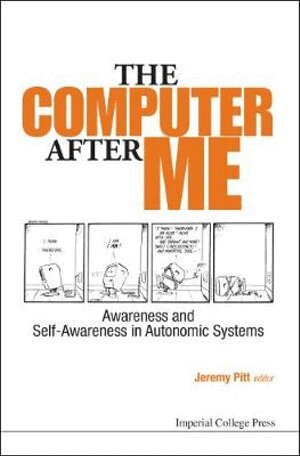
We are increasingly seeing computer systems which are expected to function without operator intervention. This is perhaps acceptable for running computer networks or traffic lights; however, we are now seeing computer systems deployed to qualitatively influence human judgments such as rulings on legal disputes or fitness for work to evaluate disability benefits. In keeping with the precautionary principle, it is important that those who are developing this capability — technologists and scientists — think through its potential implications.The aim of this book is to explore the technological and social and implications of computers and robots becoming increasingly ‘aware’ of their environment and the people in it, and their being increasingly ‘self-aware’ of their own existence within it.The wide-ranging scope of the text covers three different angles of the concept of ‘the computer after me’: (1) the next generation of computationally powerful aware systems; (2) systems in which the computer is aware of qualitatively impact human concerns such as law, health and rules; and (3) computers and robots which are aware of themselves.
Self-organising Multi-agent Systems: Algorithmic Foundations Of Cyber-anarcho-socialism
Inbunden, Engelska, 2021
1 953 kr
Skickas inom 3-6 vardagar
The paradigm of self-organisation is fundamental to theories of collective action in economic science and democratic governance in political science. Self-organisation in these social systems critically depends on voluntary compliance with conventional rules: that is, rules which are made up, mutually agreed, and modifiable 'on the fly'. How, then, can we use the self-organisation observed in such social systems as an inspiration for decentralised computer systems, which can face similar problems of coordination, cooperation and collaboration between autonomous peers?Self-Organising Multi-Agent Systems presents an innovative and systematic approach to transforming theories of economics and politics (and elements of philosophy, psychology, and jurisprudence) into an executable logical specification of conventional rules. It shows how sets of such rules, called institutions, provide an algorithmic basis for designing and implementing cyber-physical systems, enabling intelligent software processes (called agents) to manage themselves in the face of competition for scarce resources. It also provides a basis for implementing socio-technical systems with interacting human and computational intelligences in a way that is sustainable, fair and legitimate.This interdisciplinary book is essential reading for anyone interested in the 'planned emergence' of global properties, commonly-shared values or successful collective action, especially as a product of social construction, knowledge management and political arrangements. For those studying both computer science and social sciences, this book offers a radically new gateway to a transformative understanding of complex system development and social system modelling.Understanding how a computational representation of qualitative values like justice and democracy can lead to stability and legitimacy of socio-technical systems is among the most pressing software engineering challenges of modern times. This book can be read as an invitation to make the Digital Society better.Related Link(s)
1 531 kr
Skickas inom 5-8 vardagar
Imagine a world where your clothes sense your blood pressure, heart rate and body temperature. Suppose the sensors transmit this information to ‘the cloud’, continuously and unobtrusively. Suppose artificial intelligence in ‘the cloud’ detects an anomaly. Suppose it tells your doctor: sighs of relief all round. But then suppose it tells an actuary, who tells your insurer, who tells your employer …This is the world of pervasive adaptation.This Pervasive Day explores the potential — and perils — of daily living with pervasive adaptive computing. This is the result of saturating ourselves and our physical environment with sensors, cameras and devices, all connected to and inter-connected by global networks and computers, which can run increasingly intelligent machine-learning and data fusion algorithms on datasets that could be generated by the entire human population.This book takes as its unifying theme Ira Levin's 1970 science fiction novel This Perfect Day to expose both potential innovations and controversial social issues. It explores the science and technology of pervasive adaptation through a human-centred and socio-technical perspective within the cultural, ethical and legal context of contemporary life. It discusses how pervasive adaptation could provide the foundations for a new range of life-enhancing and planet-saving applications in health, sustainability and assistive living. On the other hand, with the recording, storage and processing of every action, emotion and thought, there also arise the possibilities for unwarranted surveillance, invasions of privacy, loss of civil liberties and commercial exploitation.This Pervasive Day is an insightful read for anyone concerned with the social impact of technology. Written by experienced technologists with a deep interest in computational intelligence, human-computer interaction and ambient systems, This Pervasive Day is a remarkable single source of reference — a fusion of several technical disciplines that makes for a broad scope of investigation within the domains of pervasive computing.Unifying, informative and thought-provoking, This Pervasive Day takes its place as a landmark title that will challenge the perceptions of the technologists and policy-makers, the pragmatists and the theorists, the doers and the thought-leaders.
Del 8861 - Lecture Notes in Computer Science
PRIMA 2014: Principles and Practice of Multi-Agent Systems
17th International Conference, Gold Coast, QLD, Australia, December 1-5, 2014, Proceedings
Häftad, Engelska, 2014
552 kr
Skickas inom 10-15 vardagar
This book constitutes the refereed proceedings of the 17th International Conference on Principles and Practice of Multi-Agent Systems, PRIMA 2014, held in Gold Coast, QLD, Australia, in December 2014. The 21 revised full papers presented together with 15 short papers were carefully reviewed and selected from 77 submissions.
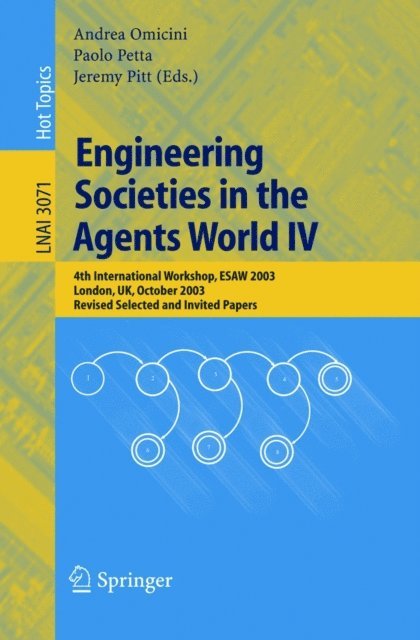
Engineering Societies in the Agents World IV
4th International Workshop, ESAW 2003, London, UK, October 29-31, 2003, Revised Selected and Invited Papers
Häftad, Engelska, 2004
552 kr
Skickas inom 10-15 vardagar
This book constitutes the thoroughly refereed post-proceedings of the 4th International Workshop on Engineering Societies in the Agents World, ESAW 2004, held in London, UK in October 2004.The 23 revised full papers presented were carefully selected during two rounds of reviewing and improvement for inclusion in the book; also included are 2 invited papers by leading researchers in order to round of the coverage of the relevant topics. The papers are organized in the following topical sections:- multidisciplinary for agent societies - coordination, organization, and security of agent societies - abstractions, methodologies, and tools for engineering agent societies - applications of agent societies
Organized Adaption in Multi-Agent Systems
First International Workshop, OAMAS 2008, Estoril, Portugal, May 13, 2008. Revised and Invited Papers
Häftad, Engelska, 2009
552 kr
Skickas inom 10-15 vardagar
Adaptation, for purposes of self-healing, self-protection, self-management, or self-regulation, is currently considered to be one of the most challenging pr- erties of distributed systems that operate in dynamic, unpredictable, and - tentially hostile environments. Engineering for adaptation is particularly c- plicated when the distributed system itself is composed of autonomous entities that, on one hand, may act collaboratively and with benevolence, and, on the other,maybehavesel?shlywhilepursuingtheirowninterests.Still,theseentities have to coordinate themselves in order to adapt appropriately to the prevailing environmental conditions, and furthermore, to deliberate upon their own and the system’s con?guration, and to be transparent to their users yet consistent with any human requirements. The question, therefore, of “how to organize the envisagedadaptationforsuchautonomousentitiesinasystematicway”becomes of paramount importance. The ?rst international workshop on “Organized Adaptation in Multi-Agent Systems” (OAMAS) was a one-day event held as part of the workshop p- gram arranged by the international conference on Autonomous Agents and Multi-Agent Systems (AAMAS). It was hosted in Estoril during May, 2008, and was attended by more than 30 researchers. OAMAS was the steady convergence of a number of lines of research which suggested that such a workshop would be timely and opportune. This includes the areas of autonomic computing, swarm intelligence, agent societies, self-organizing complex systems, and ‘emergence’ in general.