John W Finley – författare
Visar alla böcker från författaren John W Finley. Handla med fri frakt och snabb leverans.
7 produkter
7 produkter
Häftad, Engelska, 2011
548 kr
Skickas inom 10-15 vardagar
E-bok
PDF, Engelska, 2012687 kr
Läs direkt efter köp
This volume results from the Eighth Basic Symposium held by the Institute of Food Technologists in Anaheim, California on June 8-9, 1984. The theme of the symposium was "Chemical Changes in Food during Processing." The speakers included a mix of individuals from academic institu tions, governmental agencies, and the food industry. Twenty speakers discussed topics ranging from the basic chemistry relating to food constituents to the more applied aspects of chemical changes in food components during food processing. It was the intent of the organizers to bring together a group of speakers who could address the chemistry of changes in food compo nents during processing from a mechanistic point of view. As a con sequence, the proceedings of this symposium emphasize the basic chemistry of changes in food constituents from a generic perspective which is intended to provide the reader with a background to address more specific problems that may arise.
E-bok
PDF, Engelska, 20121 367 kr
Läs direkt efter köp
Elucidating the structures of biopolymers as they exist in nature has long been a goal of biochemists and biologists. Understanding how these substances interact with themselves, other solutes, and solvents can provide useful insights into many areas of biochemistry, agriculture, food science and medicine. Knowledge of the structure of a protein or complex carbohydrate in its native form provides guidelines for the chemical or genetic modifications often desired to optimize these compounds to specific needs and applications. For example, in the pharmaceutical industry, structure-function relationships involving biopolymers are studied rou tinely as a means to design new drugs and improve their efficacies. The tools to conduct structure investigations of biopolymers at the molecular level are limited in number. Historically X-ray crystallography has been the most attractive method to conduct studies of this type. How ever, X-ray methods can only be applied to highly ordered, crystalline materials, thus obviating studies of solution dynamics that are often critical to attaining a global understanding of biopolymer behavior. In recent years, nuclear magnetic resonance (NMR) spectroscopy has evolved to become a powerful tool to probe the structures of biopolymers in solution and in the solid state. NMR provides a means to study the dynamics of polymers in solution, and to examine the effects of solute, solvent and'' other factors~n polymer behavior. With the development of 2D and 3D forms of NMR spectroscopy, it is now possible to assess the solution conforma tions of small proteins, oligonucleotides and oligosaccharides.
Häftad, Engelska, 2012
1 090 kr
Skickas inom 10-15 vardagar
Elucidating the structures of biopolymers as they exist in nature has long been a goal of biochemists and biologists. Understanding how these substances interact with themselves, other solutes, and solvents can provide useful insights into many areas of biochemistry, agriculture, food science and medicine. Knowledge of the structure of a protein or complex carbohydrate in its native form provides guidelines for the chemical or genetic modifications often desired to optimize these compounds to specific needs and applications. For example, in the pharmaceutical industry, structure-function relationships involving biopolymers are studied rou tinely as a means to design new drugs and improve their efficacies. The tools to conduct structure investigations of biopolymers at the molecular level are limited in number. Historically X-ray crystallography has been the most attractive method to conduct studies of this type. How ever, X-ray methods can only be applied to highly ordered, crystalline materials, thus obviating studies of solution dynamics that are often critical to attaining a global understanding of biopolymer behavior. In recent years, nuclear magnetic resonance (NMR) spectroscopy has evolved to become a powerful tool to probe the structures of biopolymers in solution and in the solid state. NMR provides a means to study the dynamics of polymers in solution, and to examine the effects of solute, solvent and' other factors~n polymer behavior. With the development of 2D and 3D forms of NMR spectroscopy, it is now possible to assess the solution conforma tions of small proteins, oligonucleotides and oligosaccharides.
Inbunden, Engelska, 2018
1 090 kr
Skickas inom 10-15 vardagar
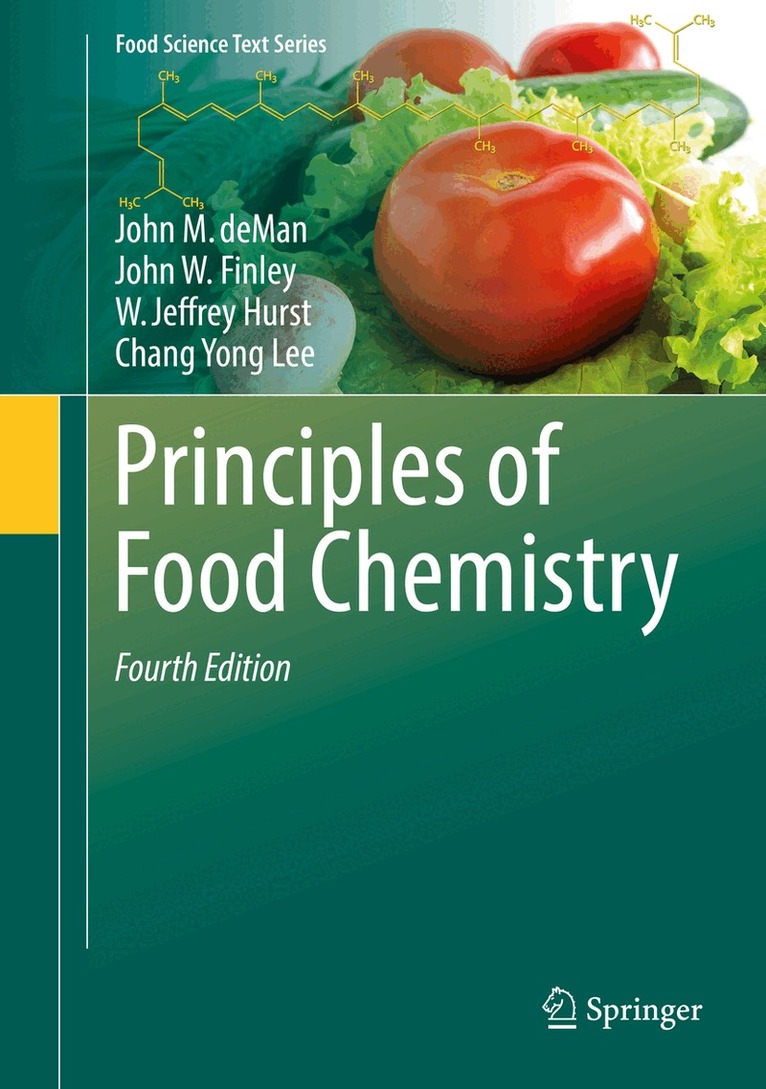
Completely revised, this new edition updates the chemical and physical properties of major food components including water, carbohydrates, proteins, lipids, minerals vitamins and enzymes. Chapters on color, flavor and texture help the student understand key factors in the visual and organoleptic aspects of food. The chapter on contaminants and additives provides an updated view of their importance in food safety. Revised chapters on beer and wine production, and herbs and spices, provide the student with an understanding of the chemistry associated with these two areas which are growing rapidly in consumer interest. New to this edition is a chapter on the basics of GMOs. Each chapter contains new tables and illustrations, and an extensive bibliography, providing readers with ready access to relevant literature and links to the internet where appropriate. Just like its widely used predecessors, this new edition is valuable as a textbook and reference.
E-bok
Engelska, 20181 214 kr
Läs direkt efter köp
Completely revised, this new edition updates the chemical and physical properties of major food components including water, carbohydrates, proteins, lipids, minerals vitamins and enzymes. Chapters on color, flavor and texture help the student understand key factors in the visual and organoleptic aspects of food. The chapter on contaminants and additives provides an updated view of their importance in food safety. Revised chapters on beer and wine production, and herbs and spices, provide the student with an understanding of the chemistry associated with these two areas which are growing rapidly in consumer interest. New to this edition is a chapter on the basics of GMOs. Each chapter contains new tables and illustrations, and an extensive bibliography, providing readers with ready access to relevant literature and links to the internet where appropriate. Just like its widely used predecessors, this new edition is valuable as a textbook and reference.
Häftad, Engelska, 2019
982 kr
Skickas inom 10-15 vardagar
Completely revised, this new edition updates the chemical and physical properties of major food components including water, carbohydrates, proteins, lipids, minerals vitamins and enzymes. Chapters on color, flavor and texture help the student understand key factors in the visual and organoleptic aspects of food. The chapter on contaminants and additives provides an updated view of their importance in food safety. Revised chapters on beer and wine production, and herbs and spices, provide the student with an understanding of the chemistry associated with these two areas which are growing rapidly in consumer interest. New to this edition is a chapter on the basics of GMOs. Each chapter contains new tables and illustrations, and an extensive bibliography, providing readers with ready access to relevant literature and links to the internet where appropriate. Just like its widely used predecessors, this new edition is valuable as a textbook and reference.