Karl-Ernst Behre – författare
Visar alla böcker från författaren Karl-Ernst Behre. Handla med fri frakt och snabb leverans.
4 produkter
4 produkter
Inbunden, Engelska, 2023
595 kr
Skickas inom 3-6 vardagar
E-bok
PDF, Engelska, 20231 247 kr
Läs direkt efter köp
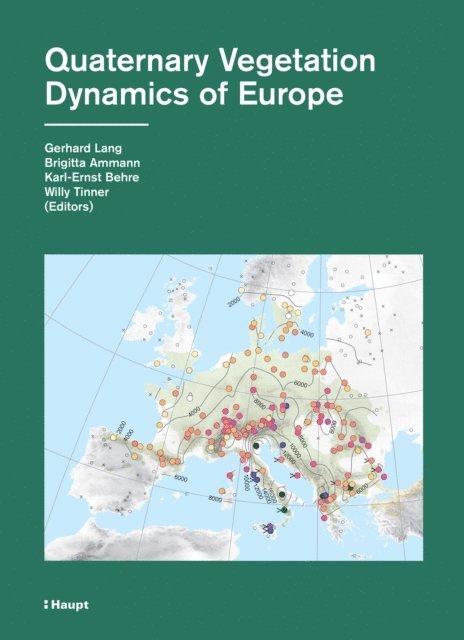
Based on palaeoecological studies by many authors, this book gives an overview of the changing history of the European plant cover during the past 2.6 million years, characterized by numerous cold and warm periods. The period of the last 20 000 years (from the Last Glacial Maximum to the present) is presented in detail, with special emphasis on the vegetation dynamics of Europe, the history of selected woody plants, the development of lakes and bogs and the emergence of European cultural landscapes under the influence of humans over thousands of years.In the analysis of the glacial and interglacial periods, the focus is on the different vegetation developments and the progressive impoverishment of the European flora. Further important topics are the spatio-temporal patterns and causes of long-term vegetation changes, the legacies of disturbances and land use on vegetation composition, the role of palaeoecology in nature conservation and its contribution to ecology and environmental sciences. In addition to recent research results, the book provides an overview of the main palaeoecological research methods. It concludes with a summary of the history of palaeoecology and Quaternary botany.For the first time, a detailed synthesis is presented of the many findings on European vegetation dynamics, which are complex and increasingly difficult to summarize. Numerous figures and tables, many of them original, accompany the text. The bibliography includes over 3000 publications. This book is primarily intended for students, researchers and practitioners in plant ecology, palaeoecology, palaeoclimatology, forestry, agronomy, Quaternary sciences, climate sciences, biogeography, geography and archaeology.
Häftad, Engelska, 2010
2 178 kr
Skickas inom 10-15 vardagar
The global environment is changing rapidly under the impact of human activities. An important element in this change is related to global climate modification. Experts from the natural and social sciences with a strong interest in history discussed common topics of great interest to society. Can the study of climate and history help in devising strategies for coping with this change? What might be the type of information most useful in this context? What are the pitfalls awaiting the unwary? These and similar questions were discussed during a four-day workshop. The resulting proceedings contain comprehensive papers of broad interest, thematic back-ground papers and reports of study groups. Apart from scientists, the papers should interest graduate students and lecturers.
E-bok
PDF, Engelska, 20132 741 kr
Läs direkt efter köp
The global environment is changing rapidly under the impact of human activities, and an important element of this change is related to global c1imate modification. Can the study of c1imate and history help in devising strategies for coping with this change? What might be the type of information most useful in this context? What are the pitfalls awaiting the unwary? These are the kinds of questions that led us to bring together experts from the natural and social sci ences with a strong interest in history, to promote discussion between workers in different disciplines by focussing on a common topic of great interest to society. The meeting was arranged in the framework of a "Hanse Conference" within the interdisciplinary program of the Hanse-Wissenschaftskolleg, a foundation set up to promote interdisciplinary studies in collaboration between the universities ofBremen and Oldenburg. The aim ofthe Hanse Conferences in general is to provide opportunities for experts from different fields of the sciences and humanities to come together and explore the larger framework oftopics of common interest. What unites the partici pants is their desire to look over the fence to neighboring disciplines. Young colleagues who wish to build an interdisciplinary career are particularly welcome. In the Hanse Conference on Climate and History, we have endeavoured to build bridges between the c1imate sciences and the sociological sciences concemed with environmental impacts on human activities. The geological sciences, we feIt, are especially well suited to the purpose because they al ready comprise historical aspects.