Prasad Thenkabail - Böcker
Visar alla böcker från författaren Prasad Thenkabail. Handla med fri frakt och snabb leverans.
3 produkter
3 produkter
15 538 kr
Skickas inom 10-15 vardagar
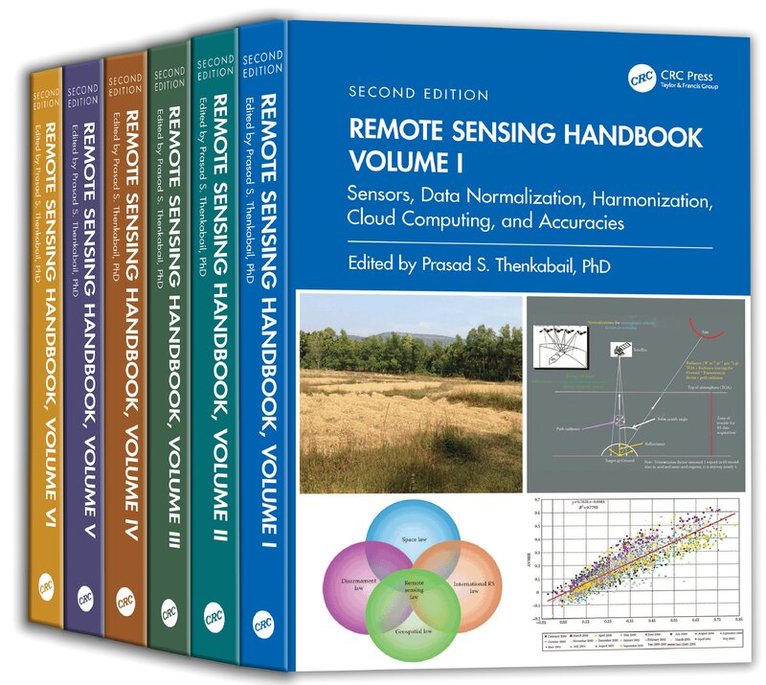
This comprehensive six volume handbook establishes a new standard for spanning and integrating discussion of remote sensing principles, data, methods, development, and applications in a scientific and social context. Advances in remote sensing with the arrival of machine learning, cloud computing, AI, and big data from multiple new generation of sensors are taken into consideration in the new edition along with many new applications of remotely sensed data. This thoroughly revised and updated volume draws on the expertise of a diverse array of leading international authorities in remote sensing and provides an essential resource for researchers at all levels interested in using remote sensing.FeaturesProvides the most up to date comprehensive coverage of remote sensing science.Discusses and analyzes data from new sensors and new satellites.Includes numerous case studies on advances and applications at a global scale.Introduces advanced methods in remote sensing such as machine learning, cloud computing, and AI.Highlights scientific achievements over the last decade and provides guidance for future developments.This set is an excellent resource for the entire remote sensing and GIS community. Academics, researchers, undergraduate and graduate students, as well as practitioners, decision-makers, and policymakers, will benefit from the expertise of the professionals featured in these handbooks, and their extensive knowledge of new and emerging trends.
1 105 kr
Skickas inom 10-15 vardagar
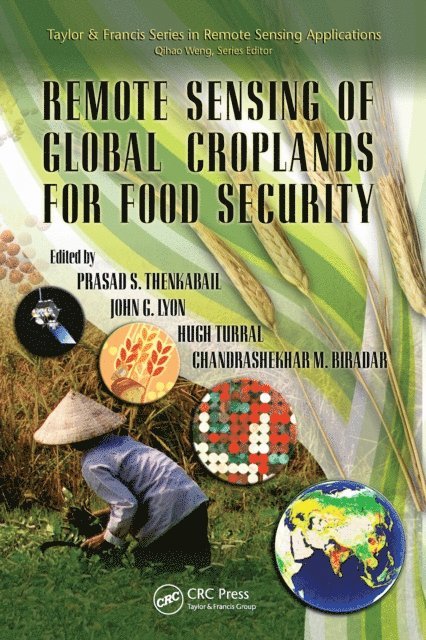
Increases in populations have created an increasing demand for food crops while increases in demand for biofuels have created an increase in demand for fuel crops. What has not increased is the amount of croplands and their productivity. These and many other factors such as decreasing water resources in a changing climate have created a crisis like situation in global food security. Decision makers in these situations need accurate information based on science. Remote Sensing of Global Croplands for Food Security provides a comprehensive knowledge base in use of satellite sensor-based maps and statistics that can be used to develop strategies for croplands (irrigated and rainfed) and their water use for food security. Over 50 Multi-disciplinary Global Experts Give Insight and Provide Practical Approaches Emphasizing practical mapping technologies based on advanced remote sensing data and methods, this book provides approaches for estimating irrigated and rainfed cropland areas and their water use on a national, continental, or global basis. Written by 50+ leading experts working at the forefront of this critical area, it offers case studies from a variety of continents highlighting the subtle requirements of each. In a very practical way it demonstrates the experience, utility, and models for determining water resources used and resulting yields of irrigated and rainfed croplands. The authors discuss: (a) innovative methods used for mapping croplands, (b) approaches adopted to collect cropland data in different countries by traditional and non-traditional means, (c) accuracies, uncertainties, and errors involved in producing cropland products, (d) surface energy balance models used to assess crop water use, and (e) extensive results and outcomes pertaining to global croplands and their water use.Develop Strategies for an Enhanced Green Revolution and an Accelerated Blue RevolutionLinking croplands to water use and food security, the book provides a global perspective on this sensitive issue. It gives insight into the extent of cropland usage, their spatial distribution, their cropping intensities, and their water use patterns. The editors collect the experience, methods, models, and results that show the way forward and help in decision-making on water resources and food security. All of this is required for developing strategies for an enhanced green revolution and for an accelerated blue revolution.
2 185 kr
Tillfälligt slut
Increases in populations have created an increasing demand for food crops while increases in demand for biofuels have created an increase in demand for fuel crops. What has not increased is the amount of croplands and their productivity. These and many other factors such as decreasing water resources in a changing climate have created a crisis like situation in global food security. Decision makers in these situations need accurate information based on science. Remote Sensing of Global Croplands for Food Security provides a comprehensive knowledge base in use of satellite sensor-based maps and statistics that can be used to develop strategies for croplands (irrigated and rainfed) and their water use for food security. Over 50 Multi-disciplinary Global Experts Give Insight and Provide Practical Approaches Emphasizing practical mapping technologies based on advanced remote sensing data and methods, this book provides approaches for estimating irrigated and rainfed cropland areas and their water use on a national, continental, or global basis. Written by 50+ leading experts working at the forefront of this critical area, it offers case studies from a variety of continents highlighting the subtle requirements of each. In a very practical way it demonstrates the experience, utility, and models for determining water resources used and resulting yields of irrigated and rainfed croplands. The authors discuss: (a) innovative methods used for mapping croplands, (b) approaches adopted to collect cropland data in different countries by traditional and non-traditional means, (c) accuracies, uncertainties, and errors involved in producing cropland products, (d) surface energy balance models used to assess crop water use, and (e) extensive results and outcomes pertaining to global croplands and their water use.Develop Strategies for an Enhanced Green Revolution and an Accelerated Blue RevolutionLinking croplands to water use and food security, the book provides a global perspective on this sensitive issue. It gives insight into the extent of cropland usage, their spatial distribution, their cropping intensities, and their water use patterns. The editors collect the experience, methods, models, and results that show the way forward and help in decision-making on water resources and food security. All of this is required for developing strategies for an enhanced green revolution and for an accelerated blue revolution.