Sanford Kwinter – författare
Visar alla böcker från författaren Sanford Kwinter. Handla med fri frakt och snabb leverans.
8 produkter
8 produkter
Häftad, Engelska, 2002
556 kr
Skickas inom 5-8 vardagar
Häftad, Engelska, 2026
308 kr
Kommande
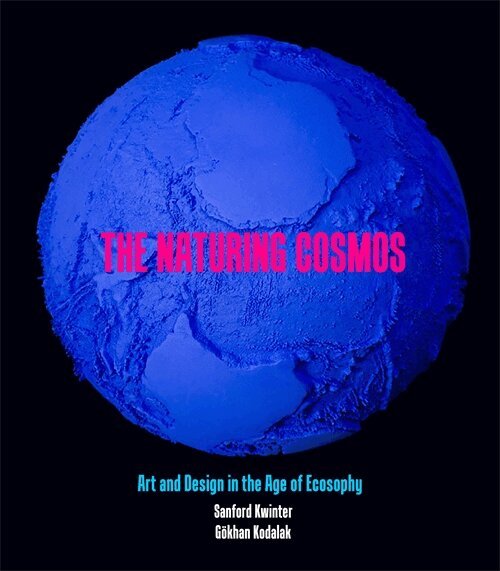
The transformation of our environment is now taking place at a faster rate and on a larger scale than we are capable of tracking. The recent surge of concern about the so-called inatural world has led to little more than a proliferation of bromides about conservation. Theoretical notions like the Anthropocene may pose as critical advances, but from the point of view of changing the grim trajectory on which we are presently set they are extraordinarily unambitious. The contributors to The Naturing Cosmos argue that only by going beyond the cultural and metaphysical frameworks that brought us to this point can we ever hope to address the crises that now face us. What is required of us is nothing short of a change of mind: a fundamental reassessment of the intellectual patterns that determine our attitudes towards and relationship with the world around us.In pursuit of just such a transformation, The Naturing Cosmosinaugurates a major new dialogue between philosophy, design theory, and ecology. The opening essays in this collection build on the work of three philosophers of nature—Baruch de Spinoza, Alfred Whitehead, and Gilbert Simondon—whose thought shares a powerful commitment to removing the false separation of human being from the wider being of the world. The contributors then place those singularly modern thinkers in relation to animist and Indigenous worldviews in order to develop an understanding of the world as abundant in beauty and value, and as demanding to be put in service to itself and not only to us. The essays also engage the ways in which worldmaking practices—art, design, cosmovision—can orient themselves toward life, thereby expanding our sensory enjoyment of the world rather than simply degrading it. Proposing as it does a radical revaluation of existing ways of thinking and being, The Naturing Cosmos is a crucial intervention in some of the most urgent debates of our time.
E-bok
PDF, Engelska, 2015161 kr
Läs direkt efter köp
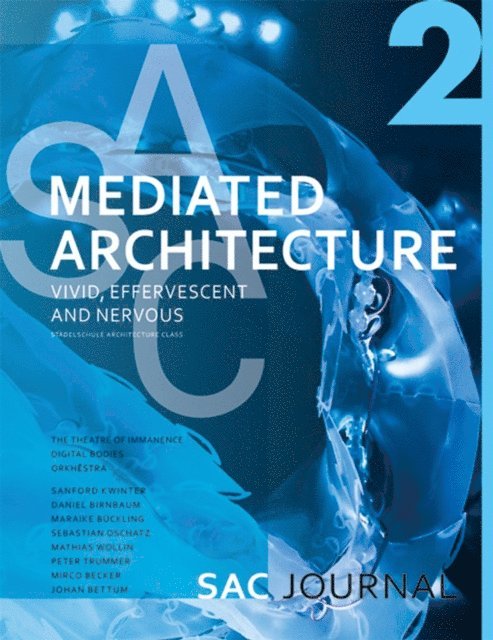
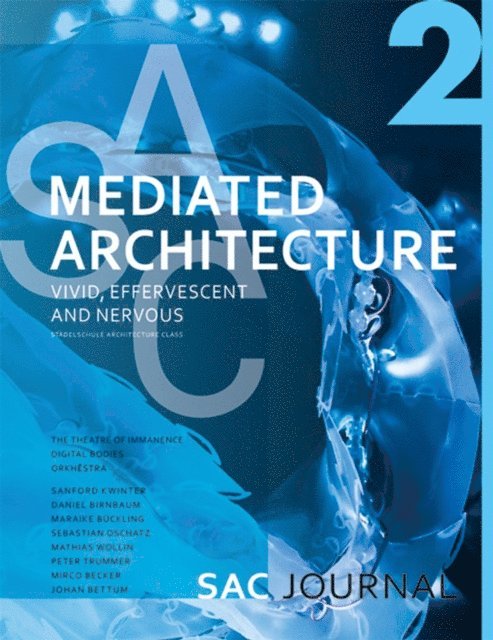
MEDIATED ARCHITECTURE: Vivid, Effervescent and Nervous, the second issue of the SAC JOURNAL, presents three projects de- signed at SAC during the last eight years. The three projects are: The Theatre of Immanence (2007), an installation and exhibition project in Städelschule''s Portikus gallery; Digital Bodies (2013-14), an experimental research project; and Orkhēstra (2014), which was an installation on a large, public square in Frankfurt and part of Luminale, ''Biennale of Lighting Culture''. The projects vary in scale and nature from gallery installation via laboratory-style modelling experiment to an urban intervention. They span a period in which architecture''s contribution to the production of space has become increasingly me- diated by technology. Each in their own way, the three projects probe this condition and explore new design opportunities given to archi- tecture. The results are vivid, effervescent and nervous – and always a mediated architecture. Accompanying extensive portfolios of drawi- ngs and pictures that document the respective design processes and their results, are texts that expound on the theoretical and practical implications of each project
E-bok
PDF, Engelska, 2016160 kr
Läs direkt efter köp
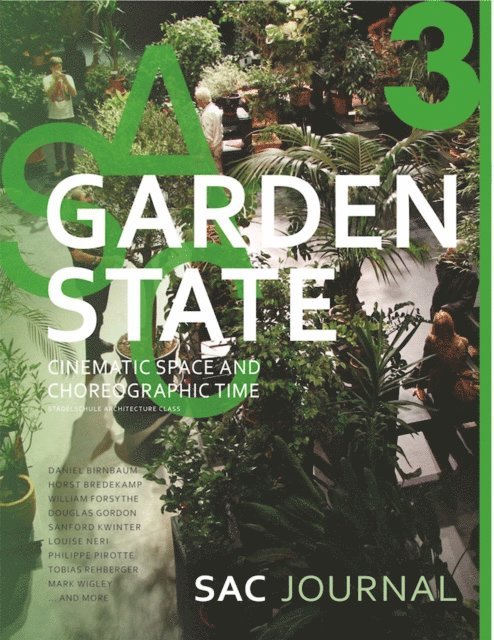
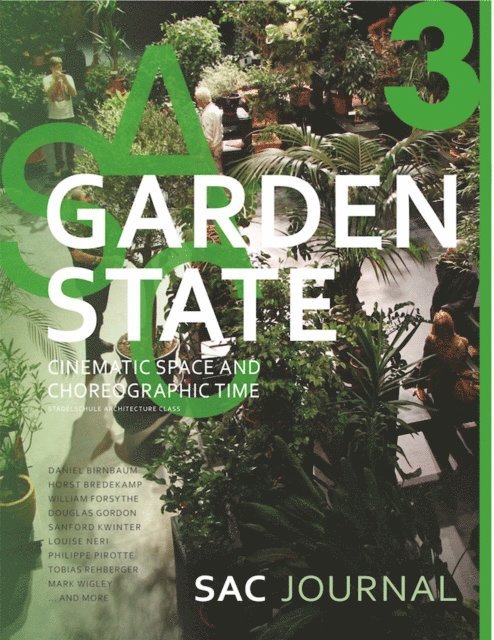
GARDEN STATE - Cinematic Space and Choreographic Timeis the third issue of the SAC JOURNAL and explores the garden as a utopia wherein time and space may be thought of in archi- tectural terms yet not easily deciphered against architecture''s traditions and practices. The garden herein is a changeable and vulnerable condition, embodying the ephemerality of life, which in turn contrasts with the customary expectations of architec- ture''s longevity. However, Garden State also engages with the contemporary arts, specifically video, cinema and ballet, and with it time and space open up with new, fragile dimensions. A choreographic framework emerges which is at once more precise yet loose, more responsive yet open, than that space architecture normally engenders. Choreographed movement differs from that prescribed by the calculable paths so often invoked in the spatial syntax of latter-day architecture. The garden emerges as a state, in all its social glory, a realm that we already occupy but perhaps never can own?Contributors to this issue include: Daniel Birnbaum, Horst Bredekamp, William Forsythe, Hu Fang, Douglas Gordon, Damjan Jovanovic, Sanford Kwinter, Philippe Pirotte, Louise Neri, Tobias Rehberger, Julia Voss, Mark Wigley and Johan Bettum. Also included are the three finalist projects for 2014 SAC AIV Master Thesis Prize.
E-bok
PDF, Engelska, 2018160 kr
Läs direkt efter köp
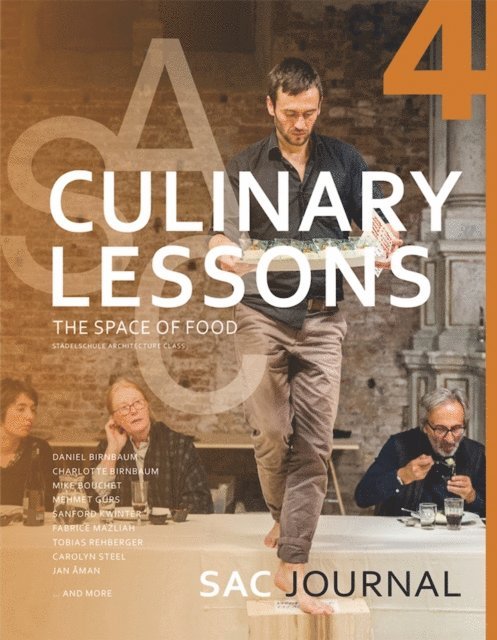
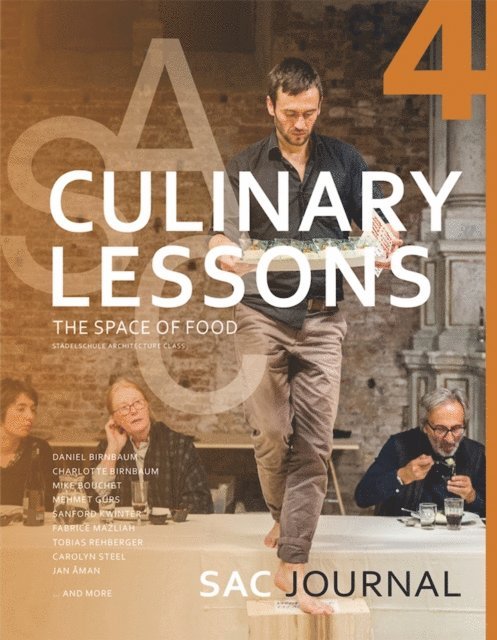
CULINARY LESSONS - The Space of Food is based on a series of events, Culinary Lessons, which were hosted by the Städelschule Architecture Class and which engaged with the relation between food, art and architecture. The series addressed the enormous so- cial, economic and cultural spaces that accompany the production and consumption of food, and attempted to unravel some of these spaces'' structure and dynamics. The central ambition was to learn from culinary history and, not the least, the recent vanguard of culinary practice.No human activity is so encompassing and engenders such ef- fects on our societies and lives as the culinary. Culinary practices lay out aesthetic as much as ethical trajectories that span from century-old traditions to lifesaving experiments for the present and future. They provide for human sustenance and the highest form of bodily enjoyment while transversing the spaces that they at once produce and profoundly affect.This fourth issue of the SAC JOURNAL presents the central con- versation in Culinary Lessons, which took place in Venice, together with a series of texts and projects that chart and speculate on the relationship between architecture, art and the culinary wor- ld. Contributors to this issue include, amongst others, Charlotte Birnbaum, Daniel Birnbaum, Mike Bouchet, Sanford Kwinter, Fabrice Mazliah, Tobias Rehberger, David Ruy, Kivi Sotamaa, Carolyn Steel, Jan Åman and Johan Bettum. It also features the winning projects of the AIV Master Thesis Prize in 2015 and 2016.SAC JOURNAL is a publication series that addresses topical isues within architecture. The journal documents, critically reviews and presents theoretical discussions concerning contemporary design and research. The content of SAC JOURNAL is produced by invited contributors and students and faculty at the Städel- schule Architecture Class.
E-bok
Engelska, 2015160 kr
Läs direkt efter köp
MEDIATED ARCHITECTURE: Vivid, Effervescent and Nervous, the second issue of the SAC JOURNAL, presents three projects de- signed at SAC during the last eight years. The three projects are: The Theatre of Immanence (2007), an installation and exhibition project in Städelschule''s Portikus gallery; Digital Bodies (2013-14), an experimental research project; and Orkhēstra (2014), which was an installation on a large, public square in Frankfurt and part of Luminale, ''Biennale of Lighting Culture''. The projects vary in scale and nature from gallery installation via laboratory-style modelling experiment to an urban intervention. They span a period in which architecture''s contribution to the production of space has become increasingly me- diated by technology. Each in their own way, the three projects probe this condition and explore new design opportunities given to archi- tecture. The results are vivid, effervescent and nervous – and always a mediated architecture. Accompanying extensive portfolios of drawi- ngs and pictures that document the respective design processes and their results, are texts that expound on the theoretical and practical implications of each project
E-bok
Engelska, 2016160 kr
Läs direkt efter köp
GARDEN STATE - Cinematic Space and Choreographic Timeis the third issue of the SAC JOURNAL and explores the garden as a utopia wherein time and space may be thought of in archi- tectural terms yet not easily deciphered against architecture''s traditions and practices. The garden herein is a changeable and vulnerable condition, embodying the ephemerality of life, which in turn contrasts with the customary expectations of architec- ture''s longevity. However, Garden State also engages with the contemporary arts, specifically video, cinema and ballet, and with it time and space open up with new, fragile dimensions. A choreographic framework emerges which is at once more precise yet loose, more responsive yet open, than that space architecture normally engenders. Choreographed movement differs from that prescribed by the calculable paths so often invoked in the spatial syntax of latter-day architecture. The garden emerges as a state, in all its social glory, a realm that we already occupy but perhaps never can own?Contributors to this issue include: Daniel Birnbaum, Horst Bredekamp, William Forsythe, Hu Fang, Douglas Gordon, Damjan Jovanovic, Sanford Kwinter, Philippe Pirotte, Louise Neri, Tobias Rehberger, Julia Voss, Mark Wigley and Johan Bettum. Also included are the three finalist projects for 2014 SAC AIV Master Thesis Prize.
E-bok
Engelska, 2018161 kr
Läs direkt efter köp
CULINARY LESSONS - The Space of Food is based on a series of events, Culinary Lessons, which were hosted by the Städelschule Architecture Class and which engaged with the relation between food, art and architecture. The series addressed the enormous so- cial, economic and cultural spaces that accompany the production and consumption of food, and attempted to unravel some of these spaces'' structure and dynamics. The central ambition was to learn from culinary history and, not the least, the recent vanguard of culinary practice.No human activity is so encompassing and engenders such ef- fects on our societies and lives as the culinary. Culinary practices lay out aesthetic as much as ethical trajectories that span from century-old traditions to lifesaving experiments for the present and future. They provide for human sustenance and the highest form of bodily enjoyment while transversing the spaces that they at once produce and profoundly affect.This fourth issue of the SAC JOURNAL presents the central con- versation in Culinary Lessons, which took place in Venice, together with a series of texts and projects that chart and speculate on the relationship between architecture, art and the culinary wor- ld. Contributors to this issue include, amongst others, Charlotte Birnbaum, Daniel Birnbaum, Mike Bouchet, Sanford Kwinter, Fabrice Mazliah, Tobias Rehberger, David Ruy, Kivi Sotamaa, Carolyn Steel, Jan Åman and Johan Bettum. It also features the winning projects of the AIV Master Thesis Prize in 2015 and 2016.SAC JOURNAL is a publication series that addresses topical isues within architecture. The journal documents, critically reviews and presents theoretical discussions concerning contemporary design and research. The content of SAC JOURNAL is produced by invited contributors and students and faculty at the Städel- schule Architecture Class.