Shakunthala Sridhara - Böcker
Visar alla böcker från författaren Shakunthala Sridhara. Handla med fri frakt och snabb leverans.
7 produkter
7 produkter
709 kr
Skickas inom 7-10 vardagar
Animal behavior studies are essential for various reasons, primarily in conservation, livestock and wildlife management, animal welfare, sustainable utilization of animal and human resources, and ultimately, enhancing our understanding of human behavior. Early on, these studies were mostly observational, until Lorenz, tin Bergen, and Frischs groundbreaking work catapulted the field into the Nobel laureates realm. This led to extensive research in several areas of animal behavior, including information acquisition (neuroethology) and transfer (communication), ecological aspects (habitat-related, foraging strategies, migration, predator-prey interactions, population ecology, etc.), socio-biology (parent-filial interaction, cooperation, and conflict, grouping and dispersion, social organization, etc.), reproductive strategies, evolutionary aspects (kin selection, altruism, life history strategies, etc.), physiology (behavioral endocrinology, rhythms, neurobiology), and applied behavior (conservation, animal welfare, livestock production, wildlife management, man-animal conflict, etc.).
1 397 kr
Skickas inom 7-10 vardagar
Animal behavior is a critical area of study with multiple applications, including conservation, livestock and wildlife management, animal welfare, sustainable resource utilization, and human behavior comprehension. The early days of behavioral research were largely observational, but the groundbreaking work of Lorenz, Tinbergen, and Frisch elevated the field and led to Nobel recognition. This paved the way for extensive research in various areas of behavior, such as information acquisition and transfer, ecological aspects, socio-biology, reproductive strategies, evolutionary dynamics, physiology, and applied behavior. These areas include conservation, animal welfare, livestock production, wildlife management, and human-animal interactions.
1 693 kr
Skickas inom 10-15 vardagar
Arthropods are invertebrates that constitute over 90% of the animal kingdom, and their bio-ecology is closely linked with global functioning and survival.Arthropods play an important role in maintaining the health of ecosystems, provide livelihoods and nutrition to human communities, and are important indicators of environmental change. Yet the population trends of several arthropods species show them to be in decline. Arthropods constitute a dominant group with 1.2 million species influencing earth’s biodiversity. Among arthropods, insects are predominant, with ca. 1 million species and having evolved some 350 million years ago. Arthropods are closely associated with living and non-living entities alike, making the ecosystem services they provide crucially important. In order to be effective, plans for the conservation of arthropods and ecosystems should include a mixture of strategies like protecting key habitats and genomic studies to formulate relevant policies for in situ and ex situ conservation.This two-volume book focuses on capturing the essentials of arthropod inventories, biology, and conservation.Further, it seeks to identify the mechanisms by which arthropod populations can be sustained in terrestrial and aquatic ecosystems, and by means of which certain problematic species be managed without producing harmful environmental side-effects.This edited compilation includes chapters contributed by over 80 biologists on a wide range of topics embracing the diversity, distribution, utility and conservation of arthropods and select groups of insect taxa. More importantly, it describes in detail the mechanisms of sustaining arthropod ecosystems, services and populations. It addresses the contribution of modern biological tools such as molecular and genetic techniques regulating gene expression, as well as conventional, indigenous practices in arthropod conservation. The contributors reiterate the importance of documenting and understanding the biology of arthropods from a holistic perspective before addressing conservation issues at large. This book offers a valuable resource for all zoologists, entomologists, ecologists, conservation biologists, policy makers, teachers and students interested in the conservation of biological resources.
Economic and Ecological Significance of Arthropods in Diversified Ecosystems
Sustaining Regulatory Mechanisms
Inbunden, Engelska, 2016
2 325 kr
Skickas inom 10-15 vardagar
Arthropods are invertebrates that constitute over 90% of the animal kingdom, and their bio-ecology is closely linked with global functioning and survival.Arthropods play an important role in maintaining the health of ecosystems, provide livelihoods and nutrition to human communities, and are important indicators of environmental change. Yet the population trends of several arthropods species show them to be in decline. Arthropods constitute a dominant group with 1.2 million species influencing earth’s biodiversity. Among arthropods, insects are predominant, with ca. 1 million species and having evolved some 350 million years ago. Arthropods are closely associated with living and non-living entities alike, making the ecosystem services they provide crucially important. In order to be effective, plans for the conservation of arthropods and ecosystems should include a mixture of strategies like protecting key habitats and genomic studies to formulate relevant policies for insitu and ex situ conservation.This two-volume book focuses on capturing the essentials of arthropod inventories, biology, and conservation. Further, it seeks to identify the mechanisms by which arthropod populations can be sustained in terrestrial and aquatic ecosystems, and by means of which certain problematic species be managed without producing harmful environmental side-effects. This edited compilation includes chapters contributed by over 80 biologists on a wide range of topics embracing the diversity, distribution, utility and conservation of arthropods and select groups of insect taxa. More importantly, it describes in detail the mechanisms of sustaining arthropod ecosystems, services and populations. It addresses the contribution of modern biological tools such as molecular and genetic techniques regulating gene expression, as well as conventional, indigenous practices in arthropod conservation. The contributors reiterate the importance of documenting and understanding the biology of arthropods from a holistic perspective before addressing conservation issues at large. This book offers a valuable resource for all zoologists, entomologists, ecologists, conservation biologists, policy makers, teachers and students interested in the conservation of biological resources.
1 693 kr
Skickas inom 10-15 vardagar
Arthropods are invertebrates that constitute over 90% of the animal kingdom, and their bio-ecology is closely linked with global functioning and survival.Arthropods play an important role in maintaining the health of ecosystems, provide livelihoods and nutrition to human communities, and are important indicators of environmental change. Yet the population trends of several arthropods species show them to be in decline. Arthropods constitute a dominant group with 1.2 million species influencing earth’s biodiversity. Among arthropods, insects are predominant, with ca. 1 million species and having evolved some 350 million years ago. Arthropods are closely associated with living and non-living entities alike, making the ecosystem services they provide crucially important. In order to be effective, plans for the conservation of arthropods and ecosystems should include a mixture of strategies like protecting key habitats and genomic studies to formulate relevant policies for in situ and ex situ conservation.This two-volume book focuses on capturing the essentials of arthropod inventories, biology, and conservation.Further, it seeks to identify the mechanisms by which arthropod populations can be sustained in terrestrial and aquatic ecosystems, and by means of which certain problematic species be managed without producing harmful environmental side-effects.This edited compilation includes chapters contributed by over 80 biologists on a wide range of topics embracing the diversity, distribution, utility and conservation of arthropods and select groups of insect taxa. More importantly, it describes in detail the mechanisms of sustaining arthropod ecosystems, services and populations. It addresses the contribution of modern biological tools such as molecular and genetic techniques regulating gene expression, as well as conventional, indigenous practices in arthropod conservation. The contributors reiterate the importance of documenting and understanding the biology of arthropods from a holistic perspective before addressing conservation issues at large. This book offers a valuable resource for all zoologists, entomologists, ecologists, conservation biologists, policy makers, teachers and students interested in the conservation of biological resources.
Economic and Ecological Significance of Arthropods in Diversified Ecosystems
Sustaining Regulatory Mechanisms
Häftad, Engelska, 2018
2 325 kr
Skickas inom 10-15 vardagar
Arthropods are invertebrates that constitute over 90% of the animal kingdom, and their bio-ecology is closely linked with global functioning and survival.Arthropods play an important role in maintaining the health of ecosystems, provide livelihoods and nutrition to human communities, and are important indicators of environmental change. Yet the population trends of several arthropods species show them to be in decline. Arthropods constitute a dominant group with 1.2 million species influencing earth’s biodiversity. Among arthropods, insects are predominant, with ca. 1 million species and having evolved some 350 million years ago. Arthropods are closely associated with living and non-living entities alike, making the ecosystem services they provide crucially important. In order to be effective, plans for the conservation of arthropods and ecosystems should include a mixture of strategies like protecting key habitats and genomic studies to formulate relevant policies for insitu and ex situ conservation.This two-volume book focuses on capturing the essentials of arthropod inventories, biology, and conservation. Further, it seeks to identify the mechanisms by which arthropod populations can be sustained in terrestrial and aquatic ecosystems, and by means of which certain problematic species be managed without producing harmful environmental side-effects. This edited compilation includes chapters contributed by over 80 biologists on a wide range of topics embracing the diversity, distribution, utility and conservation of arthropods and select groups of insect taxa. More importantly, it describes in detail the mechanisms of sustaining arthropod ecosystems, services and populations. It addresses the contribution of modern biological tools such as molecular and genetic techniques regulating gene expression, as well as conventional, indigenous practices in arthropod conservation. The contributors reiterate the importance of documenting and understanding the biology of arthropods from a holistic perspective before addressing conservation issues at large. This book offers a valuable resource for all zoologists, entomologists, ecologists, conservation biologists, policy makers, teachers and students interested in the conservation of biological resources.
2 115 kr
Skickas inom 10-15 vardagar
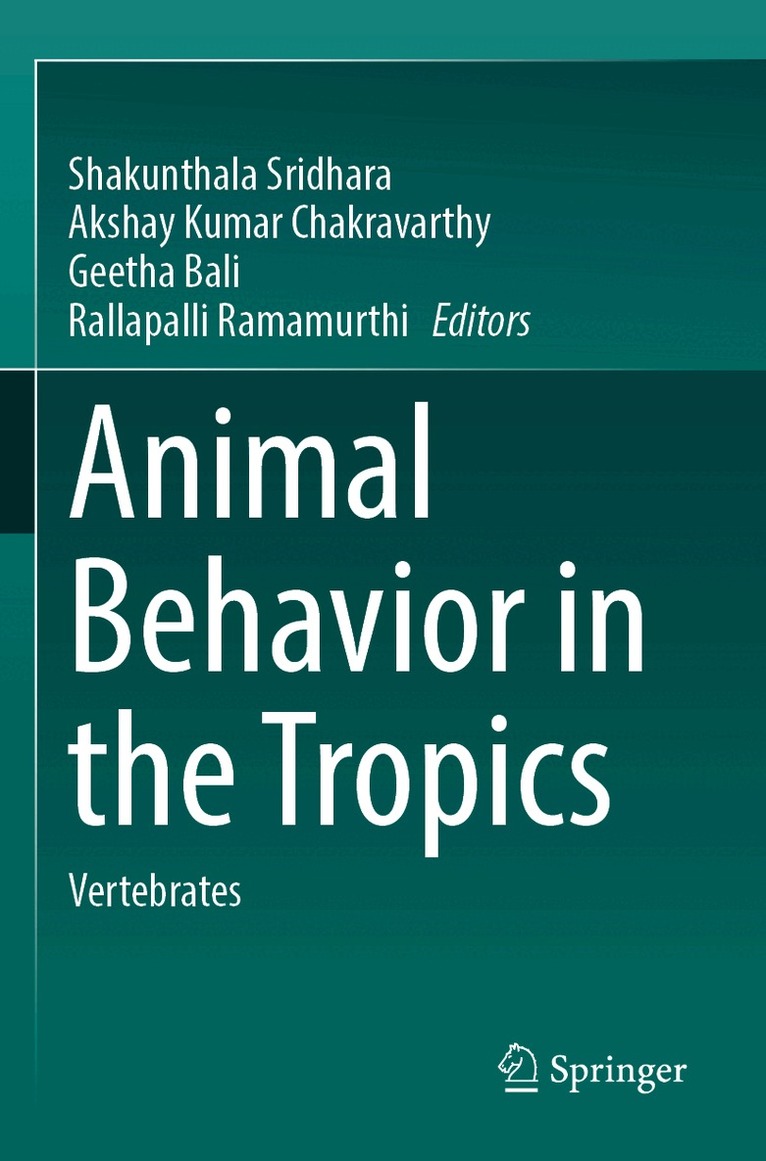
This book discusses trends in animal behavior focusing specifically on vertebrates from the tropical region.