Theofanis Tsiampokalos - Böcker
Visar alla böcker från författaren Theofanis Tsiampokalos. Handla med fri frakt och snabb leverans.
4 produkter
4 produkter
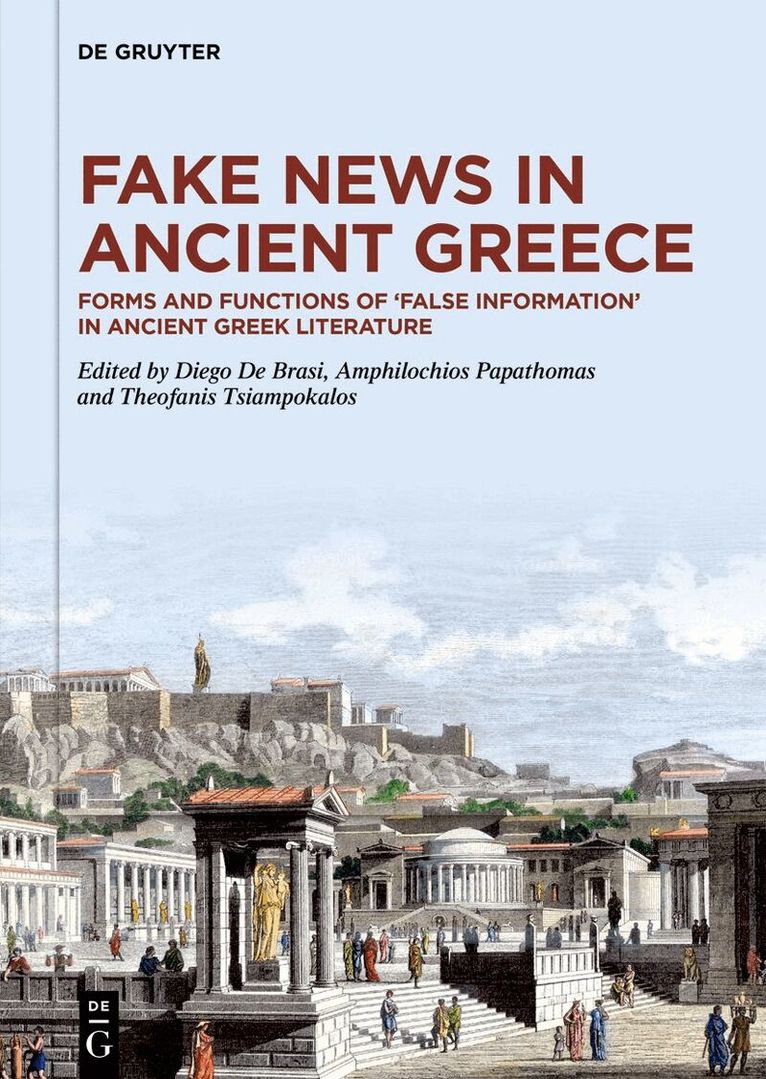
Fake News in Ancient Greece
Forms and Functions of ‘False Information’ in Ancient Greek Literature
Inbunden, Engelska, 2024
1 875 kr
Skickas inom 3-6 vardagar
Scholars have recognized that fake news is not a phenomenon peculiar to the 21st century. While efforts for a more focused approach to fake news in the ancient world have been carried out in the field of Roman history, the phenomenon of fake news in ancient Greece has received limited attention. The contributions in this volume offer a selective approach to this phenomenon by applying media and cultural studies instruments to ancient texts. They pinpoint parallels and differences between ancient and modern fake news by employing methods of literary and cultural studies, as well as historical-documentary analysis of ancient sources. In particular, they explore questions such as: To what extent does reflection on the concepts of truth, lie, and opinion influence ancient Greek political-rhetorical discourse? What is the political or social function of embedding ‘misleading information’ in ancient Greek historiographical texts or pamphlets? Which intentions are pursued with the help of fake news in literary and documentary texts? Can parallels be drawn with modern approaches to fake news? Thus, the volume investigates the mechanisms that historically lay behind the creation, dissemination, and adaptation of ‘misleading information’.
Del 11 - Transmissions
Fragmente Einer Fragmentierten Welt
Zur Problematik Des Umgangs Mit Fragmenten in Der Gegenwärtigen Klassisch-Philologischen Forschung
Inbunden, Tyska, 2024
1 761 kr
Skickas inom 3-6 vardagar
2 525 kr
Skickas inom 3-6 vardagar
Plutarch and Rhetoric
The Relationship of Rhetoric to Ethics, Politics and Education in the First and Second Centuries AD
Inbunden, Engelska, 2024
1 119 kr
Skickas inom 5-8 vardagar
A fundamental reappraisal of Plutarch’s attitude towards rhetoric.Plutarch was not only a skilled writer, but also lived during the Second Sophistic, a period of cultural renaissance. This book offers new insights into Plutarch’s seemingly moderate attitude towards rhetoric. The hypothesis explored in this study introduces, for the first time, the broader literary and cultural contexts that influenced and restricted the scope of Plutarch’s message. When these contexts are considered, a new perspective emerges that differs from that found in earlier studies. It paints a picture of a philosopher who may not regard rhetoric as a lesser means of persuasion, but who faces challenges in openly articulating this stance in his public discourse.Ebook available in Open Access.This publication is GPRC-labeled (Guaranteed Peer-Reviewed Content).