Thomas Olander – författare
Visar alla böcker från författaren Thomas Olander. Handla med fri frakt och snabb leverans.
19 produkter
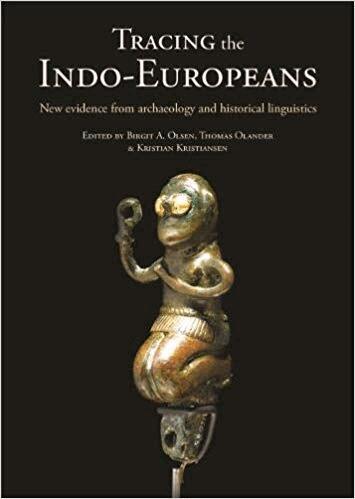
Tracing the Indo-Europeans
New evidence from archaeology and historical linguistics
Av Birgit Anette Olsen, Thomas Olander m. fl.
Häftad, 2019
435 kr
Lägg i varukorg
Recent developments in aDNA has reshaped our understanding of later European prehistory, and at the same time also opened up for more fruitful collaborations between archaeologists and historical linguists. Two revolutionary genetic studies, published independently in Nature, 2015, showed that …
Ett fönster till det förflutna : indoeuropeiska språk och myter
Av Jenny Larsson, Anders Kaliff m. fl.
Häftad, 2025
141 kr
Lägg i varukorg
Boken är resultatet av ett forskningsprogram i vilket deltagarna har arbetat för att fördjupa förståelsen av de indoeuropeiska språkens och kulturernas ursprung och utveckling. Genom att förena språkvetenskap, arkeologi och religionshistoria har projektet undersökt hur språkliga och kulturella …
Indo-European Interfaces: Integrating Linguistics, Mythology and Archaeology
Integrating Linguistics, Mythology and Archaeology
Av Jenny Larsson, Thomas Olander
2024
716 kr
Lägg i varukorg
The Indo-European Language Family
Inbunden, 2022
1559 kr
Lägg i varukorg
Modern languages like English, Spanish, Russian and Hindi as well as ancient languages like Greek, Latin and Sanskrit all belong to the Indo-European language family, which means that they all descend from a common ancestor. But how, more precisely, are the Indo-European languages related to each …
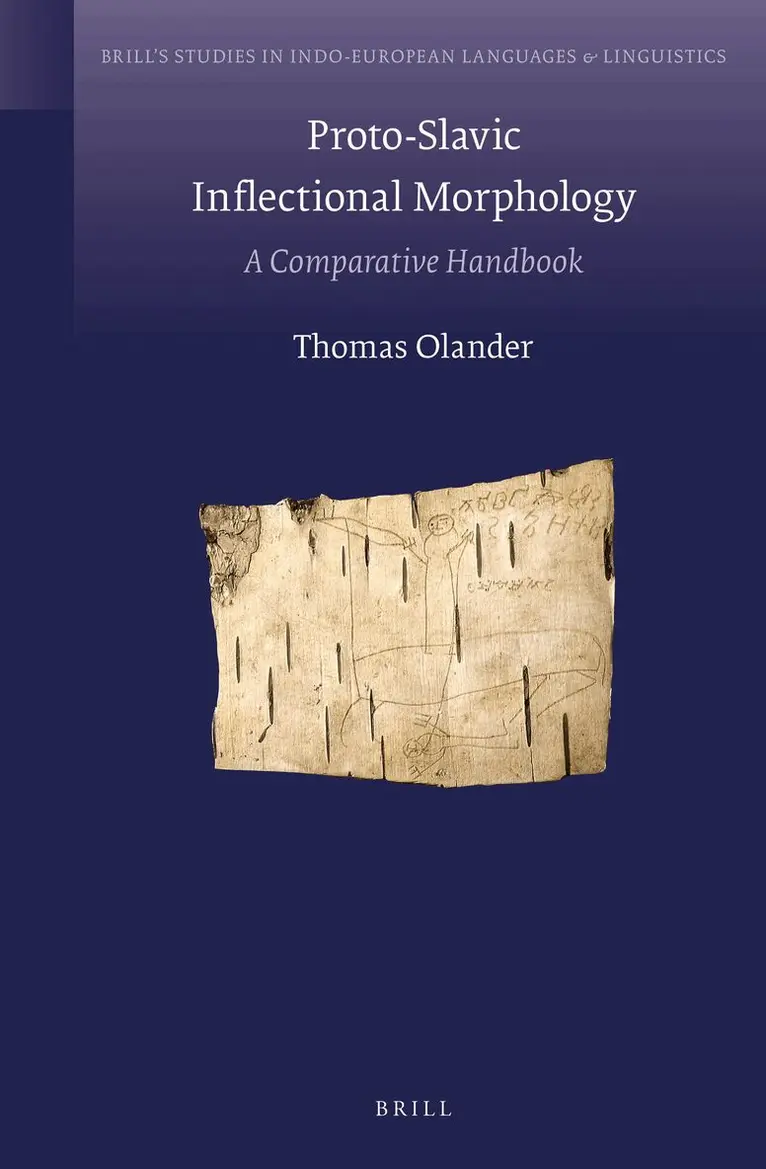
Proto-Slavic Inflectional Morphology
A Comparative Handbook
Inbunden, 2015
3774 kr
Lägg i varukorg
Proto-Slavic, the reconstructed ancestor of the Slavic languages, presents a rich inflectional system inherited from Proto-Indo-European. In this handbook all the inflectional endings of Proto-Slavic are traced back to Proto-Indo-European through a systematic comparison with the corresponding forms …
Indo-European Language Family
A Phylogenetic Perspective
E-bok, 2022
420 kr
Lägg i varukorg
Modern languages like English, Spanish, Russian and Hindi as well as ancient languages like Greek, Latin and Sanskrit all belong to the Indo-European language family, which means that they all descend from a common ancestor. But how, more precisely, are the Indo-European languages related to each …
The Indo-European Language Family
Häftad, 2025
401 kr
Lägg i varukorg
Modern languages like English, Spanish, Russian and Hindi as well as ancient languages like Greek, Latin and Sanskrit all belong to the Indo-European language family, which means that they all descend from a common ancestor. But how, more precisely, are the Indo-European languages related to each …
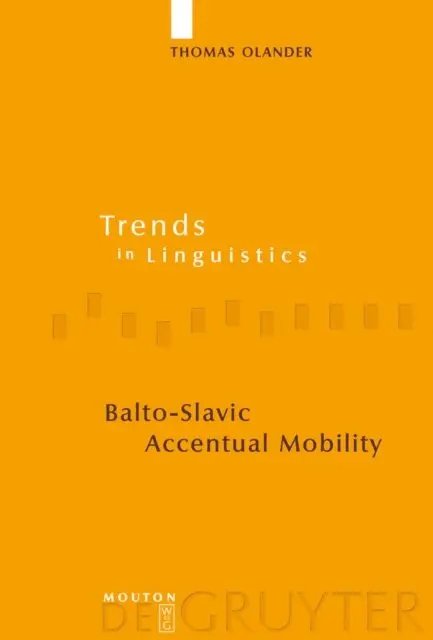
Balto-Slavic Accentual Mobility
Inbunden, 2009
2338 kr
Lägg i varukorg
Why does the accent jump back and forth in Russian words like golová 'head', acc. gólovu, gen. golový, dat. golové etc.? How come we find similar alternations in other Slavic languages and in a Baltic language like Lithuanian? The quest for the origin of the so-called "mobile accent paradigms" of …
Balto-Slavic Accentual Mobility
E-bok, 2009
2416 kr
Lägg i varukorg
Why does the accent jump back and forth in Russian words like golová ''head'', acc. gólovu , gen. golový , dat. golové etc.? How come we find similar alternations in other Slavic languages and in a Baltic language like Lithuanian? The quest for the origin of the so-called "mobile accent paradigms" …
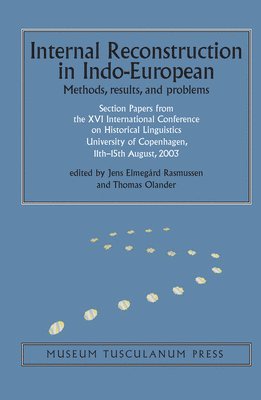
Internal Reconstruction in Indo-European
Methods, Results, and Problems
Av Jens Elmegard Rasmussen, Thomas Olander
Inbunden, 2009
689 kr
Lägg i varukorg
Text in English & German. The present volume contains selected papers from a symposium on Internal Reconstruction in Indo- European: Methods, Results and Problems, which formed a subsection of the 16th International Conference on Historical Linguistics held at the University of Copenhagen. This is …
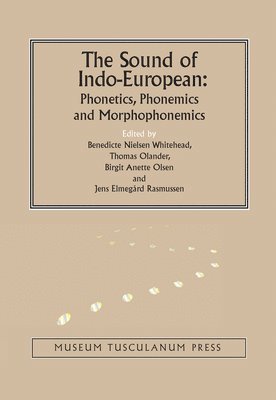
Sound of Indo-European
Phonetics, Phonemics, and Morphophonemics
Av Benedicte Nielsen Whitehead, Thomas Olander m. fl.
Inbunden, 2012
1343 kr
Lägg i varukorg
One of the most detailed and comprehensive studies of Indo-European phonology, this book brings together leading linguists working in Indo-European studies to examine both the broadest definitions of the group -- from minute phonetics to abstract levels of phonemics centring on all varieties of …
Tocharian and Indo-European Studies, Volume 13
Av Jens Elmegard Rasmussen, Georges-Jean Pinault m. fl.
Häftad, 2012
649 kr
Lägg i varukorg
Ablaut, the grammatically conditioned vowel alternations found in e.g. English sing vs. sang vs. sung, is one of the most characteristic features of the Indo-European languages. The different ablaut grades seem to be related to the position of the accent in Proto-Indo-European. A good understanding …
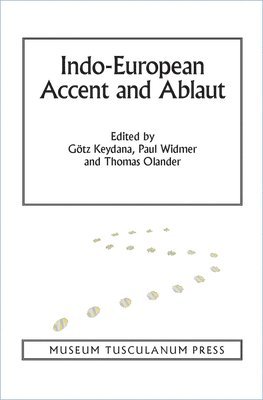
Indo-European Accent and Ablaut
Av Gotz Keydana, Paul Widmer m. fl.
Inbunden, 2013
615 kr
Lägg i varukorg
Ablaut, the grammatically conditioned vowel alternations found in e.g. English sing vs. sang vs. sung, is one of the most characteristic features of the Indo-European languages. The different ablaut grades seem to be related to the position of the accent in Proto-Indo-European. A good understanding …
Tocharian and Indo-European Studies Volume 14
Av Jens Elmegard Rasmussen, Georges-Jean Pinault m. fl.
Häftad, 2013
656 kr
Lägg i varukorg
Tocharian and Indo-European Studies (TIES) publishes central topics on the two closely related languages Tocharian A and B, attested in Central Asian Buddhist manuscripts dating from the second half of the first millennium AD. It focuses on philological and linguistic aspects of Tocharian, and its …
Tocharian and Indo-European Studies, Volume 15
Av Birgit Anette Olsen, Michael Peyrot m. fl.
Häftad, 2014
670 kr
Lägg i varukorg
Tocharian and Indo-European Studies is the central publication for the study of two closely related languages, Tocharian A and Tocharian B. Found in many Buddhist manuscripts from central Asia, Tocharian dates back to the second half of the first millennium of the Common Era, though it was not …
Tocharian and Indo-European Studies 16
Av Georges-Jean Pinault, Michael Peyrot m. fl.
Häftad, 2015
670 kr
Lägg i varukorg
Tocharian and Indo-European Studies is the central publication for the study of two closely related languages, Tocharian A and Tocharian B. Found in many Buddhist manuscripts from central Asia, Tocharian dates back to the second half of the first millennium of the Common Era, though it was not …
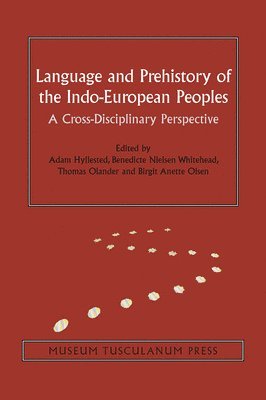
Language and Prehistory of the Indo-European Peoples
A Cross-Disciplinary Perspective
Av Adam Hyllested, Benedicte Nielsen Whitehead m. fl.
Inbunden, 2017
768 kr
Lägg i varukorg
This volume contains eighteen contributions to the increasingly detailed discussion about neolithic and bronze-age Europe. It touches on the arrival of Uralic and Indo-European settlers, on the origins of their languages, their customs, and pantheon. The contributors are historical linguists, …
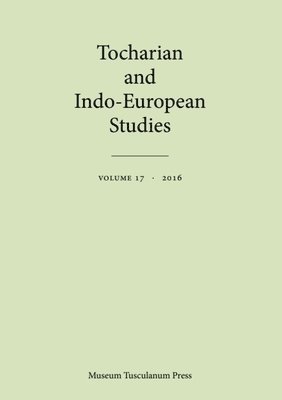
Tocharian and Indo-European Studies 17
Av Birgit Anette Olsen, Thomas Olander m. fl.
Häftad, 2016
705 kr
Lägg i varukorg
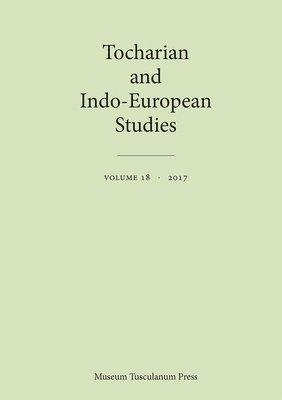
Tocharian and Indo-European Studies is the central publication for the study of two closely related languages, Tocharian A and Tocharian B. Found in many Buddhist manuscripts from central Asia, Tocharian dates back to the second half of the first millennium of the Common Era, though it was not …
Tocharian and Indo-European Studies 18
Av Birgit Anette Olsen, Thomas Olander m. fl.
Häftad, 2018
821 kr
Lägg i varukorg