Tim Niblock - Böcker
Visar alla böcker från författaren Tim Niblock. Handla med fri frakt och snabb leverans.
16 produkter
16 produkter
2 306 kr
Skickas inom 10-15 vardagar
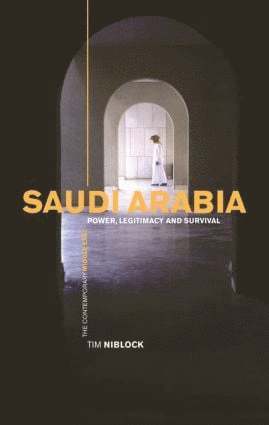
Saudi Arabia provides a clear, concise yet analytical account of the development of the Saudi state. It details the country’s historical and religious background, its oil rentier economy and its international role, showing how they interact to create the dynamics of the contemporary Saudi state. The development of the state is traced through three stages: the formative period prior to 1962; the centralization of the state and the initiation of intensive economic development between 1962 and 1979; and the re-shaping of the state over the years since 1979. Emphasis is placed on the recent period, with chapters devoted to:the economic and foreign policy problems which now confront the state the linkages between Saudi Arabia and Islamic radicalism, with the relationship/conflicts involving Al Qaeda traced through from events in Afghanistan in the 1980s the impact of 9/11 and the 2003 Gulf War the identification of major problems facing the contemporary state and their solutions. Saudi Arabia provides a unique and comprehensive understanding of this state during a crucial time. This book is essential reading for those with interests in Saudi Arabia and its role in Middle Eastern politics and on the international stage.
703 kr
Skickas inom 10-15 vardagar
Saudi Arabia provides a clear, concise yet analytical account of the development of the Saudi state. It details the country’s historical and religious background, its oil rentier economy and its international role, showing how they interact to create the dynamics of the contemporary Saudi state. The development of the state is traced through three stages: the formative period prior to 1962; the centralization of the state and the initiation of intensive economic development between 1962 and 1979; and the re-shaping of the state over the years since 1979. Emphasis is placed on the recent period, with chapters devoted to:the economic and foreign policy problems which now confront the state the linkages between Saudi Arabia and Islamic radicalism, with the relationship/conflicts involving Al Qaeda traced through from events in Afghanistan in the 1980s the impact of 9/11 and the 2003 Gulf War the identification of major problems facing the contemporary state and their solutions. Saudi Arabia provides a unique and comprehensive understanding of this state during a crucial time. This book is essential reading for those with interests in Saudi Arabia and its role in Middle Eastern politics and on the international stage.
2 170 kr
Skickas inom 10-15 vardagar
With Saudi Arabia being of immense importance both politically and economically in the Middle East, this book provides a much needed, broad ranging survey of the development of the Saudi economy from the 1960s to the present day. Written by a highly reputable author, the book includes an analysis of how political and social factors have shaped policy, and how the Saudi state is coping with the dynamics of a rapidly changing economic and political situation.
730 kr
Skickas inom 10-15 vardagar
With Saudi Arabia being of immense importance both politically and economically in the Middle East, this book provides a much needed, broad ranging survey of the development of the Saudi economy from the 1960s to the present day. Written by a highly reputable author, the book includes an analysis of how political and social factors have shaped policy, and how the Saudi state is coping with the dynamics of a rapidly changing economic and political situation.
730 kr
Skickas inom 10-15 vardagar
Contributions to this book question the concept of the clash of cultures. The challenge to the West does not lie in the monolith of Islam turning aggressively outward to Europe and the US, but in the rivalries between regimes ruling over societies divided by an imbalance in wealth and power.
2 170 kr
Skickas inom 10-15 vardagar
Contributions to this book question the concept of the clash of cultures. The challenge to the West does not lie in the monolith of Islam turning aggressively outward to Europe and the US, but in the rivalries between regimes ruling over societies divided by an imbalance in wealth and power.
414 kr
Tillfälligt slut
With the attention of the industrialized world focused on the political, economic, and social strife of Africa, Tim Niblock travels to Sudan for a first-hand investigation of the socio-economic structure of that continent's largest country. His findings hold significant implications for the wider context of Africa, the Arab countries, and the Third World. His is a systematic and comprehensive study of Sudanese politics. A country with immense economic potential, possessing extensive tracts of cultivable but currently uncultivated land, Sudan could emerge as a major source of food for the Arab world. Yet it is threatened by famine while attempts at development are frustrated by civil war and political disarray. Niblock examines the political, economic, and social factors that have shaped the country's development. The fate of Sudan will be critical to the political stability of North-East Africa and the Red Sea area, and the Sudanese experience is instructive for underdeveloped countries as a whole.
1 630 kr
Skickas inom 10-15 vardagar
First Published in 1982, Iraq: The Contemporary State presents insights into the political, social, and economic developments in Iraq. The author argues that Iraq, is a country which the outside world will need increasingly to understand for the stability of the wider Gulf region. Unlike most Arab oil-producing states, moreover, Iraq has substantial agricultural and hydrocarbon resources. This book covers themes like class determination and state formation in Iraq; developments in the Kurdish Issue; emancipation of Iraqi women; eradication of illiteracy; economic relations between Iraq and other Arab Gulf states; Iraqi oil policy between 1961-1976; and western, Soviet and Egyptian influences on Iraq’s development planning. This book is an essential read for scholars and researchers of international relations, West Asian studies, Middle East studies, and international politics.
471 kr
Skickas inom 10-15 vardagar
First Published in 1982, Iraq: The Contemporary State presents insights into the political, social, and economic developments in Iraq. The author argues that Iraq, is a country which the outside world will need increasingly to understand for the stability of the wider Gulf region. Unlike most Arab oil-producing states, moreover, Iraq has substantial agricultural and hydrocarbon resources. This book covers themes like class determination and state formation in Iraq; developments in the Kurdish Issue; emancipation of Iraqi women; eradication of illiteracy; economic relations between Iraq and other Arab Gulf states; Iraqi oil policy between 1961-1976; and western, Soviet and Egyptian influences on Iraq’s development planning. This book is an essential read for scholars and researchers of international relations, West Asian studies, Middle East studies, and international politics.
1 047 kr
Skickas inom 10-15 vardagar
Written in 1985, at a time when the world oil industry was facing a difficult period of over-supply and falling prices, this book examines some of the most important strategic issues facing both the producers and consumers of oil and gas. A theme underlying al the papers is the need for strengthening the co-operation between producing and consuming nations, especially between the Arab Gulf States and the members of the EU. The security of supply is also examined in the light of regional instability and peace in the Middle East.
345 kr
Skickas inom 10-15 vardagar
Written in 1985, at a time when the world oil industry was facing a difficult period of over-supply and falling prices, this book examines some of the most important strategic issues facing both the producers and consumers of oil and gas. A theme underlying al the papers is the need for strengthening the co-operation between producing and consuming nations, especially between the Arab Gulf States and the members of the EU. The security of supply is also examined in the light of regional instability and peace in the Middle East.
Social and Economic Development in the Arab Gulf (RLE Economy of Middle East)
Inbunden, Engelska, 2014
2 103 kr
Skickas inom 10-15 vardagar
The crucial importance of the Gulf region today – which may be defined as comprising the states of Saudi Arabia, Iraq, Kuwait, Oman, Bahrain, Qatar and the United Arab Emirates, with Iran as a non-Arab onlooker – has stimulated surprisingly little interest in academic circles. Much of what has been written, moreover, focuses exclusively on those aspects of direct concern to external interests. The focus of this book is on the Gulf region as an area with its own problems of social, economic and political development. It examines the dimensions of the attempts by the governments and peoples of the area to create new social, economic and political structures – stemming mainly, of course, from their new-found oil wealth.First published in 1980.
598 kr
Skickas inom 10-15 vardagar
The crucial importance of the Gulf region today – which may be defined as comprising the states of Saudi Arabia, Iraq, Kuwait, Oman, Bahrain, Qatar and the United Arab Emirates, with Iran as a non-Arab onlooker – has stimulated surprisingly little interest in academic circles. Much of what has been written, moreover, focuses exclusively on those aspects of direct concern to external interests. The focus of this book is on the Gulf region as an area with its own problems of social, economic and political development. It examines the dimensions of the attempts by the governments and peoples of the area to create new social, economic and political structures – stemming mainly, of course, from their new-found oil wealth.First published in 1980.
2 235 kr
Skickas inom 10-15 vardagar
Saudi Arabia is one of the most important countries in the modern world. Not only does it possess some 25 per cent of the world’s proven oil reserves, it also plays a crucial role in the wider Gulf region where over 50 per cent of proven reserves are located. Developments in Saudi Arabia will inevitably affect the economic well-being of the Western industrialised world, Japan and much of the Third World. At the same time, Saudi Arabia is ruled in a traditional way by an all-powerful king and royal family, and is one of the key countries of Islam, the Holy City of Mecca being within the country’s boundaries. The inroad of modern Western forces into this traditional Islamic society is underlined by the fact that may key posts are filled with imported Western workers. This book, first published in 1982, containing contributions by the world’s leading Middle Eastern experts, provides a comprehensive overview of important social, political and economic developments in Saudi Arabia. The opening chapters consider the formation of the Saudi State, and the bulk of the book surveys key themes such as political opposition, the oil industry, energy policy, banking, external relations and the future direction of development.
696 kr
Skickas inom 10-15 vardagar
This book emerges out of a symposium on 'state, economy and power in Saudi Arabia' in 1980. It provides different insights into aspects of Saudi Arabian politics, society and economics. The book covers the themes of the nature of the Saudi and its relationship with the international environment.
18 688 kr
Skickas inom 7-10 vardagar
This major six-volume set reproduces the most important journal material concerning the many aspects of political economy in the Middle East. By subject, the editors concentrate on the vital issues affecting this continually developing area of the world.This collection opens up a new source of essential material to both the student and academic specializing in Middle Eastern studies. The editors have prepared individual introductions for each title in addition to a general series preface for the series.Volume I:Poor capital investment combined with the few details concerning education in the Middle East have resulted in the under-utilisation of human resources. The articles included in this collection focus on the reasons behind this development failure and also how this failure continues to affect the region.20 articles, dating from 1980 to 1995Volume II:This collection features literature on the contemporary international relations of the Middle East in the latter part of the twentieth century. The editors pay particular attention to trade, production, imports and exports, foreign investment, multinational companies in the region and labour migration.18 articles, dating from 1984 to 1997Volume III: In capitalist and socialist societies, economic systems are believed by their adherents to have universal applicability irrespective of the values held by the societies in which they are applied. Islamic economists reject this notion, believing that an economic system should reflect religious values, rather than a society's values being determined by the economic system. The articles included in this volume focus on the development of principles and the system of Islamic economics.23 articles, dating from 1963 to 1995Volume IV:Few countries have been left untouched by either economic or political liberalisation in recent history - indeed, many have been affected by both. These processes have had a substantial effect on the Middle East. Particular emphasis is given to the liberalisation of Turkey, Egypt and Iraq as well as articles featuring other main Middle Eastern states.22 articles, dating from 1981 to 1998Volume V:The articles included in this volume focus on the manner in which the character of the state affects economic policies. Attention is given to themes on the nature of the Middle Eastern State in general, the relationship between state and society, assessments of the administrative structures for economic policies and policy making and assessments of economic policies which are specific to individual state formation and structure.21 articles, dating from 1982 to 1996Volume VI:Oil is probably the most significant industry in the Middle Eastern states. The editors have selected articles which relate not only to the analysis of oil production but also to the range of effects which oil revenues have on the political economy of the Middle East. The editors have intentionally focused on material which follows the social, economic and political effects of oil resources over the past 25 years.19 articles, dating from 1978 to 1996