Yuri Gurevich – författare
Visar alla böcker från författaren Yuri Gurevich. Handla med fri frakt och snabb leverans.
8 produkter
8 produkter
Häftad, Engelska, 2001
1 959 kr
Skickas inom 10-15 vardagar
This book is addressed to all those - logicians, computer scientists, mathe maticians, philosophers of science as well as the students in all these disci plines - who may be interested in the development and current status of one of the major themes of mathematical logic in the twentieth century, namely the classical decision problem known also as Hilbert's Entscheidungsproblem. The text provides a comprehensive modern treatment of the subject, includ ing complexity theoretic analysis. We have made an effort to combine the features of a research monograph and a textbook. Only the basic knowledge of the language of first-order logic is required for understanding of the main parts of the book, and we use standard terminology. The chapters are written in such a way that various combinations of them can be used for introductory or advanced courses on undecidability, decidability and complexity of logical decision problems. This explains a few intended redundancies and repetitions in some of the chapters. The annotated bibliography, the historical remarks at the end of the chap ters and the index allow the reader to use the text also for quick reference purposes.
E-bok
PDF, Engelska, 2003714 kr
Läs direkt efter köp
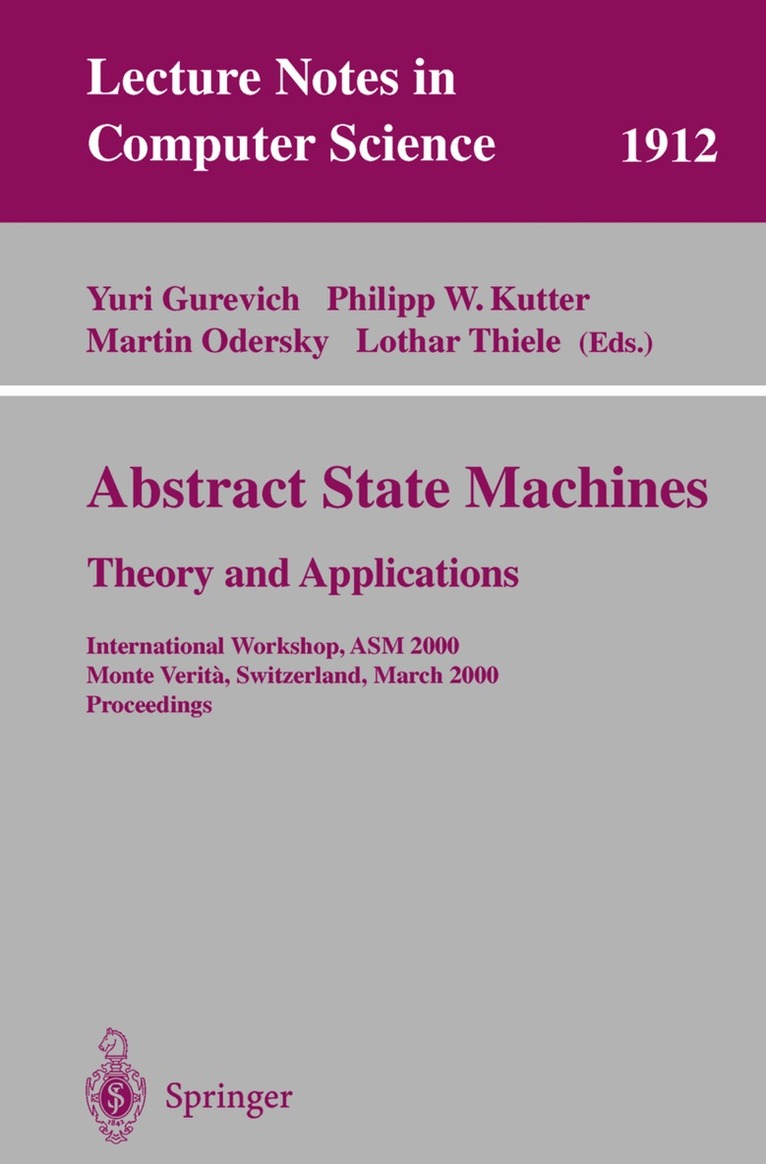
The ASM 2000 workshop was held in the conference center of the Swiss Federal Institute of Technology (ETH) at Monte Verit a, Canton Ticino, March 19-24, 2000. The ASM formalism was proposed together with the thesis that it is suitable to model arbitrary computer systems on arbitrary abstraction levels. ASMs have been successfully used to analyze and specify various hardware and software systems including numerous computer languages. The aim of the workshop was to bring together domain-experts, using ASMs as a practical speci cation method, and theorists working with ASMs and related methods. In addition the workshop served as a forum on theoretical and practical topics that relate to ASMs in a broad sense. Three tutorials including hands-on experience with tools were organized by U. Gl¨asser and G. del Castillo (on the topic \Specifying Concurrent Systems with ASMs"), H. Russ ¨ and N. Shankar (on the topic \A Tutorial Introduction to PVS"), M. Anlau , P.W. Kutter, and A. Pierantonio (on the topic \Developing Domain Speci c Languages"). In response to the organization committee’s call for papers, 30 papers were submitted, each of which was independently reviewed by four members of the program committee. This volume presents a selection of 12 of the refereed papers and two reports on industrial ASM application at Siemens AG and Microsoft Research, together with contributions based on the invited talks given by A.
Häftad, Engelska, 1994
566 kr
Skickas inom 10-15 vardagar
This volume contains the final versions of a collection of papers presented at the Annual Conference of the European Association for Computer Science Logic, CSL '93, held at Swansea, UK in September 1993.The 21 full papers included were selected from a total of 62 submissions and essentially contribute to the whole area of computer science logic research. They are devoted to such topics as set constraints, lambda calculi, process algebras, program semantics, intuitionistic logics, fixed-point logics, the equivalence problem, Horn clauses, quantifiers, and proof tranformations.
Häftad, Engelska, 2000
566 kr
Skickas inom 10-15 vardagar
The ASM 2000 workshop was held in the conference center of the Swiss Federal Institute of Technology (ETH) at Monte Verit a, Canton Ticino, March 19-24, 2000. The ASM formalism was proposed together with the thesis that it is suitable to model arbitrary computer systems on arbitrary abstraction levels. ASMs have been successfully used to analyze and specify various hardware and software systems including numerous computer languages. The aim of the workshop was to bring together domain-experts, using ASMs as a practical speci cation method, and theorists working with ASMs and related methods. In addition the workshop served as a forum on theoretical and practical topics that relate to ASMs in a broad sense. Three tutorials including hands-on experience with tools were organized by U. Gl¨asser and G. del Castillo (on the topic \Specifying Concurrent Systems with ASMs"), H. Russ ¨ and N. Shankar (on the topic \A Tutorial Introduction to PVS"), M. Anlau , P.W. Kutter, and A. Pierantonio (on the topic \Developing Domain Speci c Languages"). In response to the organization committee’s call for papers, 30 papers were submitted, each of which was independently reviewed by four members of the program committee. This volume presents a selection of 12 of the refereed papers and two reports on industrial ASM application at Siemens AG and Microsoft Research, together with contributions based on the invited talks given by A.
Häftad, Engelska, 2007
566 kr
Skickas inom 10-15 vardagar
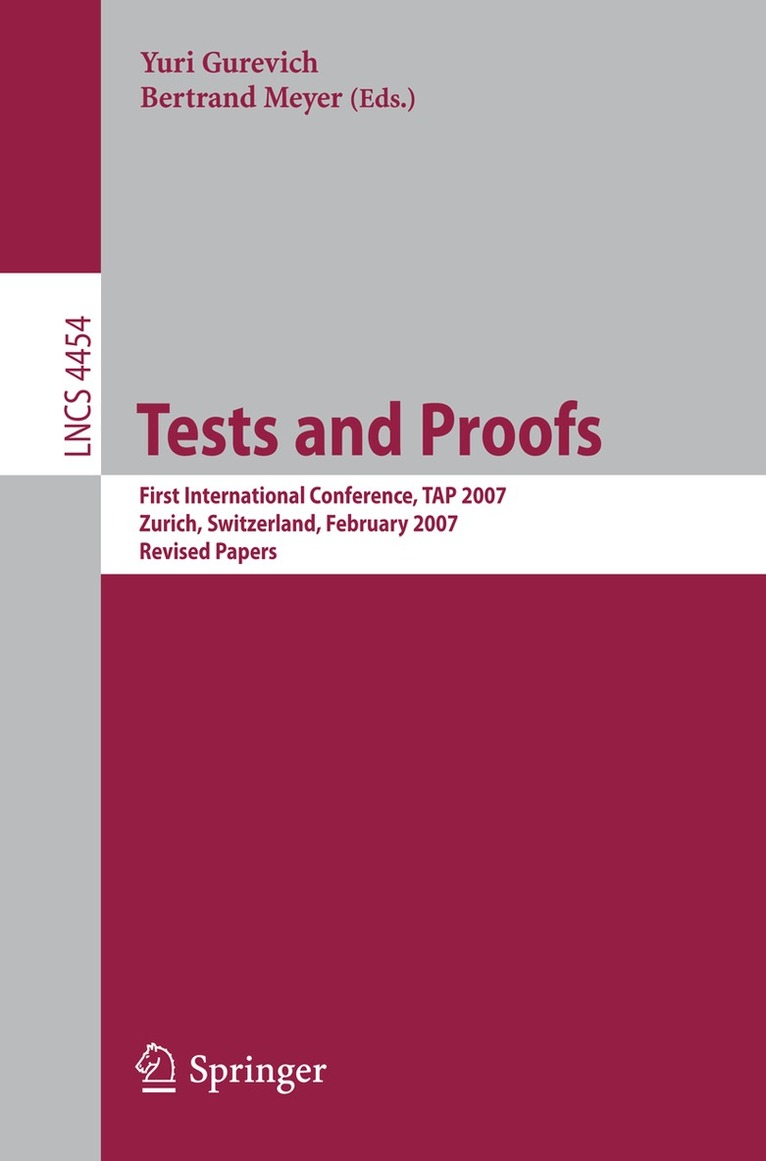
To prove the correctness of a program is to demonstrate, through impeccable mathematical techniques, that it has no bugs. To test a program is to run it with the expectation of discovering bugs. These two paths to software reliability seem to diverge from the very start: if you have proved your program correct, it is fruitless to comb it for bugs; and if you are testing it, that surely must be a sign that you have given up on any hope to prove its correctness. Accordingly, proofs and tests have, since the onset of software engineering research, been pursued by distinct communities using different kinds of techniques and tools. Dijkstra’s famous pronouncement that tests can only show the presence of errors — in retrospect, perhaps one of the best advertisements one can imagine for testing, as if “only” finding bugs were not already a momentous achievement! — didn’t help make testing popular with provers, or proofs attractive to testers. And yet the development of both approaches leads to the discovery of common issues and to the realization that each may need the other. The emergence of model checking was one of the first signs that apparent contradiction may yield to complementarity; in the past few years an increasing number of research efforts have encountered the need for combining proofs and tests, dropping earlier dogmatic views of incompatibility and taking instead the best of what each of these software engineering domains has to offer.
E-bok
PDF, Engelska, 2007708 kr
Läs direkt efter köp
To prove the correctness of a program is to demonstrate, through impeccable mathematical techniques, that it has no bugs. To test a program is to run it with the expectation of discovering bugs. These two paths to software reliability seem to diverge from the very start: if you have proved your program correct, it is fruitless to comb it for bugs; and if you are testing it, that surely must be a sign that you have given up on any hope to prove its correctness. Accordingly, proofs and tests have, since the onset of software engineering research, been pursued by distinct communities using different kinds of techniques and tools. Dijkstra’s famous pronouncement that tests can only show the presence of errors — in retrospect, perhaps one of the best advertisements one can imagine for testing, as if “only” finding bugs were not already a momentous achievement! — didn’t help make testing popular with provers, or proofs attractive to testers. And yet the development of both approaches leads to the discovery of common issues and to the realization that each may need the other. The emergence of model checking was one of the first signs that apparent contradiction may yield to complementarity; in the past few years an increasing number of research efforts have encountered the need for combining proofs and tests, dropping earlier dogmatic views of incompatibility and taking instead the best of what each of these software engineering domains has to offer.
E-bok
PDF, Spanska, 202475 kr
Läs direkt efter köp
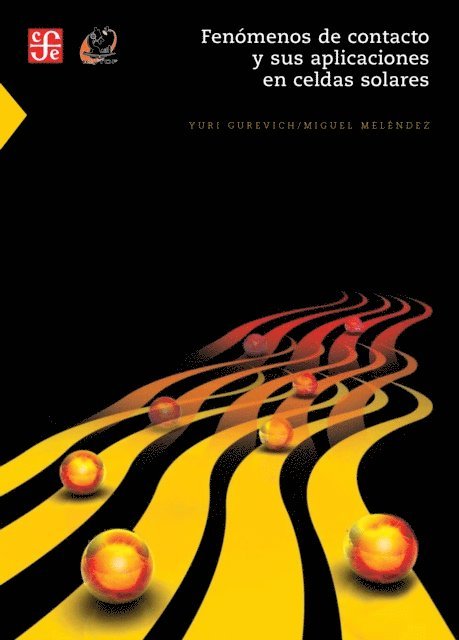
Esta obra aborda el estudio de las celdas solares considerándolas un dispositivo electrónico. Primero, presenta en forma breve detalles históricos de las celdas solares, el desarrollo de sus aplicaciones y las estrategias utilizadas en diversos países. Después expone los conceptos físicos fundamentales que intervienen en el funcionamiento de los dispositivos eléctricos basados en semiconductores. Por último, trata la transformación de la energía luminosa en energía eléctrica a través de las celdas solares.
Del 40 - World Scientific Series In Computer Science
Current Trends In Theoretical Computer Science: Essays And Tutorials
Inbunden, Engelska, 1993
2 569 kr
Tillfälligt slut
The book is a very up-to-date collection of articles in theoretical computer science, written by leading authorities in the field. The topics range from algorithms and complexity to algebraic specifications, and from formal languages and language-theoretic modeling to computational geometry. The material is based on columns and articles that have appeared in the EATCS Bulletin during the past two to three years. Although very recent research is discussed, the largely informal style of writing makes the book accessible to readers with little or no previous knowledge of the topics.