• Fri frakt över 249 kr
  • •
  • Snabba leveranser
  • •
  • Billiga böcker
Kundservice

Du är på sajten för privatpersoner.

Företag, bibliotek eller offentlig verksamhet?

Du handlar på classic.bokus.com, där alla dina funktioner finns intakta.
Till classic.bokus.com
Bokus logotyp. Gå till startsidan.
  • Erbjudanden
  • Nyheter
  • Student
  • Topplistor
  • Barn & ungdom
  • Bokus Play
  • E-böcker
  • Pocketböcker
  • Spel & pussel

10% rabatt på allt med kod NYSTART10 →

Sidfot

Mina sidor

    Hjälp

    • Kundservice
    • Vanliga frågor och svar
    • Frakt och leverans
    • Retur vid ångerrätt
    • Reklamera vara
    • Betalning
    • Köpvillkor
    • Allmänna villkor
    • Information om webbplatsens tillgänglighet

    Om Bokus

    • Om oss
    • Pressrum
    • För studenter
    • För företag
    • För bibliotek och offentlig verksamhet
    • För leverantörer
    • Hållbarhet

    Populärt

    • Aktuella erbjudanden
    • Presentkort
    • Studentlitteratur
    • Nya böcker
    • Topplistor
    • Signerade böcker
    • Engelska böcker

    Inspiration

    • Boktips
    • BookTok
    • Populära bokserier
    • Barnbokskaraktärer
    • Populära författare
    Logotyp för Bokus
    Följ oss på Facebook (extern länk)Följ oss på Instagram (extern länk)Följ oss på YouTube (extern länk)Följ oss på TikTok (extern länk)
    bokus @ CookiesAnpassa cookiesIntegritetspolicyKöpvillkor
    Till Citymail hemsida (extern länk)Till Budbee hemsida (extern länk)Till Postnord hemsida (extern länk)Till Schenker hemsida (extern länk)Till Early Bird hemsida (extern länk)Till Walleys hemsida (extern länk)
    1. Samhälle och politik
    2. Samhälle och kultur
    3. Kultur och medier
    4. Referensverk och tvärvetenskap

    Bertolt Brecht

    Critical and Primary Sources

    AvDavid Barnett

    Bloomsbury Publishing PLC

    2020

    Del i serien Critical and Primary Sources

    10 687 kr

    Beställningsvara. Skickas inom 5-8 vardagar. Fri frakt över 249 kr.

    Beskrivning

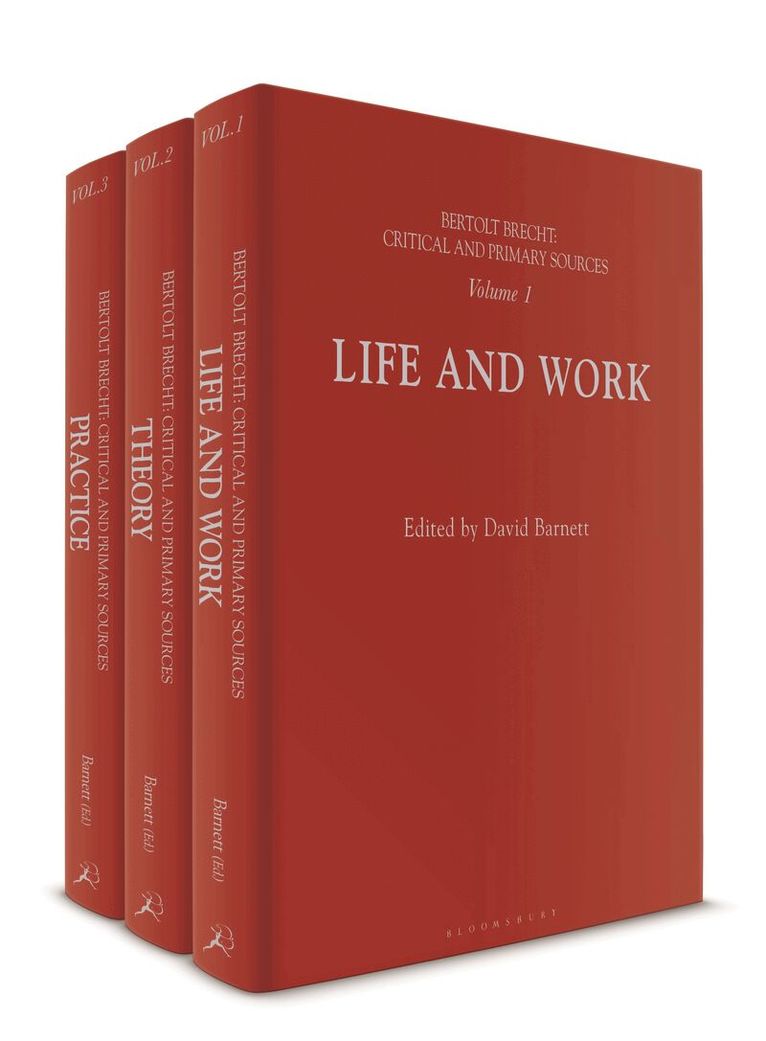
    With over 80 scholarly articles, reviews, and critical interventions from the last 50 years, Bertolt Brecht: Critical and Primary Sources set covers the key periods of Brecht’s life, from his time in Augsburg (1898–1918) through the Weimer Republic (1918–1933), exile (1933–1948) and the German Democratic Republic (1949–1956). It also explores his theories, fundamentally his belief in the theatre’s ability to represent and change the world, core practices and relationships. Alongside primary sources that include writings by Brecht published in English for the first time, such as his short but important reflection in ‘originality’ in theatre production, key featured scholars include Fredric Jameson and his essay ‘Episch, or, the Third Person’, and pieces on Brecht’s collaborative working methods by Claus and Wera Küchenmeister, and the director Egon Monk.Volume 1 covers Brecht's life and work, including essays on his famous Mother Courage and Her Children, production reviews, poetry, novels and short stories, with some thoughts on his journals. Volume 2 covers theory, containing essays and primary writings on Brechtian terminology, and some of the more enigmatic terms like ‘Epic theatre’, ‘Verfremdung’, ‘Gestus’ and ‘Fabel’, features a survey of important theoretical works, a section on Brecht on non-theatre media, his relationship to other major thinkers, ideas and sources and the reception of his ideas. Volume 3 covers practice, including Brecht’s practice as documenter and director, beginning with his disastrous start in the Weimar Republic through to his later role as director as the Berliner Ensemble, his relationships with other practitioners and his own collaborators, reviews of important productions and global receptions.Each volume includes a contextualizing introduction surveying the topics covered and the development of scholarship on Brecht.

    Produktinformation

    • Märke:Bloomsbury Publishing PLC
    • Utgivningsdatum:2020-04-16
    • Höjd:174 x 252 x 72 mm
    • Vikt:2 340 g
    • Språk:Engelska
    • Serie:Critical and Primary Sources
    • Förlag:Bloomsbury Publishing PLC
    • EAN:9781474299497

    Utforska kategorier

    • Referensverk och tvärvetenskap inom Samhälle och politik
    • Litteraturvetenskap inom Skönlitteratur
    • Skådespelare och artister inom Kultur

    Mer om författaren

    David Barnett is Professor of Theatre at the University of York, UK. He is the author of A History of the Berliner Ensemble (2015), Brecht in Practice: Theatre, Theory and Performance (Bloomsbury Methuen Drama, 2014), Rainer Werner Fassbinder and the German Theatre (2005) and a monograph on Heiner Müller (1998). He has written several articles and essays on German-, English-language, political and postdramatic theatre.

    Innehållsförteckning

    • Volume One: Life and WorkLifeThe young Brecht1. Werner Frisch and K.W. Obermeier, ‘Schülerzeitung Die Ernte’, in Frisch and Obermeier, Brecht in Augsburg. Erinnerungen, Dokumente, Texts, Fotos (Frankfurt/Main: Suhrkamp, 76)2. Tom Kuhn, ‘“Ja, damals waren wir Dichter”: Hanns Otto Münsterer, Bertolt Brecht and the Dynamics of Literary Friendship, Brecht Yearbook, 21 (1996)Brecht and the Weimar Republic3. Philip Glahn, ‘Sachlichkeit’, in Glahn, Bertolt Brecht (London: Reaktion, 2014)Brecht in Exile4. James K. Lyon, ‘“Changing Countries More Often Than Shoes’, in Lyon, Bertolt Brecht in America (London: Methuen, 1982)Brecht in the GDR 5. Stephen Parker, ‘A Life’s Work Curtailed? The Ailing Brecht’s Struggle with the SED Leadership over GDR Cultural Policy’, in Laura Bradley and Karen Leeder (eds.), Brecht and the GDR. Politics, Culture, Posterity (Rochester NY: Camden House, 2011)6. Brecht, ‘[Eigenarten des Berliner Ensembles 2], in Brecht, Schriften, vol. 3 (Berlin and Frankfurt/Main: Aufbau and Suhrkamp, 1993)WorkPlays:Early/Weimar work7. R. C. Speirs, ‘Brecht's Plays of the Weimar Period’, in Alan F. Bance, (ed.), Weimar Germany: Writers and Politics (Edinburgh: Scottish Academic Press, 1982) 8. Herbert Ihering, ‘[Review of Drums in the Night]’, in Monika Wyss, Brecht in der Kritik (Munich: Kindler, 1977)9. Monty Jacobs, ‘[Review of The Threepenny Opera]’ , in Monika Wyss, Brecht in der Kritik (Munich: Kindler, 1977)The Lehrstücke10. Brecht, ‘Zur Theorie des Lehrstücks’, in Brecht, Schriften, vol. 2 (Berlin and Frankfurt/Main: Aufbau and Suhrkamp, 1993)11. Andrzej Wirth, ‘The Lehrstück as Performance’, The Drama Review, 43: 4 (1999)12. Durus, ‘[Review of The Measures Taken’], in Monika Wyss, Brecht in der Kritik (Munich: Kindler, 1977)Exile13. Brecht, ‘Thesen für proletarische Literatur’, in Brecht, Schriften, vol. 2 (Berlin and Frankfurt/Main: Aufbau and Suhrkamp, 1993) 14. Ehrhard Bahr, ‘Brechts Episches Theater als Exiltheater’, in Alexander Stephan, (ed.); Hans Wagener, (ed.), Schreiben im Exil: Zur Ästhetik der deutschen Exilliteratur 1933-1945 (Bonn: Bouvier, 1985)15. Hans Ott, ‘[Review of Mother Courage and her Children]’ , in Monika Wyss, Brecht in der Kritik (Munich: Kindler, 1977)Return to Germany/Adaptations16. David Barnett, ‘Adaptations for the Berliner Ensemble’, in Brecht, Berliner Ensemble Adaptations (London: Bloomsbury, 2014)17. Gerhard Wahnrau, ‘[Review of Mother Courage and her Children]’ , in Monika Wyss, Brecht in der Kritik (Munich: Kindler, 1977)18. Franz Schonauer, ‘[Review of Coriolan]’ , in Monika Wyss, Brecht in der Kritik (Munich: Kindler, 1977)Fragments19. Judith Wilke, ‘The Making of a Document: An Approach to Brecht's "Fatzer" Fragment’, TDR 43: 4 (1999)Poetry:City poems20. David Midgely, ‘The Poet in Berlin: Brecht’s City Poetry of the 1920s’, in Tom Kuhn and Karen Leeder (eds), Empedocles’ Shoe (London: Methuen, 2002)Exile poems21. Tom Kuhn, ‘“Visit to a Banished Poet”: Brecht's Svendborg Poems and the Voices of Exile’ in Ronald Speirs (ed.), Brecht's Poetry of Political Exile (Cambridge: Cambridge UP; 2000)Sonnets22. David Constantine, ‘Brecht’s Sonnets’, in Tom Kuhn and Karen Leeder (eds), Empedocles’ Shoe (London: Methuen, 2002)Later poetry23. Karl H. Schoeps, ‘Brecht in Buckow: The Buckow Elegies’, Germanic Review, 61, 4 (1986)Prose:The novels24. Klaus-Detlef Müller, ‘Der nichtaristotelische Roman: Brechts Beitrag zum Roma der klassischen Moderne’, in Robert Gillett and Godela Weiss-Sussex (eds.), “Verwisch die Spuren!”. Bertolt Brecht’s Work and Legacy. A Reassessment (Amsterdam: Rodopi, 2008)The short stories25. Sonia Arribas, ‘The Subject Herr Keuner: Towards a Brechtian Ethics’, Brecht Yearbook, 35 (2010)Volume Two: TheoryNegotiating terminologyEpic1. Fredric Jameson, ‘Episch, or, the Third Person’, in Jameson, Brecht and Method (London: Verso, 1998)Dialectics2. David Barnett, ‘Dialectics and the Brechtian Tradition’, Performance Research, 21:3 (2016)Verfremdung3. Brecht, ‘Verfremdung bestimmter Vorgänge durch eine Darstellungsart, die sonst Sitten und Gebräuche erfahren würden’, in Brecht, Schriften, vol. 2 (Berlin and Frankfurt/Main: Aufbau and Suhrkamp, 1993)4. Anthony Squiers, ‘A Critical Response to Heidi M. Silcox’s “What’s Wrong with Alienation?”’, Philosophy and Literature, 39: 1 (2015)Gestus5. Meg Mumford, ‘Getting the Gist of Gestus’, in Mumford, Showing the Gestus, unpublished PhD thesis, University of Bristol, 1997Fabel6. Brecht, ‘[Die Fabel]’, in Brecht, Schriften, vol. 3 (Berlin and Frankfurt/Main: Aufbau and Suhrkamp, 1993)7. Craig Kinzer, ‘Brecht, the “Fable”, and the Teaching of Directing’, Brecht Yearbook, 16 (1991)Historicization8. Astrid Oesmann, ‘Art as the Speaker of History’, in Oesmann, Staging History (Albany NY: State University of New York, 2005)9. Brecht, ‘Wie lerne ich das Lernen?’, in Brecht, Schriften, vol. 2 (Berlin and Frankfurt/Main: Aufbau and Suhrkamp, 1993)Naivety10. Karl-Heinz Schoeps, ‘From Distancing Alienation to Intuitive Naiveté: Bertolt Brecht’s Establishment of a New Aesthetic Category’, Monatshefte, 81: 2 (1989)Major theoretical writings11. John J. White, ‘On the Sociology of Opera’ (pp. 31-50) and ‘Scheming Brecht’ (pp. 50-66), in White, Bertolt Brecht’s Dramatic Theory (Rochester NY: Camden House, 2004). The Messingkauf/Buying Brass12. Martin Puchner, The drama of ideas : platonic provocations in theater and philosophy(New York and Oxford: Oxford University Press, 2010)Me-ti13. Antony Tatlow, ‘Introduction’ in Bertolt Brecht's Me-ti: Book of Interventions in the Flow of Things - to be edited by David BarnettTheatre Work14. Detlev Schöttker, ‘Brechts Theaterarbeit: Ein Grundlagenwerk und seine Ausgrenzungen’, Weimarer Beiträge, 53: 3 (2007)Brecht and other mediaRadio15. Patrick Primavesi, ‘Apparat ohne Zuschauer? Zur Dekonstruktion des Mediums in Brechts Ozeanflug’, Brecht Yearbook, 24 (1999)Film16. Angelos Koutsourakis, ‘Utilizing the “Ideological Antiquity”: Rethinking Brecht and Film Theory’ Monatshefte, 107: 2 (2015)Music17. Kim H. Kowalke, ‘Brecht and Music: Theory and Practice’, in Peter Thomson and Glendyr Sacks (eds.), The Cambridge Companion to Brecht, second edition (Cambridge: CUP, 2006)Brecht in the information age18. Dorothee Ostmeier, ‘Bertolt Brecht and the Internet’, Brecht Yearbook, 26 (2001)The play of ideasThe Bible19. G. Ronald Murphy, Brecht and the Bible: A Study of Religious Nihilism and Human Weakness in Brecht's Drama Mortality and the City (Chapel Hill: U of North Carolina P, 1980)Shakespeare20. David Barnett, ‘Brecht as Great Shakespearean: A Lifelong Connection’, in Ruth Morse (ed.), Great Shakespeareans, vol. 14 (London: Bloomsbury, 2013)Marxism, Productivity and UsefulnessCapitalism21. Oesmann, Astrid, ‘Tracing the crimes of capitalism: from Mahagonny to Nazi Germany’, Brecht Yearbook, 29 (2004)The natural sciences22. Katharina Brinkert, ‘Brecht und die Naturwissenschaften – die Naturwissenschaften und Brecht?’, in Christian Hippe and Volker Ißbrucker (eds.), Brecht und Naturwissenschaften (Berlin: Verbrecher, 2017)Thought from the Far East23. Markus Wessendorf, ‘Brecht’s Materialist Ethics between Confucianism and Mohism’ Philosophy East and West, 66: 1 (2016)Genre:Comedy/humour24. Ralf Simon, ‘Zur poetisches Anthropologie der Komödie in Brechts Messingkauf’, Brecht Yearbook, 24 (1999)25. Brecht, ‘On Humour’, in Brecht, Bertolt Brecht’s Me-ti (London: Bloomsbury, 2016)Tragedy26. Sean Carney, ‘Modern Tragedy’ and ‘Brechtian Tragedy’, in Carney, Brecht and Critical Theory (London: Routledge, 2005)Gendered performance/feminism27. Elin Diamond, ‘Brechtian Theory/ Feminist Theory: Toward a Gestic Feminist Criticism’, TDR 32: 1 (1988)Post-colonial Brecht28. Marc Silberman, ‘A Postcolonial Brecht?’, Brecht Yearbook, 36 (2011)Volume Three: PracticeBrecht as theatre director and documenter Weimar Republic1. Edward Braun, ‘Brecht’s Formative Years’, in Braun, The Director and the Stage (London: Methuen, 1982)Switzerland/GDR/Berliner Ensemble2. Bruno C. Duarte, ‘Rhythm and Structure: Brecht’s Antigone in performance’, Performance Philosophy, 2: 2 (2017) online3. Brecht, ‘[Originale Auffassungen zu Brechtstücken]’, in Brecht, Schriften, vol. 3 (Berlin and Frankfurt/Main: Aufbau and Suhrkamp, 1993)4. David Barnett, ‘Undogmatic Marxism. Brecht as Director at the Berliner Ensemble’, in Laura Bradley and Karen Leeder (eds.), Brecht and the GDR. Politics, Culture, Posterity (Rochester NY: Camden House, 2011)Brecht and the actor5. Brecht, ‘Anweisungen and die Schauspieler’, in Brecht, Schriften, vol. 2 (Berlin and Frankfurt/Main: Aufbau and Suhrkamp, 1993)6. John Rouse, ‘Brecht and the Contradictory Actor’, Theatre Journal, 36: 1 (1984)Brecht and documentationModelbooks7. Kristopher Imbrigotta, ‘Couragemodell: Detail and Arrangement of a Model Book’, in Imbrigotta, Framing Brecht: Photography and Experiment in the Modellbücher, ‘Arbeitsjournale’, and ‘Kriegsfibel’, unpublished PhD thesis, University of Madison, Wisconsin8. Photography/the imageTom Kuhn, ‘Was besagt eine Fotografie?’ Early Brechtian Perspectives on Photography’, Brecht Yearbook, 31 (2006)Brecht’s relationships with practitionersErwin PiscatorCaspar Neher9. Susanne de Ponte, ‘Stilmittel einer Bühne Caspar Nehers für das epische Theater von Brecht’, in de Ponte, Caspar Neher. Bertolt Brecht. Eine Bühne für das epische Theater (Munich: Henschel, 2006)Helene Weigel10. Brecht, ‘Helene Weigel’, in Brecht, Schriften, vol. 2 (Berlin and Frankfurt/Main: Aufbau and Suhrkamp, 1993)11. Patrick Primavesi, ‘Gestalt und Entstaltung der Weigel in Texten Brechts’, Brecht Yearbook, 25 (2000)Karl Korsch12. Douglas Kellner, ‘Brecht's Marxist Aesthetic: The Korsch Connection’, Betty Nance Weber, Hubert Heinen, Iring Fetscher, and Frank Trommler, Bertolt Brecht: Political Theory and Literary Practice (Athens; U of Georgia P; 1980)Walter Benjamin13. Erdmut Wizisla, ‘Walter Benjamin und Bertolt Brecht: Bericht über eine Konstellation’, in Robert Gillett and Godela Weiss-Sussex (eds.), “Verwisch die Spuren!”. Bertolt Brecht’s Work and Legacy. A Reassessment (Amsterdam: Rodopi, 2008)Kurt Weill14. Michael Morley, ‘“Suiting the Action to the Word”: Some Observations on Gestus and Gestische Musik’, in Kim H. Kowalke (ed.), A New Orpheus: Essays on Kurt Weill (New Haven: Yale UP, 1986)Hanns Eisler15. Albrecht Dümling, ‘Eisler/Brecht oder Brecht/Eisler?’, in Albrecht Riethmüller (ed.), Brecht und seine Komponisten (Laaber: Laaber, 2000)Paul Dessau16. Paul Dessau and Hella Freud Bernays, ‘Composing for BB: Some Comments’, TDR, 12: 2 (1968)Brecht’s female collaborators 17. Sabine Kebir, ‘Opferhaltung oder Tarnung? Die Bescheidenheit der Elisabeth Hauptmann’, in Kebir, Ich fragte nicht nach meinem Anteil. Elisabeth Hauptmanns Arbeit mit Bertolt Brecht (Berlin: Aufbau, 1997)18. Wolfgang Jeske, ‘“...jetzt habe ich ihm wieder Flöhe ins Ohr gesetzt”: Anmerkungen zu Margarete Steffin, “Hauslektorin” bei Brecht’, Brecht Yearbook, 19 (1994)19. Grischa Meyer, ‘Berlau fotografiert bei Brecht--eine Zusammenarbeit (mehr oder weniger)’, Brecht Yearbook, 30 (2005)Brecht’s assistants in the theatre20. Brecht, ‘Aushang [3]’, in Brecht, Schriften, vol. 3 (Berlin and Frankfurt/Main: Aufbau and Suhrkamp, 1993) 21. Interviews with Claus and Wera Küchenmeister and with Egon Monk, in Joachim Lang and Jürgen Hillesheim (eds.), “Denken heißt verändern…”. Erinnerungen an Brecht (Augsburg: Maro, 1997)Global BrechtEurope22. David W. Price, ‘The Politics of the Body: Pina Bausch's “Tanztheater”’, Theatre Journal, 42: 3 (1990)23. Agnieszka Karch, ‘Theatre for the People: The Impact of Brechtian Theory on the Production and Performance of 1789 by Ariane Mnouchkine’s Theatre du Soleil’, Opticon1826, 10 (2011), onlineAsia24. Antony Tatlow, ‘Brecht's East Asia’, Brecht Yearbook, 36 (2011)25. Amal Allana, ‘Brecht: A Participant in the Process of Nation-Building’, Brecht Yearbook, 36 (2011)Africa26. Brian Crow, ‘African Brecht’, Research in African Literatures, 40: 2 (2009)North America27. Peter W. Ferran, ‘New Measures for Brecht in America’, Theater,; 25: 2 (1994)South America28. Diane Taylor, ‘Brecht and Latin America's “Theatre of Revolution”’, in Carol Martin and Henry Bial (eds.), Brecht Sourcebook (London: Routledge, 2000)29. Steven K. Smith, ‘Activist theater: from Brecht through Boal’, Brecht Yearbook, 30 (2005)