• Fri frakt över 249 kr
  • •
  • Snabba leveranser
  • •
  • Billiga böcker
Kundservice

Du är på sajten för privatpersoner.

Företag, bibliotek eller offentlig verksamhet?

Du handlar på classic.bokus.com, där alla dina funktioner finns intakta.
Till classic.bokus.com
Bokus logotyp. Gå till startsidan.
  • Erbjudanden
  • Nyheter
  • Student
  • Topplistor
  • Barn & ungdom
  • Bokus Play
  • E-böcker
  • Pocketböcker
  • Spel & pussel

10% rabatt på allt med kod NYSTART10 →

Sidfot

Mina sidor

    Hjälp

    • Kundservice
    • Vanliga frågor och svar
    • Frakt och leverans
    • Retur vid ångerrätt
    • Reklamera vara
    • Betalning
    • Köpvillkor
    • Allmänna villkor
    • Information om webbplatsens tillgänglighet

    Om Bokus

    • Om oss
    • Pressrum
    • För studenter
    • För företag
    • För bibliotek och offentlig verksamhet
    • För leverantörer
    • Hållbarhet

    Populärt

    • Aktuella erbjudanden
    • Presentkort
    • Studentlitteratur
    • Nya böcker
    • Topplistor
    • Signerade böcker
    • Engelska böcker

    Inspiration

    • Boktips
    • BookTok
    • Populära bokserier
    • Barnbokskaraktärer
    • Populära författare
    Logotyp för Bokus
    Följ oss på Facebook (extern länk)Följ oss på Instagram (extern länk)Följ oss på YouTube (extern länk)Följ oss på TikTok (extern länk)
    bokus @ CookiesAnpassa cookiesIntegritetspolicyKöpvillkor
    Till Citymail hemsida (extern länk)Till Budbee hemsida (extern länk)Till Postnord hemsida (extern länk)Till Schenker hemsida (extern länk)Till Early Bird hemsida (extern länk)Till Walleys hemsida (extern länk)
    1. Samhälle och politik
    2. Sociologi och antropologi
    3. Antropologi

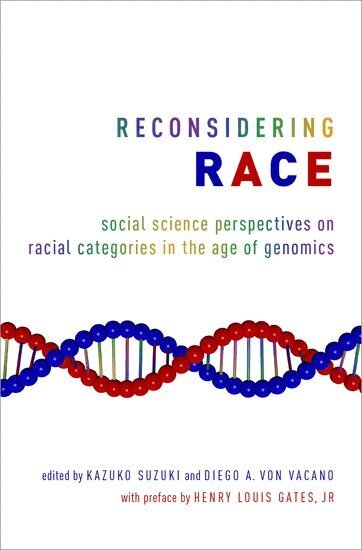
    Reconsidering Race

    Social Science Perspectives on Racial Categories in the Age of Genomics

    AvSuzuki,Kazuko Suzuki

    Inbunden, Engelska, 2018

    1 648 kr

    Beställningsvara. Skickas inom 5-8 vardagar. Fri frakt över 249 kr.

    Beskrivning

    Race is one of the most elusive phenomena of social life. While we generally know it when we see it, it's not an easy concept to define. Social science literature has argued that race is a Western, socio-political concept that emerged with the birth of modern imperialism, whether in the sixteenth century (the Age of Discovery) or the eighteenth century (the Age of Enlightenment). The editors of this book point out that there is a disjuncture between the way race is conceptualized in the social science and medical literature: some of the modern sciences employ racial and ethnic categories, but they do so to analyze, diagnose, and treat particular conditions such as organ transplants for mixed-race children, heart disease, cancer, osteoporosis, skin disorders, obesity, and gastrointestinal diseases. As such, race has a physical, as opposed to a purely social, dimension. In order to more fully understand what we mean by "race", social scientists need to engage genetics, medicine, and health. To be sure, the long shadow of eugenics and the Nazi use of scientific racism have cast a pall over the effort to understand this complicated relationship between social science and race. But while the contributors of this volume reject pseudoscience and hierarchical ways of looking at race, they make the claim that it is time to reassess the Western-based, "social construction" paradigm. The chapters in this book consider three fundamental tensions in thinking about race: one between theories that see race as fixed or malleable; a second between the idea that race is a universal but modern Western concept and the idea that it has a deeper and more complicated cultural history; and a third between socio-political and biological/bio-medical concepts of race. Arguing that race is not merely socially constructed, the contributors, including Henry Louis Gates, Jr., Ann Morning, Jennifer Hochschild, Rogers Brubaker, Michael Keevak, Carolyn Rouse, and Sandra Soo-Jin Lee, offer a provocative collection of views on the way that social scientists must reconsider the idea of race in the age of genomics.

    Produktinformation

    • Utgivningsdatum:2018-06-07
    • Mått:236 x 163 x 25 mm
    • Vikt:567 g
    • Format:Inbunden
    • Språk:Engelska
    • Antal sidor:324
    • Förlag:OUP USA
    • ISBN:9780190465285

    Utforska kategorier

    • Antropologi inom Samhälle och politik
    • Statsvetenskap och politisk teori inom Samhälle och politik
    • Etnicitet inom Samhälle och politik

    Mer om författaren

    Kazuko Suzuki is Associate Professor of Sociology at Texas A&M University and the author of Divided Fates: The State, Race, and Korean Immigrants' Adaptation in Japan and the United States, winner of the 2017 Book Award on Asia/Transnational from the Asia and Asian American Section of the American Sociological Association.Diego A. von Vacano is Associate Professor of Political Science at Texas A&M University and the author of The Color of Citizenship: Race, Modernity and Latin American/Hispanic Political Thought and The Art of Power: Machiavelli, Nietzsche and the Making of Aesthetic Political Theory.

    Recensioner i media

    "What becomes clear from reading the chapters in this volume is just how important it is to employ a social constructivist lens to view the new narratives surrounding genomic science. So while the editors of Reconsidering Race maintain that the social sciences would do better to adapt their frameworks to encompass knowledge learned from genomics, the many rich contributions to this volume actually show that the hard sciences could stand to learn something from the social sciences." - Perspectives on Politics

    Innehållsförteckning

    • Preface: Race is Socially Constructed but Mutations Are Real -Henry Louis Gates, Jr. Acknowledgments A Critical Analysis of Racial Categories in the Age of Genomics: An Introduction-Kazuko Suzuki and Diego A. von Vacano Part One: The New Challenges to the Social Construction Approach to Race Chapter 1: Biological Theories of Race beyond the Millennium-Joseph L. Graves, Jr. Chapter 2: Americans' Attitudes on Individual or Racially-Inflected Genetic Inheritance-Jennifer Hochschild and Maya Sen Chapter 3: The Constructivist Concept of Race-Ann Morning Chapter 4: The Return of Biology-Rogers Brubaker Part Two: Race, Genomics, and Health Chapter 5: A Sociogenomic World-Catherine Bliss Chapter 6: Nature versus Nurture in the Explanations for Racial/Ethnic Health Disparities: Parsing Disparities in the Era of Genome-Wide Association Studies-Jay S. Kaufman, Dinela Rushani, and Richard S. Cooper Chapter 7: Genetic Ancestry Tests and Race: Who Takes Them, Why, and How Do They Affect Racial Identities?-Wendy D. Roth and Katherine A. Lyon Part Three: Global Perspectives on Race and Genomics Debates Chapter 8: Recasting Race: Science, Politics, and Group-Making in the Postcolony-Ruha Benjamin Chapter 9: Evidence of What?: Recreating Race through Evidence-Based Approaches to Global Health-Carolyn Rouse Chapter 10: How Did East Asians Become Yellow?-Michael Keevak Chapter 11: Reconsiderations of Race: Commissioning Parents and Transnational Surrogacy in India-Sharmila Rudrappa Chapter 12: Academic Regionalism and the Study of Human Genetic Variation in a Transnational Context: Asianism and the Racialization of Ethnicity-Shirley Sun Conclusion: Thinking about Race in the Age of Genomics: Assessments and Prospects-Kazuko Suzuki and Diego A. von Vacano Bibliography About the Contributors Index