• Fri frakt över 249 kr
  • •
  • Snabba leveranser
  • •
  • Billiga böcker
Kundservice

Du är på sajten för privatpersoner.

Företag, bibliotek eller offentlig verksamhet?

Du handlar på classic.bokus.com, där alla dina funktioner finns intakta.
Till classic.bokus.com
Bokus logotyp. Gå till startsidan.
  • Erbjudanden
  • Nyheter
  • Student
  • Topplistor
  • Barn & ungdom
  • Bokus Play
  • E-böcker
  • Pocketböcker
  • Spel & pussel

10% rabatt på allt med kod: NYSTART10 →

Sidfot

Mina sidor

    Hjälp

    • Kundservice
    • Vanliga frågor och svar
    • Frakt och leverans
    • Retur vid ångerrätt
    • Reklamera vara
    • Betalning
    • Köpvillkor
    • Allmänna villkor
    • Information om webbplatsens tillgänglighet

    Om Bokus

    • Om oss
    • Pressrum
    • För studenter
    • För företag
    • För bibliotek och offentlig verksamhet
    • För leverantörer
    • Hållbarhet

    Populärt

    • Aktuella erbjudanden
    • Presentkort
    • Studentlitteratur
    • Nya böcker
    • Topplistor
    • Signerade böcker
    • Engelska böcker

    Inspiration

    • Boktips
    • BookTok
    • Populära bokserier
    • Barnbokskaraktärer
    • Populära författare
    Logotyp för Bokus
    Följ oss på Facebook (extern länk)Följ oss på Instagram (extern länk)Följ oss på YouTube (extern länk)Följ oss på TikTok (extern länk)
    bokus @ CookiesAnpassa cookiesIntegritetspolicyKöpvillkor
    Till Citymail hemsida (extern länk)Till Budbee hemsida (extern länk)Till Postnord hemsida (extern länk)Till Schenker hemsida (extern länk)Till Early Bird hemsida (extern länk)Till Walleys hemsida (extern länk)
    1. Kultur
    2. Musikböcker
    3. Musik: stilar och genrer
    4. Klassisk musik, konstmusik och orkestermusik

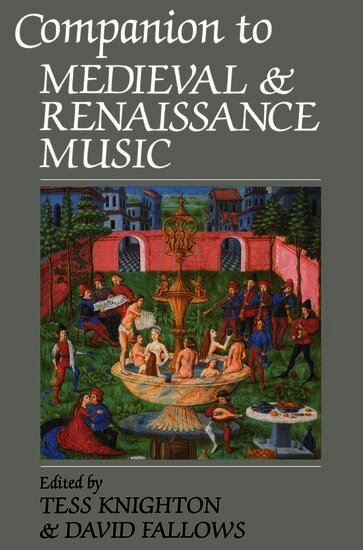
    Companion to Medieval and Renaissance Music

    AvTess Knighton,David Fallows

    Häftad, Engelska, 1998

    860 kr

    Beställningsvara. Skickas inom 7-10 vardagar. Fri frakt över 249 kr.

    Beskrivning

    The years since the early music revival gathered momentum in the 1960s and 70s have witnessed many new developments in the field of pre-Baroque music: some revelatory recordings and concert performances have opened our ears to a new range of possible sound worlds for music of this period, and scholars have made discoveries that in many ways challenge the accepted views about this until recently neglected end of the repertory. Much pre-1600 music, the more so the further we go back in time, sound not only unfamiliar but also strange to modern ears accustomed to the harmonies and rhythms that later came to dominate the Western musical tradition. How to account for this strangeness and how to weave it into our own musical experience are questions that confront us whenever we attempt to draw nearer to the music: its beauty is readily appreciated, but its meaning is often elusive. David Fallows and Tess Knighton, scholars and critics in the field of medieval and Renaissance music, invited a number of international researchers and performers to contribute short essays on some of the most intriguing aspects of the subject. The aim was not so much a comprehensive reference book, although the Glossary gives brief definitions of terms and composer biographies, nor a strictly chronological survey, though the Chronology provides an overview of the main developments of the period, for these basic tools are already available. Rather, the Companion to Medieval and Renaissance Music, spanning over eight centuries of music-making, hopes to broaden and stimulate the reader's interest by discussing issues of live debate such as the original context for the music, how it was composed, and the ways in which it was performed. What was it like to be a composer in the Middle Ages? Can we appreciate the difference between a good and a bad piece of medieval polyphony? Why did certain musical genres flourish and others fall into disuse? What can surviving documents or pictures or the musical manuscripts themselves tell us about how the music was performed, listened to, and appreciated during the period? The essays consider a wide range of the kind of evidence from which scholars and performers have to draw their conclusions and make the decisions that affect the ways in which the music can be brought back to life today.

    Produktinformation

    • Utgivningsdatum:1998-04-02
    • Mått:154 x 235 x 22 mm
    • Vikt:697 g
    • Format:Häftad
    • Språk:Engelska
    • Antal sidor:448
    • Förlag:OUP OXFORD
    • ISBN:9780198165408

    Utforska kategorier

    • Klassisk musik, konstmusik och orkestermusik inom Kultur
    • Tonsättare och låtskrivare inom Kultur

    Mer om författaren

    Tess Knighton is Fellow of Clare College, Cambridge and the editor of the journal Early Music. David Fallows is Reader in Music at Manchester University.

    Innehållsförteckning

    • Illustrations ; Music examples ; Abbreviations ; Introduction ; Contributors ; I: THE MUSIC OF THE PAST AND THE MODERN EAR ; 1. The good, the bad, and the boring ; 2. Value Judgements in music of the Renaissance ; 3. The English a cappella heresy ; 4. Going down on record ; 5. The work is not the performance ; 6. Beyond authenticity ; 7. Hard-sell, scholarship, and silly titles ; II: ASPECTS OF MUSIC AND SOCIETY ; 8. Centre and periphery: mainstream and provincial music ; 9. The meeting of sacred ritual and secular piety: endowments for music ; 10. Ritual reflections ; 11. Musicus and cantor ; 12. A day in the life of Francisco de Penalosa ; 13. A portrait of Sir Henry Unton ; 14. Women's history and early music ; III: QUESTIONS OF FORM AND STYLE ; GENRES: VOCAL ; 15. Chant, or the politics of inscription ; 16. Monophonic song: quesions of category ; 17. Early Western polyphony ; 18. The late-medieval motet ; 19. Mass polyphony ; 20. Polyphonic song ; 21. Genre and function: some thoughts on Italian secular vocal music in the sixteenth century ; GENRES: INSTRUMENTAL ; 22. Fourteenth- and fifteenth-century keyboard music ; 23. Plucked instruments: silver tones of a golden age ; 24. The medieval fiddle: reflections of a performer ; 25. On the trail of ensemble music in the fifteenth century ; 26. Wind ensembles in the Renaissance ; TECHNIQUES OF COMPOSITION: ; 27. Musical design and the rise of the cyclic Mass ; 28. Borrowed music: 'Allez regrets' and the use of pre-existent material ; IV: USING THE EVIDENCE ; 29. Music and pictures in the Middle Ages ; 30. Music in Italian Renaissance painting ; 31. Echoes of the past in the present ; 32. Surviving instruments ; 33. Unwritten and written music ; 34. Researching the past: archival studies ; 35. A manuscript case-study ; V: PRE-PERFORMANCE DECISIONS ; 36. The editor: diplomat or dictator? ; 37. Mode ; 38. Musica ficta ; 39. Renaissance pitch ; 40. Is underlay necessary? ; 41. Restored pronunciation ; 42. Finding the right context: where to perform early music ; VI: PERFORMANCE TECHNIQUES ; 43. Framing the life of the words ; 44. Reconstructing lost voices ; 45. Pythagoras at the forge: tuning in early music ; 46. Tempo to 1500 ; 47. Tempo and tactus after 1500 ; 48. Divisions in Renaissance music ; 49. 'Perfect' instruments ; Chronology ; Glossary ; Index