• Fri frakt över 249 kr
  • •
  • Snabba leveranser
  • •
  • Billiga böcker
Kundservice

Du är på sajten för privatpersoner.

Företag, bibliotek eller offentlig verksamhet?

Du handlar på classic.bokus.com, där alla dina funktioner finns intakta.
Till classic.bokus.com
Bokus logotyp. Gå till startsidan.
  • Erbjudanden
  • Nyheter
  • Student
  • Topplistor
  • Barn & ungdom
  • Bokus Play
  • E-böcker
  • Pocketböcker
  • Spel & pussel

10% studentrabatt med kod TERM26

Sidfot

Mina sidor

    Hjälp

    • Kundservice
    • Vanliga frågor och svar
    • Frakt och leverans
    • Retur vid ångerrätt
    • Reklamera vara
    • Betalning
    • Köpvillkor
    • Allmänna villkor
    • Information om webbplatsens tillgänglighet

    Om Bokus

    • Om oss
    • Pressrum
    • För studenter
    • För företag
    • För bibliotek och offentlig verksamhet
    • För leverantörer
    • Hållbarhet

    Populärt

    • Aktuella erbjudanden
    • Presentkort
    • Studentlitteratur
    • Nya böcker
    • Topplistor
    • Signerade böcker
    • Engelska böcker

    Inspiration

    • Boktips
    • BookTok
    • Populära bokserier
    • Barnbokskaraktärer
    • Populära författare
    Logotyp för Bokus
    Följ oss på Facebook (extern länk)Följ oss på Instagram (extern länk)Följ oss på YouTube (extern länk)Följ oss på TikTok (extern länk)
    bokus @ CookiesAnpassa cookiesIntegritetspolicyKöpvillkor
    Till Citymail hemsida (extern länk)Till Budbee hemsida (extern länk)Till Postnord hemsida (extern länk)Till Schenker hemsida (extern länk)Till Early Bird hemsida (extern länk)Till Walleys hemsida (extern länk)
    1. Juridik
    2. Internationell rätt
    3. Folkrätt

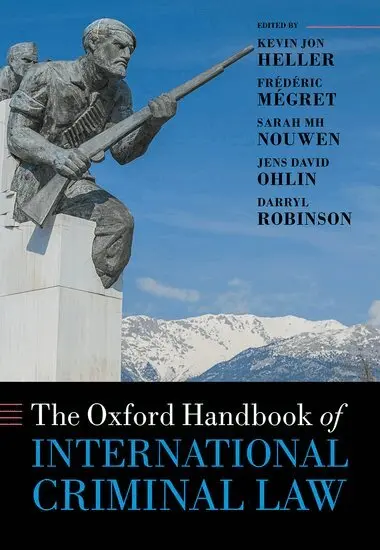
    The Oxford Handbook of International Criminal Law

    AvDarryl Robinson,Kevin Heller

    Inbunden, Engelska, 2020

    Del i serien Oxford Handbooks

    3 076 kr

    Beställningsvara. Skickas inom 5-8 vardagar. Fri frakt över 249 kr.

    Beskrivning

    In the past twenty years, international criminal law has become one of the main areas of international legal scholarship and practice. Most textbooks in the field describe the evolution of international criminal tribunals, the elements of the core international crimes, the applicable modes of liability and defences, and the role of states in prosecuting international crimes. The Oxford Handbook of International Criminal Law, however, takes a theoretically informed and refreshingly critical look at the most controversial issues in international criminal law, challenging prevailing practices, orthodoxies, and received wisdoms. Some of the contributions to the Handbook come from scholars within the field, but many come from outside of international criminal law, or indeed from outside law itself. The chapters are grounded in history, geography, philosophy, and international relations. The result is a Handbook that expands the discipline and should fundamentally alter how international criminal law is understood.

    Produktinformation

    • Utgivningsdatum:2020-02-25
    • Mått:182 x 252 x 58 mm
    • Vikt:1 720 g
    • Format:Inbunden
    • Språk:Engelska
    • Serie:Oxford Handbooks
    • Antal sidor:912
    • Förlag:OUP OXFORD
    • ISBN:9780198825203

    Utforska kategorier

    • Folkrätt inom Juridik
    • Politik och statsskick inom Samhälle och politik
    • Straffrätt: process och brott inom Juridik

    Mer om författaren

    Kevin Jon Heller is Associate Professor of Public International Law at the University of Amsterdam and Professor of Law at the Australian National University. He holds a PhD in law from Leiden University and a JD with distinction from Stanford Law School. His research interests focus on international criminal law, international humanitarian law, and the use of force, with a particular emphasis on the methodologies employed by those fields. His books include The Nuremberg Military Tribunals and the Origins of International Criminal Law (OUP, 2011); The Hidden Histories of War Crimes Trials (OUP, 2013) (edited with Gerry Simpson); and The Handbook of Comparative Criminal Law (Stanford University Press, 2011) (edited with Markus Dubber).Frédéric Mégret is a Full Professor and William Dawson Scholar at the Faculty of Law, McGill University. He holds an LLB from King's College London, a DEA from the Université de Paris I (Panthéon Sorbonne), and a PhD from the Graduate Institute of International Studies (Geneva), as well as a diploma from Sciences Po Paris. His research focuses on international criminal justice, the laws of war, international human rights law, transitional justice, and general international law.Sarah MH Nouwen is Reader in International Law at the University of Cambridge, Co-Deputy Director and Fellow of the Lauterpacht Centre for International Law, and a Fellow of Pembroke College. As of September 2020, she will be a Professor of International Law at the European University Institute in Florence. Sarah is also an Editor-in-Chief of the European Journal of International Law. She is the author of Complementarity in the Line of Fire: The Catalysing Effect of the International Criminal Court in Uganda and Sudan (CUP, 2013), an empirical study into the effects of the complementarity principle in the Rome Statute on the legal systems in Uganda and Sudan. She has advised the Netherlands Ministry of Foreign Affairs, the Department for International Development and several NGOs. In 2010-2011 she was seconded as Senior Legal Advisor to the African Union High-Level Implementation Panel on Sudan.Jens David Ohlin is Vice Dean and Professor of Law at Cornell Law School. Professor Ohlin's work stands at the intersection of four related fields: criminal law, criminal procedure, public international law, and the laws of war. Trained as both a lawyer and a philosopher, his research has tackled questions as diverse as criminal conspiracy and the punishment of collective criminal action, the philosophical foundations of international law, and the role of new technologies in warfare, including cyberwar, remotely piloted drones, and autonomous weapons. He is the author of the forthcoming monograph, Election Interference: International Law and the Future of Democracy (CUP, 2020).Darryl Robinson is Associate Professor at Queen's University Faculty of Law (Canada). He was a Hauser Scholar at New York University School of Law (LL.M International Legal Studies), a Gold Medalist at the UWO Faculty of Law, and a clerk at the Supreme Court of Canada. He served as a Legal Officer at Foreign Affairs Canada from 1997-2004. His work in the creation of the International Criminal Court and in the development of Canada's new war crimes legislation earned him a Minister's Citation and a Minister's Award for Foreign Policy Excellence. He is a co-author of Robert Cryer et al, Introduction to International Criminal Law and Procedure (CUP, 2019, 4th edition), and was the 2013-14 recipient of the Antonio Cassese Prize for International Criminal Legal Studies.

    Innehållsförteckning

    • 0: Kevin Heller, Frédéric Mégret, Sarah Nouwen, Jens Ohlin and Darryl Robinson: Introduction SECTION I: ACTORS 1: Marie-Sophie Devresse & Damien Scalia: An Empirical Analysis of International Criminal Law: The Perception and Experience of the Accused 2: Jenia Iontcheva Turner: Defense Perspectives on Fairness and Efficiency at the International Criminal Court 3: Dov Jacobs: Neither Here nor There: The Position of the Defence in International Criminal Tribunals 4: Mikkel Jarle Christensen: The Creation of an Ad Hoc Elite: And the Value of International Criminal Law Expertise on a Global Market 5: Neha Jain: Teachings of Publicists and the Reinvention of the Sources Doctrine in International Criminal Law SECTION II: SPACES 6: Tom Dannenbaum: Legitimacy in War and Punishment: The Security Council and the ICC 7: Christopher Gevers: Africa and International Criminal Law 8: Harmen van der Wilt: On Regional Criminal Courts as Representatives of Political Communities: The Special Case of the African Criminal Court SECTION III: RATIONALES 9: Miriam Gur-Arye & Alon Harel: Taking Internationalism Seriously: Why International Criminal Law Matters 10: Mark A. Drumbl: Impunities 11: Marko Milanovic: Courting Failure: When Are International Criminal Courts Likely to be Believed by Local Audiences? SECTION IV: CRIMES 12: Alexander K.A. Greenawalt: 'What is An International Crime?' 13: Alejandro Chehtman: A Theory of International Crimes: Conceptual and Normative Issues 14: Samuel Moyn: From Aggression to Atrocity: Rethinking the History of International Criminal Law 15: Edwin Bikundo: Enslavement as a Crime against Humanity: Some Doctrinal, Historical, and Theoretical Considerations SECTION V: MODALITIES 16: Alette Smeulers: A Criminological Approach to the ICC's Control Theory 17: Jean d'Aspremont: The Two Cultures of International Criminal Law 18: Adil Ahmad Haque: Immunity and Impunity 19: Mark Klamberg: Epistemological Controversies and Evaluation of Evidence in International Criminal Trials 20: Leora Bilsky: The Right to Truth in International Criminal Law 21: Saira Mohamed: From Machinery to Motivation: The Lost Legacy of Criminal Organizations Liability SECTION VI: NARRATIVES 22: Kim Christian Priemel: Historical Reasoning and Judicial Historiography in International Criminal Trials 23: Lawrence Douglas: Criminal/Enemy 24: David Luban: The Enemy of All Humanity 25: Sofia Stolk & Wouter Werner: Moving Images: Modes of Representation and Images of Victimhood in Audio-Visual Productions SECTION VII: ANXIETIES 26: Henry Lovat: International Criminal Tribunal Backlash 27: Sergey Vasiliev: The Crises and Critiques of International Criminal Justice 28: Itamar Mann: Hangman's Perspective: Three Genres of Critique following Eichmann 29: Marlies Glasius & Tim Meijers: Inequality of Arms Reversed? Defendants in the Battle for Political Legitimacy SECTION VIII: BOUNDARIES 30: Laurel E. Fletcher: International Criminal Law and the Subordination of Emancipation: The Question of Legal Hierarchy in Transitional Justice 31: Sara Kendall and Sarah M.H. Nouwen: International Criminal Justice and Humanitarianism 32: Cheah W.L.: International Criminal Law and Culture 33: Christine Schwöbel-Patel: The Core Crimes of International Criminal Law 34: Douglas Guilfoyle: Transnational Crimes 35: Frédéric Mégret: The Unity of International Criminal Law: A Socio-Legal View SECTION IX: FUTURE(S) 36: Gerry Simpson: International Criminal Law: The Next Hundred Years