• Fri frakt över 249 kr
  • •
  • Snabba leveranser
  • •
  • Billiga böcker
Kundservice

Du är på sajten för privatpersoner.

Företag, bibliotek eller offentlig verksamhet?

Du handlar på classic.bokus.com, där alla dina funktioner finns intakta.
Till classic.bokus.com
Bokus logotyp. Gå till startsidan.
  • Erbjudanden
  • Nyheter
  • Student
  • Topplistor
  • Barn & ungdom
  • Bokus Play
  • E-böcker
  • Pocketböcker
  • Spel & pussel

10% studentrabatt med kod TERM26

Sidfot

Mina sidor

    Hjälp

    • Kundservice
    • Vanliga frågor och svar
    • Frakt och leverans
    • Retur vid ångerrätt
    • Reklamera vara
    • Betalning
    • Köpvillkor
    • Allmänna villkor
    • Information om webbplatsens tillgänglighet

    Om Bokus

    • Om oss
    • Pressrum
    • För studenter
    • För företag
    • För bibliotek och offentlig verksamhet
    • För leverantörer
    • Hållbarhet

    Populärt

    • Aktuella erbjudanden
    • Presentkort
    • Studentlitteratur
    • Nya böcker
    • Topplistor
    • Signerade böcker
    • Engelska böcker

    Inspiration

    • Boktips
    • BookTok
    • Populära bokserier
    • Barnbokskaraktärer
    • Populära författare
    Logotyp för Bokus
    Följ oss på Facebook (extern länk)Följ oss på Instagram (extern länk)Följ oss på YouTube (extern länk)Följ oss på TikTok (extern länk)
    bokus @ CookiesAnpassa cookiesIntegritetspolicyKöpvillkor
    Till Citymail hemsida (extern länk)Till Budbee hemsida (extern länk)Till Postnord hemsida (extern länk)Till Schenker hemsida (extern länk)Till Early Bird hemsida (extern länk)Till Walleys hemsida (extern länk)
    1. Ekonomi och Ledarskap
    2. Företagsekonomi
    3. Entreprenörskap

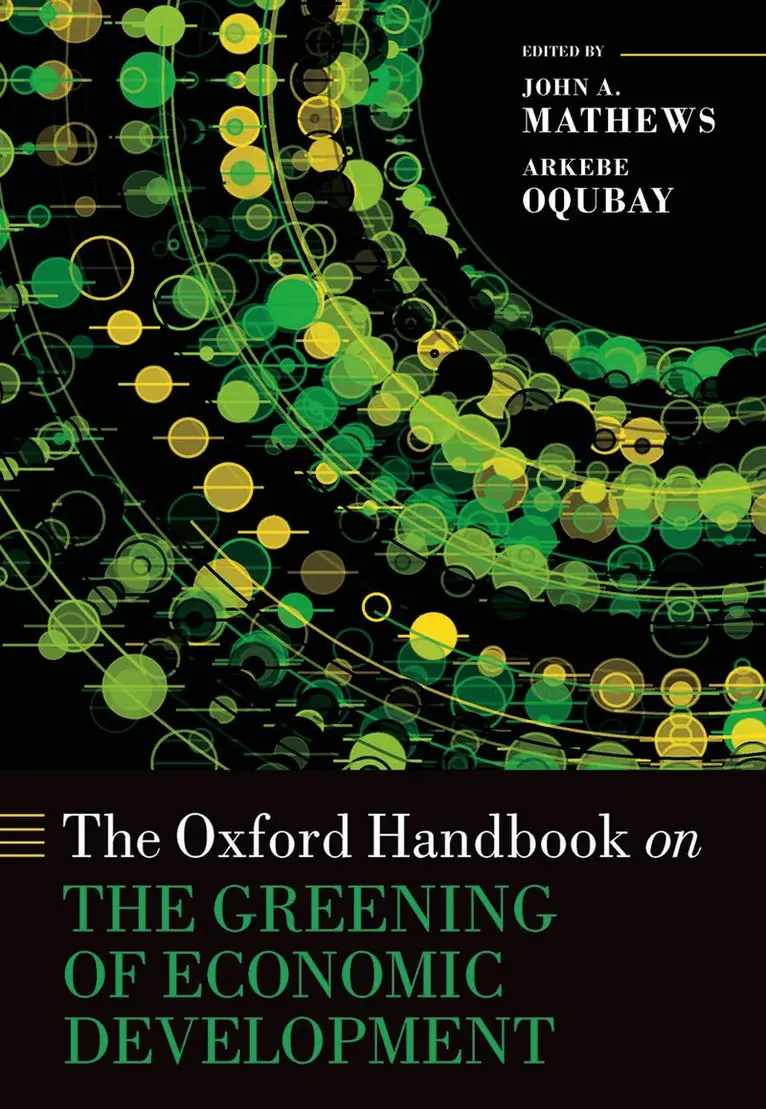
    The Oxford Handbook on the Greening of Economic Development

    AvJohn A. Mathews,Arkebe Oqubay

    Inbunden, Engelska, 2025

    Del i serien Oxford Handbooks

    2 623 kr

    Beställningsvara. Skickas inom 5-8 vardagar. Fri frakt över 249 kr.

    Beskrivning

    Economic development, in its traditional formulation, ignores the impact of decisions made regarding energy, resources, and finance. The standard choices made are to use stocks of fossil fuels, stocks of resources and their linear flow, and generic finance. The implications of this are now clear. An alternative is being crafted which is based on flows of renewable energy and renewable fuels, on circular flows of resources, and on greening of financial instruments, such as equities and bonds. This involves a vast industrial revolution, creating the 'next' Great Transformation of the global economic system, one that is creating an economy that emulates life through its interconnections and circular flows. The shift is comprehensive, global, and all-encompassing. Greening of economic development is driven by industrial policy, technological capability, and enhancement of industrial capacity.With over fifty contributors, this volume draws on specialist expertise to provide a comprehensive overview of this process of greening of economic development. It demonstrates how the shift in energy, resource flows, and finance is a process rather than an endpoint; that it is compatible with economic growth; that it is powered by economic drivers such as cost reductions generated by experience curves; and that at the vast scale and rapid pace required it calls for a global Green Deal.The handbook frames novel objectives through greening that take state action and guidance in fresh directions and argues that the strategies involved are as relevant for emerging industrial economies creating new industries as to developed economies looking to transform themselves. Overall, it emphasizes how 'greening' creates a self-sustaining economy that does not cost the earth.

    Produktinformation

    • Utgivningsdatum:2025-05-29
    • Mått:180 x 250 x 50 mm
    • Vikt:1 805 g
    • Format:Inbunden
    • Språk:Engelska
    • Serie:Oxford Handbooks
    • Antal sidor:890
    • Förlag:OUP OXFORD
    • ISBN:9780198883487

    Utforska kategorier

    • Entreprenörskap inom Ekonomi och Ledarskap
    • Internationell ekonomi inom Ekonomi och Ledarskap
    • Miljövetenskap och miljöpolitik inom Naturvetenskap och teknik

    Mer om författaren

    John A. Mathews is Professor Emeritus at Macquarie University, Sydney, in the Macquarie Business School. He was Professor of Strategy at Macquarie Graduate School of Management from 2000 and previous to that held positions at University of NSW and a professorial fellowship at the Australian National University. He has focused for more than a decade on the strategic dynamics of greening of industry, applying insights from business theory to the greening of economic development.Arkebe Oqubay is a British Academy Global Professor at SOAS University of London. He is a former Senior Minister and Special Advisor to three successive Prime Ministers of Ethiopia and the former Mayor of Addis Ababa. His current research focuses on structural transformation, catch-up, green transformation, and industrial policy with a focus on Africa.

    Innehållsförteckning

    • Acknowledgements List of Figures List of Tables List of Contributors I. Greening of Economic Development: Context and Theoretical Perspectives 1: John A. Mathews and Arkebe Oqubay: Greening of economic development: An introduction 2: Jan Fagerberg: The global green shift: History, dynamics, and prospects 3: Sung-Young Kim, Hao Tan, and Elizabeth Thurbon: Developmental environmentalism: Green growth in East Asia 4: Rasmus Lema and Carlota Perez: Green transformation as new direction for techno-economic development 5: Maj Munch Andersen: Evolutionary dynamics of the Green and Circular Economy II. Greening of Energy, Resource Flows, and Finance 6: Nicola Armaroli: Fossil fuels exit: Challenges, perspectives, and bottlenecks 7: Tomas Kaberger: Reversing the fuel-electricity system provides for complete fossil fuel replacement and a stable grid 8: Mark Delucchi: Social cost-benefit analysis of 100 percent renewables systems 9: Gerhard Swiegers with Rahman Daiyan, Abbey Last, and M. Haider Ali Khan: Renewable hydrogen production economics: Influence of electrolyser performance 10: Meg Jo-Chen Lin, Justin Che-Ping Chou, and Mei-Chih Hu: Taiwan's green technology development: The role of fuel cells and the green hydrogen economy 11: Jusen Asuka: Japanese debates over the energy transformation (GX) 12: Marian R. Chertow and Koichi S. Kanaoka: Greening the economy: industrial ecology and industrial symbiosis 13: Ulrich Volz and Damon Aitken: The role of finance in greening economic development 14: Mariana Mazzucato and Laurie Macfarlane: Role of mission-oriented development banks in greening III. Greening along Value Chains 15: Lindsay Whitfield, Felix Maile, and Tobias Wuttke: Green windows of opportunity and catch-up industrialization in Africa 16: Xianlai Zeng and Xin Xiong: Economic performance of urban mining for future resource supply 17: Aarti Krishnan: Greening of global value chains 18: John Schooneveldt: Regenerative farming and greening of food production 19: Chan-Yuan Wong, Chia-Chen Chang, and Hon-Ngen Fung: Patenting strategies for electric vehicles IV. Greening of Regions 20: Jeffrey Ball: How China's green strategy is changing the world 21: Simran Talwar and Maartje Feenstra: Greening in Central and South Asia: India 22: Ewan Gibbs: Greening in Northern Europe: Offshore wind power 23: Euston Quah and Jun Rui Tan: Greening the economy: The Singapore model 24: Rajah Rasiah and Gopi Krishnan Vijayaraghavan: Greening in Southeast Asia 25: Amir Lebdioui: Greening of Latin American economies 26: Michael A. Landesmann: The European Union's green industrial policy 27: Robert Pollin: A green transition in the United States: The case of fossil fuel-dependent West Virginia V. Greening of strategies for economic development 28: Keun Lee: Conditions for success of green industrial policy 29: Richard Kozul-Wright, Diana Barrowclough, and Piergiuseppe Fortunato: Greening industrial development strategies 30: Michael H. Best: Greening of economic development: The New Deal's enduring legacy 31: John A. Mathews and Arkebe Oqubay: Greening of economic development: The next Great Transformation - Conclusions and pathways to the future