• Fri frakt över 249 kr
  • •
  • Snabba leveranser
  • •
  • Billiga böcker
Kundservice

Du är på sajten för privatpersoner.

Företag, bibliotek eller offentlig verksamhet?

Du handlar på classic.bokus.com, där alla dina funktioner finns intakta.
Till classic.bokus.com
Bokus logotyp. Gå till startsidan.
  • Erbjudanden
  • Nyheter
  • Student
  • Topplistor
  • Barn & ungdom
  • Bokus Play
  • E-böcker
  • Pocketböcker
  • Spel & pussel

10% studentrabatt med kod TERM26

Sidfot

Mina sidor

    Hjälp

    • Kundservice
    • Vanliga frågor och svar
    • Frakt och leverans
    • Retur vid ångerrätt
    • Reklamera vara
    • Betalning
    • Köpvillkor
    • Allmänna villkor
    • Information om webbplatsens tillgänglighet

    Om Bokus

    • Om oss
    • Pressrum
    • För studenter
    • För företag
    • För bibliotek och offentlig verksamhet
    • För leverantörer
    • Hållbarhet

    Populärt

    • Aktuella erbjudanden
    • Presentkort
    • Studentlitteratur
    • Nya böcker
    • Topplistor
    • Signerade böcker
    • Engelska böcker

    Inspiration

    • Boktips
    • BookTok
    • Populära bokserier
    • Barnbokskaraktärer
    • Populära författare
    Logotyp för Bokus
    Följ oss på Facebook (extern länk)Följ oss på Instagram (extern länk)Följ oss på YouTube (extern länk)Följ oss på TikTok (extern länk)
    bokus @ CookiesAnpassa cookiesIntegritetspolicyKöpvillkor
    Till Citymail hemsida (extern länk)Till Budbee hemsida (extern länk)Till Postnord hemsida (extern länk)Till Schenker hemsida (extern länk)Till Early Bird hemsida (extern länk)Till Walleys hemsida (extern länk)
    1. Samhälle och politik
    2. Politik och statsskick
    3. Statsskick och politiska processer
    4. Konstitution: stat och regering

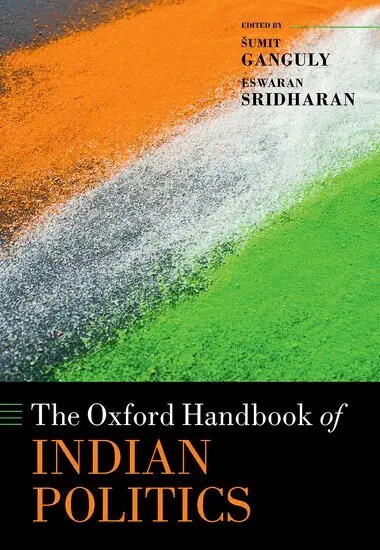
    The Oxford Handbook of Indian Politics

    AvSumit Ganguly,Sumit Ganguly

    Inbunden, Engelska, 2024

    2 593 kr

    Beställningsvara. Skickas inom 3-6 vardagar. Fri frakt över 249 kr.

    Beskrivning

    The study of Indian politics has witnessed a dramatic revival worldwide in the last few decades. There have been significant developments in national politics since 2014 with the advent of the single-party majority government of the Bharatiya Janata Party, the first such majority since 1984. Moreover, the results of the 17th Lok Sabha (Lower House) election in India in 2019 have had major implications for the party system in India. In the light of these developments, The Oxford Handbook of Indian Politics provides the most comprehensive, up-to-date coverage of the state of contemporary Indian politics. To that end, it examines the evolution of core institutions, processes, policies, and associated issues that are being debated in India's politics. It also provides historical contexts, discusses the state of the extant literature in each issue area, and suggests avenues for future research. The contributors to this volume are all noted scholars and researchers in their respective fields of specialization located both in India and around the world. The major topics covered include the Constitution, citizenship, the houses of Parliament, the Cabinet, the judiciary, federalism and local governments, elections, parties and coalitions, secularism and minorities, caste, gender and migration, political violence, political finance, political economy, and foreign and defence policies. In effect, The Oxford Handbook of Indian Politics offers scholars, analysts, and students a sweeping overview of the current landscape of Indian politics, with particular attention to issues that have emerged over the past decade.

    Produktinformation

    • Utgivningsdatum:2024-08-29
    • Mått:171 x 246 x 40 mm
    • Vikt:2 599 g
    • Format:Inbunden
    • Språk:Engelska
    • Antal sidor:672
    • Förlag:OUP OXFORD
    • ISBN:9780198894261

    Utforska kategorier

    • Konstitution: stat och regering inom Samhälle och politik
    • Statsskick: demokrati inom Samhälle och politik
    • Offentlig förvaltning inom Samhälle och politik

    Mer om författaren

    Sumit Ganguly is a Senior Fellow and directs the Huntington Program on Strengthening US-India Relations at the Hoover Institution, Stanford University. He is Distinguished Professor of Political Science Emeritus and the Rabindranath Tagore Chair in Indian Cultures and Civilizations Emeritus at Indiana University, Bloomington.A specialist on the contemporary politics of South Asia, he is the author, co-author, editor, or co-editor of 20 books on the region.Professor Ganguly is member of the Council on Foreign Relations (New York) and a Fellow of the American Academy of Arts and Sciences. He serves on the editorial boards of Asian Security, Current History, Journal of Democracy, Foreign Policy Analysis, The Nonproliferation Review, Pacific Affairs, International Security, and Small Wars & Insurgencies.His most recent book (edited with Eswaran Sridharan) is The Oxford Handbook of Indian Politics.Eswaran Sridharanis the Academic Director and Chief Executive, University of Pennsylvania Institute for the Advanced Study of India (UPIASI), Delhi. He is a political scientist whose published work covers political parties, party system change, coalition politics, political finance, the political economy of liberalization, the Indian middle classes, and international relations theory and India as an emerging power. He has held visiting appointments at the London School of Economics, the Institute of Developing Economies (Tokyo), University of California, Berkeley, and the Institute of South Asian Studies, Singapore. He is the author, editor, or co-editor of twelve books, with three forthcoming titles, and has published 96 academic articles. He is the Editor-in-Chief ofIndia Review, published by Taylor & Francis, UK,and is on the editorial advisory boards ofCommonwealth and Comparative Politics,International Studies Review, andMillenial Asia.

    Innehållsförteckning

    • Sumit Ganguly and E. Sridharan: Editors' Introduction and Acknowledgements Section I: Core Institutions 1: Niraja Gopal Jayal: Rights and Citizenship 2: M. R. Madhavan: Lok Sabha 3: Sandeep Shastri: The Rajya Sabha: A 'Federal Chamber' Or A Mere Upper House in the Indian Parliament? 4: Ajay K. Mehra: The Indian Cabinet 5: Ronojoy Sen: The Supreme Court Section II: Federalism and Local Politics 6: Rekha Saxena: The Changing Nature of Federalism in India 7: Ashutosh Kumar: Political Leadership in India 8: George Mathew: Politics in the Third Tier: Municipalities and Panchayats Section III: Elections 9: Banasmita Bora: The Election Commission of India and Its Evolution 10: Sanjay Kumar: Elections in India: A Journey over the Last Seven Decades 11: Rahul Verma: Media Exposure and Vote Choice in Indian Elections: 1996-2019 Section IV: The Major Parties 12: Christophe Jaffrelot: BJP's Ideology, Structures, Sociology, and Strategies 13: Zoya Hasan: Congress Party in Decline 14: Adam Ziegfeld: Regional Parties Section V: Parties and Coalitions 15: K. K. Kailash: Political Parties: Centralised Electoral Machines 16: Rekha Diwakar: The Party System 17: E. Sridharan: Coalition Politics in India Section VI: Caste, Gender, Migration 18: Suhas Palshikar: Caste and Politics: Limits of Democratization 19: Carole Spary: Women in Indian Politics 20: Ashwani Kumar and Shashwat Dhar: The Politics of Interstate Migration in India Section VII: Money and Politics 21: Milan Vaishnav: Political Finance in India 22: Kanta Murali: State-Business Relations in India Section VIII: Secularism and Minorities 23: Rajeev Bhargava: Indian Secularism at Crossroads: An Interpretation 24: Ashutosh Varshney: Communalism 25: Adnan Farooqui: Muslim Representation Section IX: Political Economy 26: Surupa Gupta: The Political Economy of Macroeconomic Policy in India 27: John Echeverri-Gent: The Evolution of India's Economic Regulation: From Dirigisme to the New Regulatory State 28: Diego Maiorano: The Politics of Public Service Delivery in India Section X: Political Violence 29: Paul Staniland: Insurgencies and Political Violence in India 30: Arvind Verma: Coercive Instruments of the State Section XI: Foreign Policy and Security 31: Sumit Ganguly: The Evolution of India's Foreign Policy 32: Arzan Tarapore: Indian Defence Policy 33: Happymon Jacob: Drivers of India's South Asia Policy 34: Anit Mukherjee: India's Civil-Military Relations 35: Gaurav Kampani: The New Normal: India's Quest for the 'Credible' in Nuclear Deterrence