• Fri frakt över 249 kr
  • •
  • Snabba leveranser
  • •
  • Billiga böcker
Kundservice

Du är på sajten för privatpersoner.

Företag, bibliotek eller offentlig verksamhet?

Du handlar på classic.bokus.com, där alla dina funktioner finns intakta.
Till classic.bokus.com
Bokus logotyp. Gå till startsidan.
  • Erbjudanden
  • Nyheter
  • Student
  • Topplistor
  • Barn & ungdom
  • Bokus Play
  • E-böcker
  • Pocketböcker
  • Spel & pussel

10% studentrabatt med kod TERM26

Sidfot

Mina sidor

    Hjälp

    • Kundservice
    • Vanliga frågor och svar
    • Frakt och leverans
    • Retur vid ångerrätt
    • Reklamera vara
    • Betalning
    • Köpvillkor
    • Allmänna villkor
    • Information om webbplatsens tillgänglighet

    Om Bokus

    • Om oss
    • Pressrum
    • För studenter
    • För företag
    • För bibliotek och offentlig verksamhet
    • För leverantörer
    • Hållbarhet

    Populärt

    • Aktuella erbjudanden
    • Presentkort
    • Studentlitteratur
    • Nya böcker
    • Topplistor
    • Signerade böcker
    • Engelska böcker

    Inspiration

    • Boktips
    • BookTok
    • Populära bokserier
    • Barnbokskaraktärer
    • Populära författare
    Logotyp för Bokus
    Följ oss på Facebook (extern länk)Följ oss på Instagram (extern länk)Följ oss på YouTube (extern länk)Följ oss på TikTok (extern länk)
    bokus @ CookiesAnpassa cookiesIntegritetspolicyKöpvillkor
    Till Citymail hemsida (extern länk)Till Budbee hemsida (extern länk)Till Postnord hemsida (extern länk)Till Schenker hemsida (extern länk)Till Early Bird hemsida (extern länk)Till Walleys hemsida (extern länk)
    1. Naturvetenskap och teknik
    2. Matematik och naturvetenskap
    3. Biologi
    4. Biovetenskap

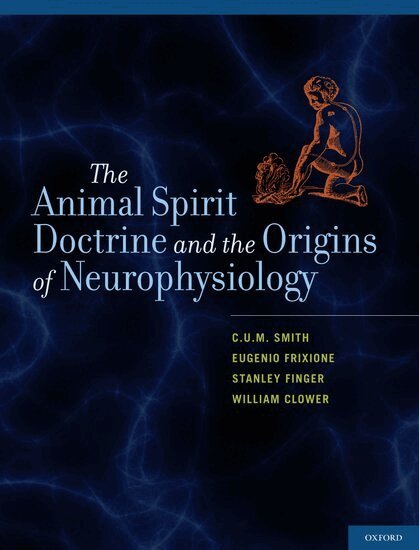
    The Animal Spirit Doctrine and the Origins of Neurophysiology

    AvC.U.M. Smith,Eugenio Frixione

    Inbunden, Engelska, 2012

    3 210 kr

    Beställningsvara. Skickas inom 5-8 vardagar. Fri frakt över 249 kr.

    Beskrivning

    How do we become aware of things and events in the outside world, and how does the brain control the muscular system and behavior? This book examines the history of Western attempts to explain how messages might be sent from the sense organs to the brain and from the brain to the muscles. It focuses on a construct called animal spirit, which would permeate philosophy and guide physiology and medicine for over two millennia.The authors' story opens along the Eastern Mediterranean, where they examine how Pre-Socratic philosophers related the soul to air-wind or pneuma. They then trace what Hippocrates, Plato and Aristotle wrote about this pneuma, and how Stoic and Epicurean philosophers approached it. They also visit Alexandria, where Hellenistic anatomists provided new thoughts about the nerves and the ventricles. Thereafter, the authors return to the Greek mainland, where they show how Galen's pneuma psychikon or spiritus animae would provide an explanation for sensations and movements.Galen's writings would guide science and medicine for well over a thousand years, albeit with some modifications. One change, found in early Christian writers Nemesius and Augustine, involved assigning perception, cognition, and memory to different spirit-filled ventricles. After examining how pious Scholastics later dealt with the nerve spirit, the authors turn to how questions began to be raised about it in the 1500s and 1600s. Here they examine the rise of modern science with its revealing experiments, microscopic observations, and attempts to break with the past. Descartes, Swammerdam, Borelli, Glisson, Willis, Newton, Hartley, Boerhaave and Haller are among the featured players in this part of the story. Nevertheless, the animal spirit doctrine continued to survive (although modified), because no adequate replacement for it was immediately forthcoming. The replacement theory stemmed from experiments on electric fishes started in the 1750s. Additional research on these fishes and then on frogs eventually led scientists to abandon their time-honored ideas. The authors trace some of the developments leading to modern electrophysiology and end with an epilogue centered on what this history teaches us about paradigmatic changes in the life sciences.

    Produktinformation

    • Utgivningsdatum:2012-08-02
    • Mått:282 x 224 x 25 mm
    • Vikt:1 270 g
    • Format:Inbunden
    • Språk:Engelska
    • Antal sidor:304
    • Förlag:OUP USA
    • ISBN:9780199766499

    Utforska kategorier

    • Biovetenskap inom Naturvetenskap och teknik
    • Kognitiv psykologi inom Psykologi och pedagogik

    Mer om författaren

    Chris Smith holds degrees in Zoology, Physics and Biophysics and a PhD in Neuroscience. Since retiring as Dean of the Faculty of Life and Health Sciences at Aston in 1996 he has devoted his time to the history and philosophy of neuroscience. He has published a number of books on neuroscience and the history of biology and has edited books on cranial trepanation, Erasmus Darwin, and eighteenth-century neuroscience. He has published some 140 academic papers and chapters and has acted as section editor in neurophilosophy for the Journal of the History of the Neurosciences.Eugenio Frixione is a cell physiologist who has published mainly experimental basic research on several mechanisms of cell motility in neural and epithelial tissues, and in unicellular parasites. Recently he has published studies on the intellectual evolution of major concepts about cell structure and function, as well as on key advances in the understanding of muscle physiology and other instances of biological motion. Stanley Finger first studied recovery from brain damage and then turned to the history of the neurosciences. His monographs in the latter domain include Origins of Neuroscience (with OUP), Minds Behind the Brain (with OUP), Doctor Franklin's Medicine, and most recently (with OUP), A Shocking History of Electric Fishes. He has edited books on cranial trepanation, eighteenth-century neuroscience, and the history of neurology, has published approximately 150 papers in edited journals, and has long served and continues to serve as editor of the Journal of the History of the Neurosciences.Will Clower is trained in neurophysiology, studying the mechanisms of movement control associated with motor learning. In the process of performing his neuroscience research in France, Dr Clower wrote and later published two books on the Mediterranean dietary behaviors. He now provides wellness programming for corporations, hospitals, and wellness centers around the United States.

    Innehållsförteckning

    • Section 1: The Doctrine Introduced ; Introduction ; Chronology ; Chapter 1: Psyche and soma ; Chapter 2: Alexandria and Hellenistic psychophysiology ; Section 2: The Doctrine Established ; Introduction ; Chronology ; Chapter 3: Biblical anima-spirit ; Chapter 4: The Islamic Ascendancy ; Chapter 5: Animal spirit in an age of Faith ; Section 3: The Doctrine Questioned ; Introduction ; Chronology ; Chapter 6: Descartes ; Chapter 7: Experiment and observation ; Chapter 8: Theory and argument ; Section 4: The Doctrine in Retreat ; Introduction ; Chronology ; Chapter 9: Vibrations and subtle fluids ; Chapter 10: Animal spirit in action ; Chapter 11: Non-spiritual physiology I: <"Physic>" rather than <"Psychic <" Functions ; Chapter 12 Non-spiritual physiology II: Irritable fibers ; Section 5: The Doctrine Discarded ; Introduction ; Chronology ; Chapter 13: The increasingly electrical world ; Chapter 14: Electric fishes and the path to animal electricity ; Chapter 15: From Fish to Frogs and nerve Electricity ; Epilogue ; Bibliography ; Index