• Fri frakt över 249 kr
  • •
  • Snabba leveranser
  • •
  • Billiga böcker
Kundservice

Du är på sajten för privatpersoner.

Företag, bibliotek eller offentlig verksamhet?

Du handlar på classic.bokus.com, där alla dina funktioner finns intakta.
Till classic.bokus.com
Bokus logotyp. Gå till startsidan.
  • Erbjudanden
  • Student
  • Topplistor
  • Barn & ungdom
  • Bokus Play
  • E-böcker
  • Ljudböcker
  • Pocketböcker
  • Spel och pussel

Skapa nya rutiner – hälsoböcker upp till 50% →

Sidfot

Mina sidor

    Hjälp

    • Kundservice
    • Vanliga frågor och svar
    • Frakt och leverans
    • Retur vid ångerrätt
    • Reklamera vara
    • Betalning
    • Köpvillkor
    • Allmänna villkor
    • Information om webbplatsens tillgänglighet

    Om Bokus

    • Om oss
    • Pressrum
    • För studenter
    • För företag
    • För bibliotek och offentlig verksamhet
    • För leverantörer
    • Hållbarhet

    Populärt

    • Aktuella erbjudanden
    • Presentkort
    • Studentlitteratur
    • Nya böcker
    • Topplistor
    • Signerade böcker
    • Engelska böcker

    Inspiration

    • Boktips
    • BookTok
    • Barnbokskaraktärer
    • Populära författare
    Logotyp för Bokus
    Följ oss på Facebook (extern länk)Följ oss på Instagram (extern länk)Följ oss på YouTube (extern länk)Följ oss på TikTok (extern länk)
    bokus @ CookiesAnpassa cookiesIntegritetspolicyKöpvillkor
    Till Citymail hemsida (extern länk)Till Budbee hemsida (extern länk)Till Postnord hemsida (extern länk)Till Schenker hemsida (extern länk)Till Early Bird hemsida (extern länk)Till Walleys hemsida (extern länk)
    1. Psykologi och pedagogik
    2. Psykologi
    3. Kognitiv psykologi

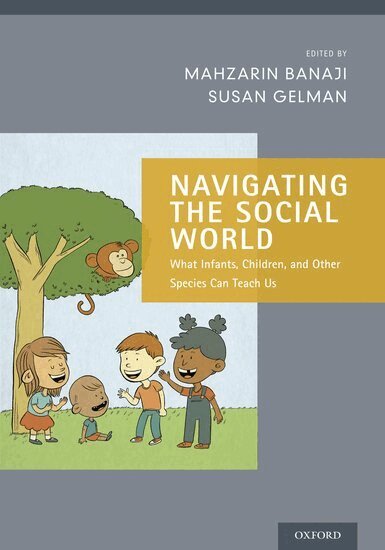
    Navigating the Social World

    What Infants, Children, and Other Species Can Teach Us

    AvBANAJI,Banaji

    Inbunden, Engelska, 2013

    Del i serien Social Cognition and Social Neuroscience

    2 855 kr

    Beställningsvara. Skickas inom 5-8 vardagar. Fri frakt över 249 kr.

    Beskrivning

    Navigating the social world requires sophisticated cognitive machinery that, although present quite early in crude forms, undergoes significant change across the lifespan. This book will be the first to report on evidence that has accumulated on an unprecedented scale, showing us what capacities for social cognition are present at birth and early in life, and how these capacities develop through learning in the first years of life. The volume will highlight what is known about the discoveries themselves but also what these discoveries imply about the nature of early social cognition and the methods that have allowed these discoveries -- what is known concerning the phylogeny and ontogeny of social cognition. To capture the full depth and breadth of the exciting work that is blossoming on this topic in a manner that is accessible and engaging, the editors invited 70 leading researchers to develop a short report of their work that would be written for a broad audience. The purpose of this format was for each piece to focus on a single core message: are babies aware of what is right and wrong, why do children have the same implicit intergroup preferences that adults do, what does language do to the building of category knowledge, and so on. The unique format and accessible writing style will be appealing to graduate students and researchers in cognitive psychology, developmental psychology, and social psychology.

    Produktinformation

    • Utgivningsdatum:2013-05-02
    • Mått:254 x 185 x 30 mm
    • Vikt:975 g
    • Format:Inbunden
    • Språk:Engelska
    • Serie:Social Cognition and Social Neuroscience
    • Antal sidor:448
    • Förlag:OUP USA
    • ISBN:9780199890712

    Utforska kategorier

    • Kognitiv psykologi inom Psykologi och pedagogik
    • Biovetenskap inom Naturvetenskap och teknik

    Mer om författaren

    Mahzarin Banaji taught at Yale University for many years and currently teaches at Harvard where she is Cabot Professor of Social Ethics in the Department of Psychology. Banaji studies unconscious thoughts and feelings as they unfold in social context and explores the implications of her research for raising the quality of individual responsibility and organizational practices in business, law, government, medicine and health. Banaji is a fellow of the American Academy of Arts and Sciences, Herbert A. Simon Fellow of the American Academy of Political and Social Science, a fellow of the American Association for the Advancement of Science, and the Association for Psychological Science (of which she was President).Banaji has won Yale's Lex Hixon Prize for Teaching Excellence, a James McKeen Cattell Award, the Morton Deutsch Award for Social Justice, the Gordon Alloprt Prize foreutsch Intergroup Relations, and fellowships from the John Simon Guggenheim Foundation, the Rockefeller Foundation, themon Radcliffe Institute for Advanced Study and the Santa Fe Institute. Her career contributions have been recognized by a Presidential Citation from the American Psychologicald by Association as well as the Diener Award for Outstanding Contributions to Social Psychology.Susan Gelman teaches at the University of Michigan, Ann Arbor, where she is the Heinz Werner Collegiate Professor of Psychology. Gelman's research focuses on concept and language development in young children. She is the author of over 200 scholarly publications, including The Essential Child (Oxford University Press 2003), which received the Cognitive Development Society Book Award and the Eleanor Maccoby Book Prize from the American Psychological Association (Division 7), and the Cognitive Science Society. She has received numerous awards, including a J. S. Guggenheim Fellowship, a James McKeen Cattell Fund sabbatical fellowship, the American Psychological Association Distinguished Scientific Award for Early Career Contribution to Psychology in the Developmental Area, and the Developmental Psychology Mentor Award of Division 7, American Psychological Association. Gelman was elected to the National Academy of Sciences 2012.

    Recensioner i media

    "From good and evil to trust, imitation, and theory of mind, an amazing collection of up-to-the-minute snapshots by an all-star cast." Gary Marcus, Professor of Psychology, New York University, author of The Birth of the Mind, Kluge, and Guitar Zero"An abundance of contributors, and each provides a golden nugget: readable, quotable, inspiring. They do not just provide the miraculous 'look how early infants can manifest adult-like sophistication in social cognition'-though the book reveals much of that. But they offer discoveries of mechanisms and insights into the contexts for children developing social cognitive skills, as a requirement of surviving and thriving. This collection supplies not just 'wow!'but 'how...', not just 'oh my!' but 'here's why." Susan T. Fiske, Eugene Higgins Professor, Psychology and Public Affairs, Princeton University"Together at last-the cognitive and the social! In this remarkable volume, Banaji and Gelman present 70 short, lucid essays from psychology's leading thinkers. Together the chapters, rich with everyday examples and clear explanations, light up how the social world shapes children's minds and how these minds shape their worlds. All the most challenging issues are examined here-how children understand themselves and others, trust and skepticism, good and evil, usand them. This paradigm-shifting book is a must-have resource for parents, teachers, and all students of child behavior." Hazel Rose Markus, Davis-Brack Professor in the Behavioral Sciences, Stanford University

    Innehållsförteckning

    • Section 1 Framing the Issues ; 1.1 Social-Cognitive Development: A Renaissance ; 1.2 The Paradox of the Emerging Social Brain ; 1.3 Core Social Cognition ; 1.4 Core Cognition of Relational Models ; 1.5 Infant Cartographers: Mapping the Social Terrain ; 1.6 The Evolution of Concepts About Agents ; 1.7 The Evolution of Human Sociocognitive Development ; 1.8 Teleological Understanding of Actions ; 1.9 How Universals and Individual Differences Can Inform Each Other: The Case of Social Expectations in Infancy ; 1.10 The Contribution of Temperament to the Study of Social Cognition: Learning Whether the Glass Is Half Empty or Half Full ; 1.11 Emotion and Learning: New Approaches to the Old Nature-Nurture Debate ; 1.12 Early Childhood Is where Many Adult Automatic Processes are Born ; 1.13 Social Evolution ; Section 2 Mentalizing ; 2.1 Universal Social Cognition: Childhood Theory of Mind ; 2.2 Infant Foundations of Intentional Understanding ; 2.3 Why Don't Apes Understand False Beleifs? ; 2.4 False-Belief Understanding and Why it Matters: The Social-Acting Hypothesis ; 2.5 Language and Reasoning About Beliefs ; 2.6 The Myth of Mentalizing and the Primacy of Folk Sociology ; 2.7 The New Puzzle of Theory of Mind Development ; 2.8 How Real Is the Imaginary? The Capacity for High-Risk Children to Gain Comfort From Imaginary Relationships ; 2.9 Social Engagement Does Not Lead to Social Cognition: Evidence From Williams Syndrome ; Section 3 Imitation, Modeling, and Learning From and About Others ; 3.1 Natural Pedagogy ; 3.2 A Comparison of Neonatal Imitation Abilities in Humans and Macaque Infants ; 3.3 Origins of Social Cognition: Bidirectional Self-Other Mapping and the "Like-Me" Hypothesis ; 3.4 Overimitation and the Development of Casual Understanding ; 3.5 Social Cognition: Making Us Smart, or Sometimes Making Us Dumb? Overimitation, Conformity, Nonconformity, and the Transmission of Culture in Ape and Child ; 3.6 Early Social Deprivation and the Neurobiology of Interpreting Facial Expressions ; 3.7 The Emergence of Perceptual Preferences for Social Signals of Emotion ; 3.8 Some Thoughts on the Development and Neural Bases of Face Processing ; 3.9 Redescribing Action ; 3.10 Preschoolers Are Selective Word Learners ; 3.11 Culture-Gene Coevolutionary Theory and Children's Selective Social Learning ; 3.12 How Casual Learning Helps Us to Understand Other People, and How Other People Help Us to Learn About Causes: Probabilistic Models and the Development of Social Cognition ; 3.13 How Children Learn From and About People: The Fundamental Link Between Social Cognition and Statistical Evidence ; 3.14 Children Learn From and About Variability Between People ; Section IV Trust and Skepticism ; 4.1 The Gaze of Others ; 4.2 Empathy Deficits in Autism and Psychopaths: Mirror Opposites? ; 4.3 Status Seeking: The Importance of Roles in Early Social Cognition ; 4.4 Reputation Is Everything ; 4.5 Understanding Expertise: The Contribution of Social and Nonsocial Cognitive Processes to Social Judgements ; 4.6 Respectful Deference: Conformity Revisited ; 4.7 Children's Understanding of Unreliability: Evidence for a Negativity Bias ; 4.8 Biased to Believe ; 4.9 Food as a Unique Domain in Social Cognition ; Section 5 Us and Them ; 5.1 What is Group Psychology? Adaptations for Mapping Shared Unintentional Stances ; 5.2 The Conceptual Structure of Social Categories: The Social Allegiance Hypothesis ; 5.3 Essentialism: The Development of a Simple, But Potentially Dangerous, Idea ; 5.4 Generic Statements, Casual Attributions, and Children's Naive Theories ; 5.5 From Categories to Exemplars (and Back Again) ; 5.6 Bridging the Gap Between Preference and Evaluation During the First Few Years of Life ; 5.7 On the Developmental Origins of Differential Responding to Social Category Information ; 5.8 Building a Better Bridge ; 5.9 Is Gender Special? ; 5.10 Does Your Infant Say the Words "Girl" and "Boy"? How Gender Labels Matter in Early Gender Development ; 5.11 Bringing the Cognitive and Social Together: How Gender Detectives and Gender Enforcers Shape Children's Gender Development ; 5.12 The Development of Language as a Social Category ; 5.13 The Study of Lay Theories: A Piece of the Puzzle for Understanding Prejudice ; 5.14 Social Acumen: Its Role in Constructing Group Identity and Attitudes ; 5.15 Understanding and Reducing Social Stereotyping and Prejudice Among Children ; 5.16 What Are They Thinking? The Mystery of Young Children's Thoughts on Race ; 5.17 How Do Children Learn to Actively Control Their Explicit Prejudice? ; Section 6 Good and Evil ; 6.1 What Primates Can Tell Us About The Surprising Nature of Human Choice ; 6.2 Horrible Children: The Limits of Natural Morality ; 6.3 Young Children's Moral and Social-Conventional Understanding ; 6.4 The Origin of Children's Appreciation of Ownership Rights ; 6.5 Becoming a Moral Relativist: Children's Moral Conceptions of Honesty and Dishonesty in Different Sociocultural Contexts ; 6.6 The Origins of The Prosocial Ape: Insights From Comparative Studies of Social Preferences ; 6.7 Cooperation, Behavioral Diversity, and Inequity Responses ; 6.8 Morality, Intentionality, and Exclusion: How Children Navigate the Social World ; 6.9 Converging Developments in Prosocial Behavior and Self-Other Understanding in the Second Year of Life: The Second Socio-Cognitive Revolution ; 6.10 Disposition Attribution in Infancy: The Foundations of Understanding Helping and Hidering Interactions ; 6.11 What Do Children and Chimpanzees Reveal About Human Altruism?
    Hoppa över listan

    Mer från samma författare

    Banaji - Agrarian Change in Late Antiquity, Häftad

    Agrarian Change in Late Antiquity

    Banaji

    Häftad, 2007

    1 461 kr

    Hoppa över listan

    Mer från samma serie

    Michael I. Posner - Attention in a Social World, Häftad

    Attention in a Social World

    Michael I. Posner

    Häftad, 2014

    849 kr

    Mahzarin R. Banaji, Susan A. Gelman - Navigating the Social World, Häftad

    Navigating the Social World

    Mahzarin R. Banaji, Susan A. Gelman

    Häftad, 2014

    1 394 kr

    HAGGARD, Patrick Haggard, Baruch Eitam - The Sense of Agency, Inbunden

    The Sense of Agency

    HAGGARD, Patrick Haggard, Baruch Eitam

    Inbunden, 2015

    2 300 kr

    Jose Miguel Fernandez Dols, James A. Russell - The Science of Facial Expression, Inbunden

    The Science of Facial Expression

    Jose Miguel Fernandez Dols, James A. Russell

    Inbunden, 2017

    5,0 utav 5 stjärnor. Totalt antal röster:(1)

    2 574 kr

    Ran R. Hassin, James S. Uleman, John A. Bargh - The New Unconscious, Häftad

    The New Unconscious

    Ran R. Hassin, James S. Uleman, John A. Bargh

    Häftad, 2006

    1 104 kr

    Ezequiel Morsella, John A. Bargh, Peter M. Gollwitzer - Oxford Handbook of Human Action, Inbunden

    Oxford Handbook of Human Action

    Ezequiel Morsella, John A. Bargh, Peter M. Gollwitzer

    Inbunden, 2008

    1 836 kr

    Alexander Todorov, Susan Fiske, Deborah Prentice - Social Neuroscience, Inbunden

    Social Neuroscience

    Alexander Todorov, Susan Fiske, Deborah Prentice

    Inbunden, 2011

    2 529 kr

    Ran Hassin, Kevin Ochsner, Yaacov Trope - Self Control in Society, Mind, and Brain, Inbunden
    Del 5

    Self Control in Society, Mind, and Brain

    Ran Hassin, Kevin Ochsner, Yaacov Trope

    Inbunden, 2010

    1 940 kr

    Alexander Todorov, Susan T. Fiske, Deborah A. Prentice - Social Neuroscience, Häftad

    Social Neuroscience

    Alexander Todorov, Susan T. Fiske, Deborah A. Prentice

    Häftad, 2014

    958 kr

    E. Tory Higgins - Beyond Pleasure and Pain, Inbunden

    Beyond Pleasure and Pain

    E. Tory Higgins

    Inbunden, 2011

    2 056 kr

    Hoppa över listan

    Du kanske också är intresserad av

    Michael I. Posner - Attention in a Social World, Häftad

    Attention in a Social World

    Michael I. Posner

    Häftad, 2014

    849 kr

    Mahzarin R. Banaji, Susan A. Gelman - Navigating the Social World, Häftad

    Navigating the Social World

    Mahzarin R. Banaji, Susan A. Gelman

    Häftad, 2014

    1 394 kr

    Michael I. Posner - Attention in a Social World, Inbunden

    Attention in a Social World

    Michael I. Posner

    Inbunden, 2012

    1 670 kr

    Ran Hassin, Kevin Ochsner, Yaacov Trope - Self Control in Society, Mind, and Brain, Inbunden
    Del 5

    Self Control in Society, Mind, and Brain

    Ran Hassin, Kevin Ochsner, Yaacov Trope

    Inbunden, 2010

    1 940 kr

    Alexander Todorov, Susan T. Fiske, Deborah A. Prentice - Social Neuroscience, Häftad

    Social Neuroscience

    Alexander Todorov, Susan T. Fiske, Deborah A. Prentice

    Häftad, 2014

    958 kr

    Jose Miguel Fernandez Dols, James A. Russell - The Science of Facial Expression, Inbunden

    The Science of Facial Expression

    Jose Miguel Fernandez Dols, James A. Russell

    Inbunden, 2017

    5,0 utav 5 stjärnor. Totalt antal röster:(1)

    2 574 kr

    Ezequiel Morsella, John A. Bargh, Peter M. Gollwitzer - Oxford Handbook of Human Action, Inbunden

    Oxford Handbook of Human Action

    Ezequiel Morsella, John A. Bargh, Peter M. Gollwitzer

    Inbunden, 2008

    1 836 kr

    HAGGARD, Patrick Haggard, Baruch Eitam - The Sense of Agency, Inbunden

    The Sense of Agency

    HAGGARD, Patrick Haggard, Baruch Eitam

    Inbunden, 2015

    2 300 kr

    Alexander Todorov, Susan Fiske, Deborah Prentice - Social Neuroscience, Inbunden

    Social Neuroscience

    Alexander Todorov, Susan Fiske, Deborah Prentice

    Inbunden, 2011

    2 529 kr

    Ran R. Hassin, James S. Uleman, John A. Bargh - The New Unconscious, Häftad

    The New Unconscious

    Ran R. Hassin, James S. Uleman, John A. Bargh

    Häftad, 2006

    1 104 kr