• Fri frakt över 249 kr
  • •
  • Snabba leveranser
  • •
  • Billiga böcker
Kundservice

Du är på sajten för privatpersoner.

Företag, bibliotek eller offentlig verksamhet?

Du handlar på classic.bokus.com, där alla dina funktioner finns intakta.
Till classic.bokus.com
Bokus logotyp. Gå till startsidan.
  • Erbjudanden
  • Nyheter
  • Student
  • Topplistor
  • Barn & ungdom
  • Bokus Play
  • E-böcker
  • Pocketböcker
  • Spel & pussel

10% studentrabatt med kod TERM26

Sidfot

Mina sidor

    Hjälp

    • Kundservice
    • Vanliga frågor och svar
    • Frakt och leverans
    • Retur vid ångerrätt
    • Reklamera vara
    • Betalning
    • Köpvillkor
    • Allmänna villkor
    • Information om webbplatsens tillgänglighet

    Om Bokus

    • Om oss
    • Pressrum
    • För studenter
    • För företag
    • För bibliotek och offentlig verksamhet
    • För leverantörer
    • Hållbarhet

    Populärt

    • Aktuella erbjudanden
    • Presentkort
    • Studentlitteratur
    • Nya böcker
    • Topplistor
    • Signerade böcker
    • Engelska böcker

    Inspiration

    • Boktips
    • BookTok
    • Populära bokserier
    • Barnbokskaraktärer
    • Populära författare
    Logotyp för Bokus
    Följ oss på Facebook (extern länk)Följ oss på Instagram (extern länk)Följ oss på YouTube (extern länk)Följ oss på TikTok (extern länk)
    bokus @ CookiesAnpassa cookiesIntegritetspolicyKöpvillkor
    Till Citymail hemsida (extern länk)Till Budbee hemsida (extern länk)Till Postnord hemsida (extern länk)Till Schenker hemsida (extern länk)Till Early Bird hemsida (extern länk)Till Walleys hemsida (extern länk)
    1. Samhälle och politik
    2. Sociologi och antropologi
    3. Sociologi

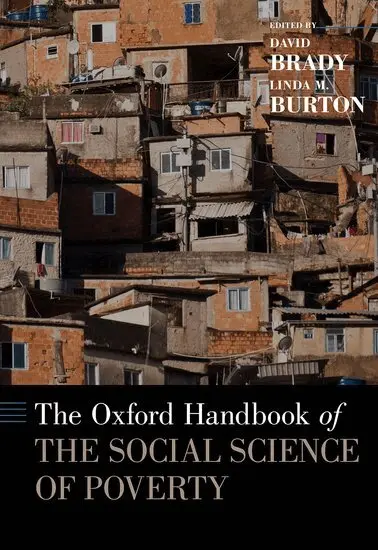
    The Oxford Handbook of the Social Science of Poverty

    AvDavid Brady,Linda M. Burton

    Inbunden, Engelska, 2016

    Del i serien Oxford Handbooks

    3 565 kr

    Beställningsvara. Skickas inom 5-8 vardagar. Fri frakt över 249 kr.

    Beskrivning

    Despite remarkable economic advances in many societies during the latter half of the twentieth century, poverty remains a global issue of enduring concern. Poverty is present in some form in every society in the world, and has serious implications for everything from health and well-being to identity and behavior. Nevertheless, the study of poverty has remained disconnected across disciplines. The Oxford Handbook of the Social Science of Poverty builds a common scholarly ground in the study of poverty by bringing together an international, inter-disciplinary group of scholars to provide their perspectives on the issue. Contributors engage in discussions about the leading theories and conceptual debates regarding poverty, the most salient topics in poverty research, and the far-reaching consequences of poverty on the individual and societal level. The volume incorporates many methodological perspectives, including survey research, ethnography, and mixed methods approaches, while the chapters extend beyond the United States to provide a truly global portrait of poverty. A thorough examination of contemporary poverty, this Handbook is a valuable tool for non-profit practitioners, policy makers, social workers, and students and scholars in the fields of public policy, sociology, political science, international development, anthropology, and economics.

    Produktinformation

    • Utgivningsdatum:2016-05-19
    • Mått:178 x 251 x 58 mm
    • Vikt:1 678 g
    • Format:Inbunden
    • Språk:Engelska
    • Serie:Oxford Handbooks
    • Antal sidor:936
    • Förlag:OUP USA
    • ISBN:9780199914050

    Utforska kategorier

    • Sociologi inom Samhälle och politik
    • Kulturvetenskap inom Samhälle och politik

    Mer om författaren

    David Brady is Professor in the School of Public Policy, and Director of the Blum Initiative on Global and Regional Poverty at the University of California, Riverside. He is also affiliated with the WZB Berlin Social Science Center, where he was Director of the Inequality and Social Policy department from 2012-2015. He is the author of Rich Democracies, Poor People: How Politics Explain Poverty.Linda M. Burton is Dean of Social Sciences and James B. Duke Professor of Sociology at Duke University.

    Recensioner i media

    "This book is a useful compendium of writings regarding the nature of poverty. Each of the sections does an effective job of discussing the traditional dimensions of poverty, such as measurement, people versus place, economics versus personal decisions, and policy responses. Readers will find the work useful for understanding the nature of this social problem." -- CHOICE"This book is a useful compendium of writings regarding the nature of poverty. Each of the sections does an effective job of discussing the traditional dimensions of poverty, such as measurement, people versus place, economics versus personal decisions, and policy responses. The hidden gem in this work, however, is the last chapter, which deals with a new paradigm for addressing poverty. Readers will find the work heavily academic but useful for understandingthe nature of this social problem." --L. T. Grover, Southern University and A&M College

    Innehållsförteckning

    • Foreword: Those Left Behind ; Carol Stack ; Chapter 1: Introduction ; David Brady and Linda M. Burton ; SECTION I: CONCEPTS, THEORIES, AND ORIENTING QUESTIONS ; Chapter 2: Poverty Measurement ; Tim Smeeding ; Chapter 3: Structural Violence, Poverty and Social Suffering ; Barbara Rylko-Bauer and Paul Farmer ; Chapter 4: Capability Deprivation ; Rod Hick and Tania Burchardt ; Chapter 5: Ideologies and Beliefs About Poverty ; Matt Hunt and Heather Bullock ; Chapter 6: How Politics and Institutions Shape Poverty and Inequality ; David Brady, Agnes Blome and Hanna Kleider ; Chapter 7: Linking Poverty and Children's Development: Concepts, Models and Debates ; Vonnie McLoyd, Rosanne M. Jocson, and Abigail Williams ; SECTION II: CLASSIC DEBATES ; Chapter 8: Poverty Knowledge and the History of Poverty Research ; Alice O'Connor ; Chapter 9: The Discourse of Deservingness: Morality and the Dilemmas of Poverty Relief in Debate and Practice ; Celeste Watkins-Hayes and Elyse Kovalsky ; Chapter 10 Gender and Poverty ; Janet Gornick and Natascia Boeri ; Chapter 11 Life, Death, and Resurrections: The Culture and Poverty Perspective ; Jessi Streib, Juhi Verma, Whitney E. Welsh, and Linda M. Burton ; Chapter 12 The Historical Origins of Poverty in Developing Countries ; Sambit Bhattacharyya ; Chapter 13 The Dynamics of Poverty ; Anirudh Krishna, Public Policy, Duke University ; SECTION III: PLACE AND CONTEXT ; Chapter 14: People and Places Left Behind: Rural Poverty in the New Century ; Daniel T. Lichter and Kai A. Schafft ; Chapter 15: Poor Neighborhoods in the Metropolis ; Mary Pattillo and John Robinson ; Chapter 16: Segregation and the Perpetuation of Disadvantage ; Doug Massey ; Chapter 17: Urban Poverty, Race and Space ; William Julius Wilson ; SECTION IV: CAUSES AND THE REPRODUCTION OF POVERTY ; Chapter 18: Single and Cohabiting Parents and Poverty ; Christina Gibson-Davis ; Chapter 19: Job-Finding Among the Poor: Do Social Ties Matter? ; Sandra Smith ; Chapter 20: Education ; Emily Hannum and Yu Xie ; Chapter 21: Employment and the Working Poor ; Jerome Gautie and Sophie Ponthieux ; Chapter 22: Great Escapes and Great Divergences: Growth, Poverty and Income Inequality on a Global Scale ; Robert Wade ; Chapter 23: Intergenerational Mobility ; Liana Fox, Florencia Torche, and Jane Waldfogel ; Chapter 24: Economic Performance, Poverty and Inequality in Rich Countries ; David Brady and Markus Jantti ; SECTION V: CONSEQUENCES ; Chapter 25: Material Deprivation and Consumption ; Basak Kus, Brian Nolan, and Christopher T. Whelan ; Chapter 26: Hunger and Food Insecurity ; Christopher B. Barrett and Erin C. Lentz ; Chapter 27: Poverty and Crime ; Patrick Sharkey, Max Besbris, and Michael Friedson ; Chapter 28: Poverty and Informal Economies ; Francois Bonnet and Sudhir Venkatesh ; Chapter 29: Social Class, Poverty and the Unequal Burden of Illness and Health ; Ronald Angel ; SECTION VI: POLICIES, SOLUTIONS, AND RESPONSES ; Chapter 30: Aid and Global Poverty ; Simon Feeny and Mark McGillivray ; Chapter 31: The Welfare States and Poverty ; Cheol-Sung Lee and In-Hoe Koo ; Chapter 32: Social Policy, Transfers, Programs and Assistance ; Laura Lein, Sandra K. Danziger, H. Luke Shaefer, and Amanda Tillotson ; Chapter 33: Poor People's Politics ; Frances Fox Piven and Lorraine C. Minnite ; Chapter 34: Why and When Do Peasants Rebel? ; Guillermo Trejo ; Chapter 35: Unions and Poverty ; Jake Rosenfeld and Jennifer Laird ; Chapter 36: Housing Programs ; Peter Kemp ; Chapter 37: Microfinance and Financial Inclusion ; Philip Mader ; Conclusion: Toward a New Paradigm for Understanding Poverty ; Mark Rank