• Fri frakt över 249 kr
  • •
  • Snabba leveranser
  • •
  • Billiga böcker
Kundservice

Du är på sajten för privatpersoner.

Företag, bibliotek eller offentlig verksamhet?

Du handlar på classic.bokus.com, där alla dina funktioner finns intakta.
Till classic.bokus.com
Bokus logotyp. Gå till startsidan.
  • Erbjudanden
  • Nyheter
  • Student
  • Topplistor
  • Barn & ungdom
  • Bokus Play
  • E-böcker
  • Pocketböcker
  • Spel & pussel

10% rabatt på allt med kod: NYSTART10 →

Sidfot

Mina sidor

    Hjälp

    • Kundservice
    • Vanliga frågor och svar
    • Frakt och leverans
    • Retur vid ångerrätt
    • Reklamera vara
    • Betalning
    • Köpvillkor
    • Allmänna villkor
    • Information om webbplatsens tillgänglighet

    Om Bokus

    • Om oss
    • Pressrum
    • För studenter
    • För företag
    • För bibliotek och offentlig verksamhet
    • För leverantörer
    • Hållbarhet

    Populärt

    • Aktuella erbjudanden
    • Presentkort
    • Studentlitteratur
    • Nya böcker
    • Topplistor
    • Signerade böcker
    • Engelska böcker

    Inspiration

    • Boktips
    • BookTok
    • Populära bokserier
    • Barnbokskaraktärer
    • Populära författare
    Logotyp för Bokus
    Följ oss på Facebook (extern länk)Följ oss på Instagram (extern länk)Följ oss på YouTube (extern länk)Följ oss på TikTok (extern länk)
    bokus @ CookiesAnpassa cookiesIntegritetspolicyKöpvillkor
    Till Citymail hemsida (extern länk)Till Budbee hemsida (extern länk)Till Postnord hemsida (extern länk)Till Schenker hemsida (extern länk)Till Early Bird hemsida (extern länk)Till Walleys hemsida (extern länk)
    1. Naturvetenskap och teknik
    2. Matematik och naturvetenskap
    3. Astronomi

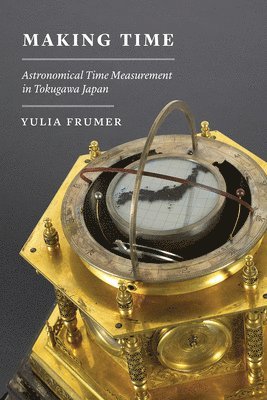
    Making Time

    Astronomical Time Measurement in Tokugawa Japan

    AvYulia Frumer

    Inbunden, Engelska, 2018

    Del i serien Studies of the Weatherhead East Asian Institute

    411 kr

    Beställningsvara. Skickas inom 5-8 vardagar. Fri frakt över 249 kr.

    Beskrivning

    What is time made of? We might balk at such a question, and reply that time is not made of anything--it is an abstract and universal phenomenon. In Making Time, Yulia Frumer upends this assumption, using changes in the conceptualization of time in Japan to show that humans perceive time as constructed and concrete. In the mid-sixteenth century, when the first mechanical clocks arrived in Japan from Europe, the Japanese found them interesting but useless, because they failed to display time in units that changed their length with the seasons, as was customary in Japan at the time. In 1873, however, the Japanese government adopted the Western equal-hour system as well as Western clocks. Given that Japan carried out this reform during a period of rapid industrial development, it would be easy to assume that time consciousness is inherent to the equal-hour system and a modern lifestyle, but Making Time suggests that punctuality and time-consciousness are equally possible in a society regulated by a variable-hour system, arguing that this reform occurred because the equal-hour system better reflected a new conception of time--as abstract and universal--which had been developed in Japan by a narrow circle of astronomers, who began seeing time differently as a result of their measurement and calculation practices. Over the course of a few short decades this new way of conceptualizing time spread, gradually becoming the only recognized way of treating time.

    Produktinformation

    • Utgivningsdatum:2018-01-25
    • Mått:229 x 152 x 22 mm
    • Vikt:534 g
    • Format:Inbunden
    • Språk:Engelska
    • Serie:Studies of the Weatherhead East Asian Institute
    • Antal sidor:272
    • Förlag:The University of Chicago Press
    • ISBN:9780226516448

    Utforska kategorier

    • Astronomi inom Naturvetenskap och teknik
    • Teknik: allmänt inom Naturvetenskap och teknik
    • Asiens historia inom Historia och arkeologi

    Mer om författaren

    Yulia Frumer is the Bo Jung and Soon Young Kim Assistant Professor of East Asian Science and Technology in the Department of History of Science and Technology, Johns Hopkins University.