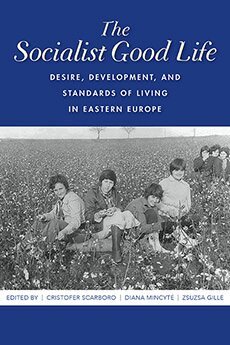
Socialist Good Life
Desire, Development, and Standards of Living in Eastern Europe
352 kr
Beställningsvara. Skickas inom 5-8 vardagar. Fri frakt över 249 kr.
Du är på sajten för privatpersoner.
352 kr
Beställningsvara. Skickas inom 5-8 vardagar. Fri frakt över 249 kr.
Cristofer Scarboro is Professor of History at King's College in Wilkes-Barre, Pennsylvania. He is author of The Late Socialist Good Life in Bulgaria: Living and Meaning in a Permanent Present Tense.Diana Mincytė is Associate Professor of Sociology at the City University of New York–New York City College of Technology.Zsuzsa Gille is Professor of Sociology and Director of Global Studies at the University of Illinois at Urbana-Champaign. She is author of Paprika, Foie Gras, and Red Mud: The Politics of Materiality in the European Union and From the Cult of Waste to the Trash Heap of History: The Politics of Waste in Socialist and Postsocialist Hungary, which received honorable mention for the ASEEES Davis Center Book Prize; editor (with Maria Todorova) of Post-Communist Nostalgia; and co-author of Global Ethnography: Forces, Connections and Imaginations in a Postmodern World.
"The Socialist Good Life is a first-class, rigorously researched, richly documented, and thought-provoking book, which will make a significant contribution to scholarship in its field."—Graham H. Roberts, author of Material Culture in Russia and the USSR: Things Values, Identities"The time is ripe for this volume of essays, given climate change, escalating socio-economic inequalities, and now the radical effects of the novel coronavirus. These studies offer a nuanced picture of the modern "good life" that emerged in state-socialist Eastern Europe, with new perspectives on its successes and failures. There are surprises here. Who would have predicted the convergence among economists in east and west on supply-side theory by the 1970s? There are also provocations. Practices we might consider desirable today arose, ironically, from what were understood at the time as the failures of state-socialist consumer regimes: reuse and recycling, D.I.Y. skills for adapting, repairing and caring for the mass-produced goods available. In the years ahead, we may have much to learn from this exploration of the state-socialist experience."—Krisztina Fehervary, author of Politics in Color and Concrete: Socialist Materialities and the Middle Class in Hungary"This trailblazing book examines the achievements and real pleasures of the socialist good life. Mobilizing their deep knowledge of state socialist Eastern Europe, the authors upend our assumptions and offer us new coordinates for understanding consumption, politics, and the good life. They question how socialist consumption has been measured and ask whether it had any relation to a 'social contract,' whether it resulted in consumerist apathy, and whether it may have, in fact, escaped alienation and offered a missed post-materialist future."—Johanna Bockman, author of Markets in the Name of Socialism"This is a thought-provoking and enlightening, if in places frustrating, collection of interdisciplinary essays that will be of benefit to social scientists interested in consumer lifeworlds under communist rule."—Gediminas Lankauskas, University of Regina, The Russian Review"The volume is a useful study of Eastern European consumption during socialism and an invaluable tool with which to think about writing the histories of consumerism and state socialism in general. The provocative conclusions regarding socialism's failures as reverse echoes of our world today, with its own tortured relation to consumption, should, one hopes, resonate beyond the confines of the fields of Eastern European and socialist history."—Victor Petrov - University of Tennessee, H-Net (Socialisms)
Michael Burawoy, Joseph A. Blum, Sheba George, Zsuzsa Gille, Millie Thayer, Teresa Gowan, Lynne Haney, Maren Klawiter, Steve Lopez, Sean O'Riain
Häftad, 2000
275 kr
Du är på sajten för privatpersoner.
352 kr
Beställningsvara. Skickas inom 5-8 vardagar. Fri frakt över 249 kr.
Cristofer Scarboro is Professor of History at King's College in Wilkes-Barre, Pennsylvania. He is author of The Late Socialist Good Life in Bulgaria: Living and Meaning in a Permanent Present Tense.Diana Mincytė is Associate Professor of Sociology at the City University of New York–New York City College of Technology.Zsuzsa Gille is Professor of Sociology and Director of Global Studies at the University of Illinois at Urbana-Champaign. She is author of Paprika, Foie Gras, and Red Mud: The Politics of Materiality in the European Union and From the Cult of Waste to the Trash Heap of History: The Politics of Waste in Socialist and Postsocialist Hungary, which received honorable mention for the ASEEES Davis Center Book Prize; editor (with Maria Todorova) of Post-Communist Nostalgia; and co-author of Global Ethnography: Forces, Connections and Imaginations in a Postmodern World.
"The Socialist Good Life is a first-class, rigorously researched, richly documented, and thought-provoking book, which will make a significant contribution to scholarship in its field."—Graham H. Roberts, author of Material Culture in Russia and the USSR: Things Values, Identities"The time is ripe for this volume of essays, given climate change, escalating socio-economic inequalities, and now the radical effects of the novel coronavirus. These studies offer a nuanced picture of the modern "good life" that emerged in state-socialist Eastern Europe, with new perspectives on its successes and failures. There are surprises here. Who would have predicted the convergence among economists in east and west on supply-side theory by the 1970s? There are also provocations. Practices we might consider desirable today arose, ironically, from what were understood at the time as the failures of state-socialist consumer regimes: reuse and recycling, D.I.Y. skills for adapting, repairing and caring for the mass-produced goods available. In the years ahead, we may have much to learn from this exploration of the state-socialist experience."—Krisztina Fehervary, author of Politics in Color and Concrete: Socialist Materialities and the Middle Class in Hungary"This trailblazing book examines the achievements and real pleasures of the socialist good life. Mobilizing their deep knowledge of state socialist Eastern Europe, the authors upend our assumptions and offer us new coordinates for understanding consumption, politics, and the good life. They question how socialist consumption has been measured and ask whether it had any relation to a 'social contract,' whether it resulted in consumerist apathy, and whether it may have, in fact, escaped alienation and offered a missed post-materialist future."—Johanna Bockman, author of Markets in the Name of Socialism"This is a thought-provoking and enlightening, if in places frustrating, collection of interdisciplinary essays that will be of benefit to social scientists interested in consumer lifeworlds under communist rule."—Gediminas Lankauskas, University of Regina, The Russian Review"The volume is a useful study of Eastern European consumption during socialism and an invaluable tool with which to think about writing the histories of consumerism and state socialism in general. The provocative conclusions regarding socialism's failures as reverse echoes of our world today, with its own tortured relation to consumption, should, one hopes, resonate beyond the confines of the fields of Eastern European and socialist history."—Victor Petrov - University of Tennessee, H-Net (Socialisms)
Michael Burawoy, Joseph A. Blum, Sheba George, Zsuzsa Gille, Millie Thayer, Teresa Gowan, Lynne Haney, Maren Klawiter, Steve Lopez, Sean O'Riain
Häftad, 2000
275 kr