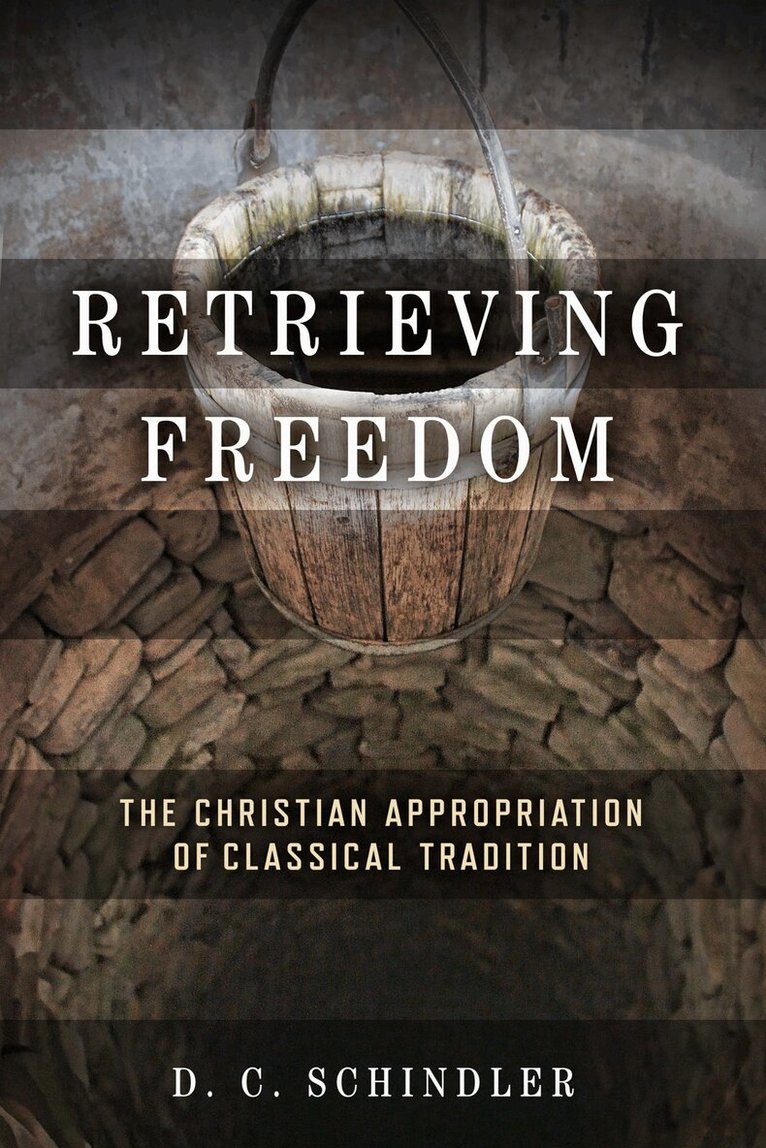
Inbunden, Engelska, 2022
Retrieving Freedom
The Christian Appropriation of Classical Tradition
Del i serien Catholic Ideas for a Secular World
2265 kr
Beställningsvara. Skickas inom 3-6 vardagar. Fri frakt över 249 kr.
Fler format och utgåvor
Beskrivning
Produktinformation
- Utgivningsdatum: 2022-10-15
- Mått: 152 x 229 x 35 mm
- Vikt: 972 g
- Format: Inbunden
- Språk: Engelska
- Serie: Catholic Ideas for a Secular World
- Antal sidor: 550
- Förlag: University of Notre Dame Press
- ISBN: 9780268203702
- Utmärkelser: Winner of Catholic Media Association Book Award: Faithful Citizenship/Religious Freedom, Third Place 2023 (United States)
Utforska kategorier
Mer om författaren
D. C. Schindler is professor of metaphysics and anthropology at the John Paul II Institute, Washington, DC. He is the author of more than a dozen books, including Freedom from Reality: The Diabolical Character of Modern Liberty.
Recensioner i media
"This book is part of an ambitious project, and specialists may quibble with Schindler—for instance, with his unitarian rather than developmental approach to Augustine and with his admitted advances beyond the explicit words of Thomas Aquinas—but Schindler's lucid and often elegant discussions cannot fail to illumine. ...Recommended." —Choice"Through a close analysis of ten key figures beginning with (the not-quite-Christian) Plotinus and ending with John Duns Scotus, Schindler walks us through a historical tour de force of major—and not so major—Christian thinkers grinding out an ever clearer understanding of freedom through a process of clashing ideas that result in syntheses." —The Heythrop Journal"Lucid, capacious, and forceful as all of Schindler's work, Retrieving Freedom reexamines the problem of human freedom within a philosophical and theological tradition spanning from Plotinus to Duns Scotus. The book's provocative decision to retrace the question of freedom within Christianity's inherently normative and metaphysical framework helpfully counteracts modernity's habit of conceiving freedom through its ostensible contrary: determinism. Instead, Schindler's brilliantly executed, contrastive approach allows us to see that the true source and origin of human freedom is found in Christianity's Triune God as revealed in the twin orders of nature and history." —Thomas Pfau, author of Incomprehensible Certainty"Retrieving Freedom is an impressive volume that locates the nature of free will in the very depth of both history and metaphysics. This is a much-needed contribution that will situate the questions of free will in the only horizon that can make them intelligible: a horizon in which we can get into view the very meaning and purpose of our freedom." —Anselm Ramelow, OP, editor of God: Reason and Reality"D.C. Schindler's work in Retrieving Freedom can show those who wish to truly restore Western civilization the true significance of freedom. Without a framework such as his, the idea of freedom as the chief political principle of a regime is surely doomed to become little more than a libertarian cliché." —The University Bookman"Schindler has provided a tremendous scholarly labor in uncovering and explaining the Christian roots to the concept of Western freedom. His work deserves a wide reading among philosophers, political theorists, and historians of freedom." —Catholic Social Science Review"This is a great work in the Augustinian tradition. Schindler rightly emphasizes that freedom should not be understood in the context of sin but as a gift of nature, with a divine origin and orientation. He repeatedly lifts the reader to higher levels, and his breadth of vision is also welcome; he writes about the complete development of a major idea and its relation to the most fundamental realities and eschews mind-numbing minutiae." —The Review of Metaphysics"Tracing the genealogy of freedom in the West, Schindler exposes the intellectual roots of fanatical modern liberty and recalls a vision of freedom in which what is given can be received with gratitude, as the context within which both our selves and our world are, by our free choice, brought to fullness of being." —Christian Research Institute"Above all, Schindler wishes to recover a 'metaphysics of freedom' that does not fall prey to the priciples underlying mere moralities of obligation, on the one hand, and philosophies of radical automony on the other. He expresses a rightful concern that when construed chiefly as a self-sufficient power, freedom becomes disengaged both from the order of nature and from its capacity to receive the word addressed in love by God." —Conversatio"The depth of Schindler's engagement with the primary authors and the secondary scholarship on each is really quite extraordinary. Moreover, his own creative interpretations struck this reviewer as both faithful to the sources expounded and genuinely insightful..." —Theological Studies
Betyg & recensioner
0 recensioner
Inga recensioner tillgängliga.