• Fri frakt över 249 kr
  • •
  • Snabba leveranser
  • •
  • Billiga böcker
Kundservice

Du är på sajten för privatpersoner.

Företag, bibliotek eller offentlig verksamhet?

Du handlar på classic.bokus.com, där alla dina funktioner finns intakta.
Till classic.bokus.com
Bokus logotyp. Gå till startsidan.
  • Erbjudanden
  • Nyheter
  • Student
  • Topplistor
  • Barn & ungdom
  • Bokus Play
  • E-böcker
  • Pocketböcker
  • Spel & pussel

10% rabatt på allt med kod: NYSTART10 →

Sidfot

Mina sidor

    Hjälp

    • Kundservice
    • Vanliga frågor och svar
    • Frakt och leverans
    • Retur vid ångerrätt
    • Reklamera vara
    • Betalning
    • Köpvillkor
    • Allmänna villkor
    • Information om webbplatsens tillgänglighet

    Om Bokus

    • Om oss
    • Pressrum
    • För studenter
    • För företag
    • För bibliotek och offentlig verksamhet
    • För leverantörer
    • Hållbarhet

    Populärt

    • Aktuella erbjudanden
    • Presentkort
    • Studentlitteratur
    • Nya böcker
    • Topplistor
    • Signerade böcker
    • Engelska böcker

    Inspiration

    • Boktips
    • BookTok
    • Populära bokserier
    • Barnbokskaraktärer
    • Populära författare
    Logotyp för Bokus
    Följ oss på Facebook (extern länk)Följ oss på Instagram (extern länk)Följ oss på YouTube (extern länk)Följ oss på TikTok (extern länk)
    bokus @ CookiesAnpassa cookiesIntegritetspolicyKöpvillkor
    Till Citymail hemsida (extern länk)Till Budbee hemsida (extern länk)Till Postnord hemsida (extern länk)Till Schenker hemsida (extern länk)Till Early Bird hemsida (extern länk)Till Walleys hemsida (extern länk)
    1. Psykologi och pedagogik
    2. Pedagogik
    3. Undervisning i specifika ämnen

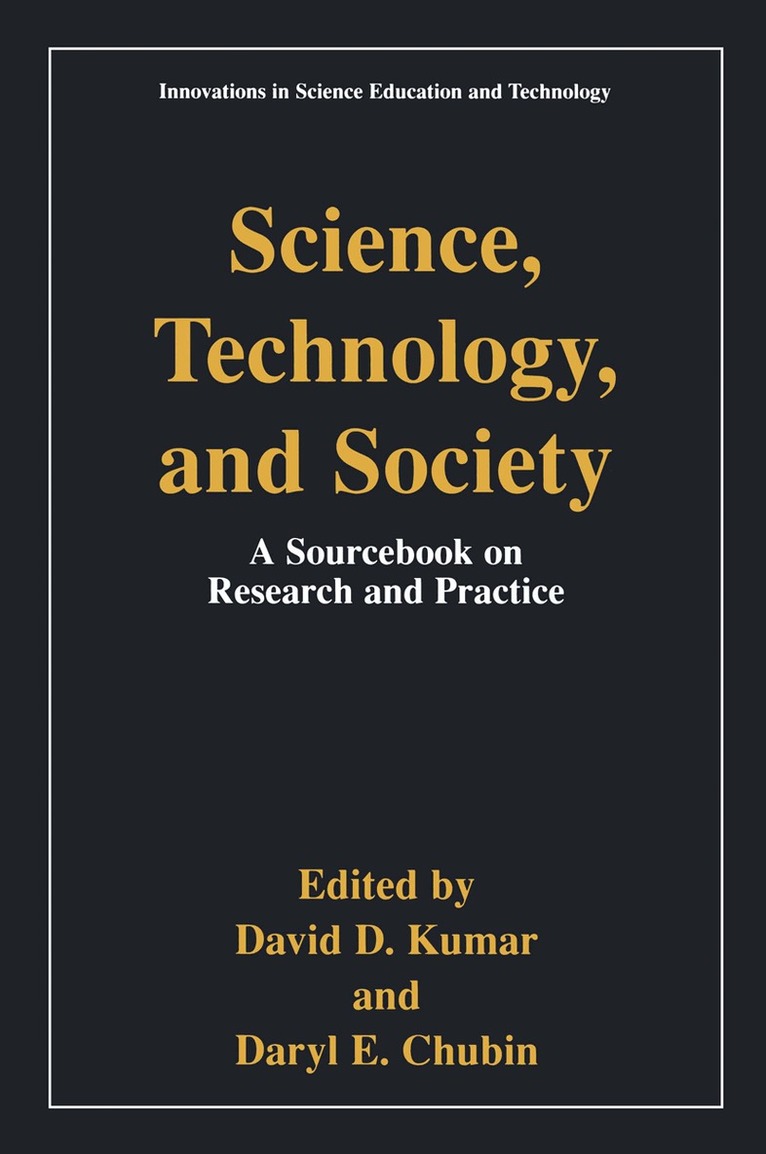
    Science, Technology, and Society

    Education A Sourcebook on Research and Practice

    AvDavid D. Kumar,Daryl E. Chubin

    Häftad, Engelska, 2000

    Del 6 i serien Innovations in Science Education and Technology

    978 kr

    Beställningsvara. Skickas inom 10-15 vardagar. Fri frakt över 249 kr.

    Beskrivning

    David D. Kumar and Daryl E. Chubin We live in an information age. Technology abounds: information tech­ nology, communication technology, learning technology. As a once popular song went, "Something's happening here, but it's just not exactly clear." The world appears to be a smaller, less remote place. We live in it, but we are not necessarily closely tied to it. We lack a satisfactory understanding of it. So we are left with a paradox: In an information age, information alone will neither inform nor improve us as citizens nor our democracy, society, or in­ stitutions. No, improvement will take some effort. It is a heavy burden to be reflective, indeed analytical, and disciplined but only constructively constrained by different perspectives. The science-based technology that makes for the complexity, contro­ versy, and uncertainty of life sows the seeds of understanding in Science, Technology, and Society. STS, as it is known, encompasses a hybrid area of scholarship now nearly three decades old. As D. R. Sarewitz,a former geologist now congressional staffer and an author, put it After all, the important and often controversial policy dilemmas posed by issues such as nuclear energy, toxic waste disposal, global climate change, or biotech­ nology cannot be resolved by authoritative scientific knowledge; instead, they must involve a balancing of technical considerations with other criteria that are explicitly nonscientific: ethics, esthetics, equity, ideology. Trade-offs must be made in light of inevitable uncertainties (Sarewitz, 1996, p. 182).

    Produktinformation

    • Utgivningsdatum:2000-04-30
    • Mått:152 x 229 x 18 mm
    • Vikt:471 g
    • Format:Häftad
    • Språk:Engelska
    • Serie:Innovations in Science Education and Technology
    • Antal sidor:308
    • Förlag:Springer Science+Business Media
    • ISBN:9780306461736

    Utforska kategorier

    • Undervisning i specifika ämnen inom Psykologi och pedagogik
    • Naturvetenskap:allmänt inom Naturvetenskap och teknik

    Innehållsförteckning

    • Why STS?.- References.- 1. Real Science Education: Replacing “PCB” with S(cience) through-STS throughout All Levels of K$#x2014;12: “Materials” as One Approach.- The Old and New Paradigms for Learning “Science”.- The Real Science Approach Based on the S—STS Paradigm.- References.- 2. The Development of Civic Scientific Literacy in the United States.- The Conceptualization and Measurement of Civic Scientific Literacy.- The Measurement of Civic Scientific Literacy.- The Development of Civic Scientific Literacy.- Conclusion.- References.- 3. STS Science in Canada: From Policy to Student Evaluation.- Science Education in Canada.- Curriculum Policy and Deliberation.- Classroom Materials and Research and Development.- Teacher Understanding and Implementation.- Student Learning and Instruction—Assessment.- Summary and Implications.- References.- 4. Trade-offs, Risks, and Regulations in Science and Technology: Implications for STS Education.- STS and the Endangered Species Act.- STS and Corporate Average Fuel Economy (CAFE) Standards.- STS and Airbags.- Implications for STS Education.- References.- 5. Thoughts about the Evaluation of STS: More Questions than Answers.- Important Issues in STS that Affect Evaluation.- Suggestions for Evaluation.- Summary.- References.- 6. Science, Technology, Society, and the Environment: Scientific Literacy for the Future.- Topics Reviewed by the Independent Commission and Findings.- Recommendations.- Conclusion.- References.- 7. Marginalization of Technology within the STS Movement in American K—12 Education.- A Matter of Definition.- Technological Literacy.- The K—12 STS Movement in America.- STS and K—12 Science Education.- STS in Technological Education.- The Perennial Challenges of Educational Reform.- Conclusion.-Acknowledgments.- References.- 8. Student Understanding of Global Warming: Implications for STS Education beyond 2000.- Scientific Literacy as a Foundation for STS Education.- The STS Leadership Institute.- The Science of Global Warming.- Discussion.- Implications for the New Millennium.- References.- 9. STS Education for Knowledge Professionals.- The Emergence of Knowledge Professionals.- Who are Knowledge Professionals?.- At Work with Knowledge Professionals.- Knowledge Professionals and STS.- STS Graduate Education for Knowledge.- Professionals.- From Glimpsing One Tree to Surveying a Forest.- Some Conclusions.- References.- 10. Reculturing Science: Politics, Policy, and Promises to Keep.- Making Changes.- Fallacy of the Market.- Calling versus Recruiting.- Images of Careers.- The New Scientist.- Institutions that Matter.- Missions and Dilemmas.- Professionalized Scrutiny of Research and Development.- Enterprise as a System.- Prospects for a New Compact.- References.- 11. Trends and Opportunities in Science and Technology Studies: A View from the National Science Foundation.- Orientation.- The National Science Foundation.- Origins of STS.- The Organizational Culture of the National Science Foundation.- How STS Decides What to Fund.- What Lies Ahead?.- Conclusion.- References.