• Fri frakt över 249 kr
  • •
  • Snabba leveranser
  • •
  • Billiga böcker
Kundservice

Du är på sajten för privatpersoner.

Företag, bibliotek eller offentlig verksamhet?

Du handlar på classic.bokus.com, där alla dina funktioner finns intakta.
Till classic.bokus.com
Bokus logotyp. Gå till startsidan.
  • Erbjudanden
  • Nyheter
  • Student
  • Topplistor
  • Barn & ungdom
  • Bokus Play
  • E-böcker
  • Pocketböcker
  • Spel & pussel

10% rabatt på allt med kod: NYSTART10 →

Sidfot

Mina sidor

    Hjälp

    • Kundservice
    • Vanliga frågor och svar
    • Frakt och leverans
    • Retur vid ångerrätt
    • Reklamera vara
    • Betalning
    • Köpvillkor
    • Allmänna villkor
    • Information om webbplatsens tillgänglighet

    Om Bokus

    • Om oss
    • Pressrum
    • För studenter
    • För företag
    • För bibliotek och offentlig verksamhet
    • För leverantörer
    • Hållbarhet

    Populärt

    • Aktuella erbjudanden
    • Presentkort
    • Studentlitteratur
    • Nya böcker
    • Topplistor
    • Signerade böcker
    • Engelska böcker

    Inspiration

    • Boktips
    • BookTok
    • Populära bokserier
    • Barnbokskaraktärer
    • Populära författare
    Logotyp för Bokus
    Följ oss på Facebook (extern länk)Följ oss på Instagram (extern länk)Följ oss på YouTube (extern länk)Följ oss på TikTok (extern länk)
    bokus @ CookiesAnpassa cookiesIntegritetspolicyKöpvillkor
    Till Citymail hemsida (extern länk)Till Budbee hemsida (extern länk)Till Postnord hemsida (extern länk)Till Schenker hemsida (extern länk)Till Early Bird hemsida (extern länk)Till Walleys hemsida (extern länk)
    1. Naturvetenskap och teknik
    2. Matematik och naturvetenskap
    3. Biologi
    4. Biovetenskap

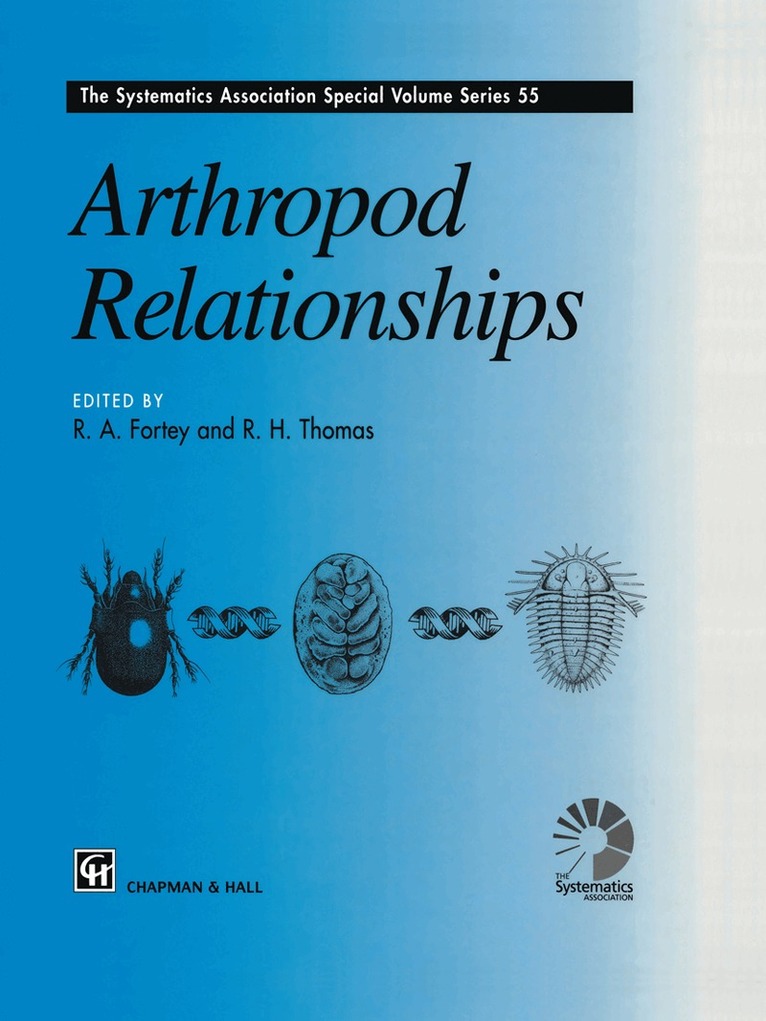
    Arthropod Relationships

    AvRichard A. Fortey,Richard H. Thomas

    Inbunden, Engelska, 1997

    Del i serien Systematics Association Special Volume Series

    2 164 kr

    Beställningsvara. Skickas inom 10-15 vardagar. Fri frakt över 249 kr.

    Beskrivning

    The arthropods contain more species than any other animal group, but the evolutionary pathways which led to their current diversity are still an issue of controversy. Arthropod Relationships provides an overview of our current understanding, responding to the new data arising from sequencing DNA, the discovery of new Cambrian fossils as direct evidence of early arthropod history, and developmental genetics. These new areas of research have stimulated a reconsideration of classical morphology and embryology. Arthropod Relationships is the first synthesis of the current debate to emerge: not since the volume edited by Gupta was published in 1979 has the arthropod phylogeny debate been, considered in this depth and breadth. Leaders in the various branches of arthropod biology have contributed to this volume. Chapters focus progressively from the general issues to the specific problems involving particular groups, and thence to a consideration of embryology and genetics. This wide range of disciplines is drawn on to approach an understanding of arthropod relationships, and to provide the most timely account of arthropod phylogeny. This book should be read by evolutionary biologists, palaeontologists, developmental geneticists and invertebrate zoologists. It will have a special interest for post-graduate students working in these fields.

    Produktinformation

    • Utgivningsdatum:1997-12-31
    • Mått:210 x 279 x 27 mm
    • Vikt:1 230 g
    • Format:Inbunden
    • Språk:Engelska
    • Serie:Systematics Association Special Volume Series
    • Antal sidor:383
    • Upplaga:1998
    • Förlag:Chapman and Hall
    • ISBN:9780412754203

    Utforska kategorier

    • Biovetenskap inom Naturvetenskap och teknik
    • Zoologi inom Naturvetenskap och teknik
    • Djurböcker inom Djur och Natur

    Recensioner i media

    '... it may mark a historical transition. For practitioners in the field this will be an important book and should find its way onto their bookshelves ...' Nature, 397 (1999) '... their splendid Arthropod Relationships ... It is a milestone that will certainly be appreciated by students as well as specialists in the field. The book represents a clear and up-to-date review of arthropod phylogeny and handless some general phylogenetic aspects.' TREE - Trends in Ecology & Evolution, 13:12 (1998)

    Innehållsförteckning

    • 1 Bodyplans, phyla and arthropods.- 2 The phylogenetic position of the Arthropoda.- 3 A defence of arthropod polyphyly.- 4 Hox genes and annelid-arthropod relationships.- 5 Arthropod and annelid relationships re-examined.- 6 Evolutionary correlates of arthropod tagmosis: scrambled legs.- 7 Theories, patterns, and reality: game plan for arthropod phylogeny.- 8 Sampling, groundplans, total evidence and the systematics of arthropods.- 9 Arthropod phylogeny: taxonomic congruence, total evidence and conditional combination approaches to morphological and molecular data sets.- 10 The place of tardigrades in arthropod evolution.- 11 Stem group arthropods from the Lower Cambrian Sirius Passet fauna of North Greenland.- 12 Cambrian ‘Orsten’-type arthropods and the phylogeny of Crustacea.- 13 Comparative limb morphology in major crustacean groups: the coxa-basis joint in postmandibular limbs.- 14 Crustacean phylogeny inferred from 18S rDNA.- 15 A phylogeny of recent and fossil Crustacea derived from morphological characters.- 16 The fossil record and evolution of the Myriapoda.- 17 The early history and phylogeny of the chelicerates.- 18 Problem of the basal dichotomy of the winged insects.- 19 Arthropod phylogeny and ‘basal’ morphological structures.- 20 Advances and problems in insect phylogeny.- 21 The groundplan and basal diversification of the hexapods.- 22 Phylogenetic relationships between higher taxa of tracheate arthropods.- 23 Myriapod-insect relationships as opposed to an insect-crustacean sister group relationship.- 24 Cleavage, germ band formation and head segmentation: the ground pattern of the Euarthropoda.- 25 Homology and parallelism in arthropod sensory processing.- 26 The organization and development of the arthropod ventral nerve cord: insights intoarthropod relationships.