• Fri frakt över 249 kr
  • •
  • Snabba leveranser
  • •
  • Billiga böcker
Kundservice

Du är på sajten för privatpersoner.

Företag, bibliotek eller offentlig verksamhet?

Du handlar på classic.bokus.com, där alla dina funktioner finns intakta.
Till classic.bokus.com
Bokus logotyp. Gå till startsidan.
  • Erbjudanden
  • Nyheter
  • Student
  • Topplistor
  • Barn & ungdom
  • Bokus Play
  • E-böcker
  • Pocketböcker
  • Spel & pussel

10% rabatt på allt med kod NYSTART10 →

Sidfot

Mina sidor

    Hjälp

    • Kundservice
    • Vanliga frågor och svar
    • Frakt och leverans
    • Retur vid ångerrätt
    • Reklamera vara
    • Betalning
    • Köpvillkor
    • Allmänna villkor
    • Information om webbplatsens tillgänglighet

    Om Bokus

    • Om oss
    • Pressrum
    • För studenter
    • För företag
    • För bibliotek och offentlig verksamhet
    • För leverantörer
    • Hållbarhet

    Populärt

    • Aktuella erbjudanden
    • Presentkort
    • Studentlitteratur
    • Nya böcker
    • Topplistor
    • Signerade böcker
    • Engelska böcker

    Inspiration

    • Boktips
    • BookTok
    • Populära bokserier
    • Barnbokskaraktärer
    • Populära författare
    Logotyp för Bokus
    Följ oss på Facebook (extern länk)Följ oss på Instagram (extern länk)Följ oss på YouTube (extern länk)Följ oss på TikTok (extern länk)
    bokus @ CookiesAnpassa cookiesIntegritetspolicyKöpvillkor
    Till Citymail hemsida (extern länk)Till Budbee hemsida (extern länk)Till Postnord hemsida (extern länk)Till Schenker hemsida (extern länk)Till Early Bird hemsida (extern länk)Till Walleys hemsida (extern länk)
    1. Naturvetenskap och teknik
    2. Teknik och industri
    3. Transportteknik
    4. Flyg- och rymdteknik

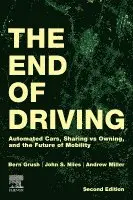
    The End of Driving

    Automated Cars, Sharing vs Owning, and the Future of Mobility

    AvBern Grush,John Niles

    Häftad, Engelska, 2025

    935 kr

    Beställningsvara. Skickas inom 10-15 vardagar. Fri frakt över 249 kr.

    Fler format och utgåvor

    Häftad

    1 103 kr

    Beskrivning

    Vehicle automation is on dual paths of entrenching private car ownership while simultaneously enhancing transportation services that would make driving unnecessary. Future impacts are uncertain.

    The End of Driving challenges the assumption that self-driving cars will by themselves reduce traffic congestion and crashes. Evolving vehicle automation will create safer, more convenient vehicles, yet continued reliance on private ownership will increase traffic volume. The authors explore psychological factors sustaining private vehicle use and the challenges of mixed-driver roads, examining why shared robotaxis face behavioral, political, and policy hurdles that will impede mass adoption, despite substantial public benefit.

    This updated edition examines real-world deployments through 2025 and introduces concepts such as zero car-ownership communities, robotaxi pickup and drop-off orchestration, and urban spaces redesigned around greater mode choices for physical access rather than parking. The book compares privately owned automated cars against shared, on-demand driverless vehicles, using new data to show which model best serves cities.

    Rather than predicting timelines, the authors use backcasting to map paths toward preferred mobility futures. They propose micro-subsidies, flexible transit integration, and regulatory frameworks to guide automation toward all three pillars of sustainability: ecology, economy, and equity. Shared, automated mobility is achievable and desirable but requires the deliberate actions described in this book.


    • Offers a workable public transit solution design melding the traditional “acquire-and-operate” mode with the absorption of new technology
    • Provides a step-by-step discussion of digital systems designs and effective regulation-by-data approaches needed for a new urban mobility
    • Learning aids include case study scenarios, chapter objectives and discussion questions, sidebars, a glossary, and updated exercises for student readers at the end of every chapter
    • New to the second edition: entirely new chapters or sections on the important distinctions between robotaxis and automated driver assistance, analysis of why automated vehicle deployment has not achieved early optimistic forecasts, infrastructure requirements supporting scaled-up robotaxi deployment, importance of on-demand automated microtransit in transit territories where fixed route is inefficient, how private fleets can be managed to expand universal urban mobility, developmental progress on vehicle automation deployment in countries around the world, and the steps needed to achieve zero-car ownership in urban zones.

    Produktinformation

    • Utgivningsdatum:2025-09-29
    • Mått:152 x 229 x 24 mm
    • Vikt:0 g
    • Format:Häftad
    • Språk:Engelska
    • Antal sidor:412
    • Upplaga:2
    • Förlag:Elsevier Science
    • ISBN:9780443223921

    Utforska kategorier

    • Flyg- och rymdteknik inom Naturvetenskap och teknik
    • Miljö-, transport- och planeringsrätt inom Juridik

    Mer om författaren

    Bern Grush is Executive Director of the Urban Robotics Foundation and project lead for ISO 4448, a technical standard for public-area mobile robots. With over four decades of experience in transportation innovation, he has founded several technology companies including Skymeter Corporation for road pricing systems and PCI Geomatics for satellite imaging analysis. His current work focuses on deployment standards and regulations for mobile robots in public spaces. He holds degrees in Human Factors Psychology from the University of Toronto and Systems Design Engineering from the University of Waterloo. John S. Niles is Founder and President of Global Telematics, a Seattle-based research consultancy focused on improving transportation efficiency and effectiveness. As a Research Associate at San Jose State University's Mineta Transportation Institute, he has published studies on transit development, ride sharing, and vehicle automation. He advocates for sustainable personal mobility through non-profit organizations including the Ridesharing Institute and Puget Sound Smarter Transit. Life-long learning beyond his studies at MIT (S.B.) and Carnegie Mellon University (M.S.) have recently focused him on defining the strategic choices available for public transport agencies to expand personal mobility options for all citizens.Andrew Miller, Ph.D., is Principal at Paladin Consulting, researching AI governance and mobility innovation. He has previously worked at Sidewalk Labs (Alphabet/Google), in private consulting, and in transport policy at all levels of government. He is the author of the Substack newsletter Changing Lanes on the future of transport, followed by more than 1,000 subscribers. He holds advanced degrees from Yale and Johns Hopkins Universities.

    Innehållsförteckning

    • Foreword by Dr. Susan ShaheenPrefaceIntroduction1. Language for automated driving2. Hype, disillusionment, and reset3. The broad context of change4. Behavioral economics, automated driving, and vehicle ownership5. A challenging transition: two competing markets6. The road ahead wherever private ownership thrives7. Barriers to shared use of vehicles8. Matters of scale9. Surviving mixed traffic10. Backcasting: Steps to achieve desired futures11. Microtransit rising12. Nudging ride-buying with microsubsidies13. Automated driving and transit-oriented development14. The path to zero-car-ownership communities15. Conclusion and recommendationsGlossaryReferences