• Fri frakt över 249 kr
  • •
  • Snabba leveranser
  • •
  • Billiga böcker
Kundservice

Du är på sajten för privatpersoner.

Företag, bibliotek eller offentlig verksamhet?

Du handlar på classic.bokus.com, där alla dina funktioner finns intakta.
Till classic.bokus.com
Bokus logotyp. Gå till startsidan.
  • Erbjudanden
  • Nyheter
  • Student
  • Topplistor
  • Barn & ungdom
  • Bokus Play
  • E-böcker
  • Pocketböcker
  • Spel & pussel

10% rabatt på allt med kod: NYSTART10 →

Sidfot

Mina sidor

    Hjälp

    • Kundservice
    • Vanliga frågor och svar
    • Frakt och leverans
    • Retur vid ångerrätt
    • Reklamera vara
    • Betalning
    • Köpvillkor
    • Allmänna villkor
    • Information om webbplatsens tillgänglighet

    Om Bokus

    • Om oss
    • Pressrum
    • För studenter
    • För företag
    • För bibliotek och offentlig verksamhet
    • För leverantörer
    • Hållbarhet

    Populärt

    • Aktuella erbjudanden
    • Presentkort
    • Studentlitteratur
    • Nya böcker
    • Topplistor
    • Signerade böcker
    • Engelska böcker

    Inspiration

    • Boktips
    • BookTok
    • Populära bokserier
    • Barnbokskaraktärer
    • Populära författare
    Logotyp för Bokus
    Följ oss på Facebook (extern länk)Följ oss på Instagram (extern länk)Följ oss på YouTube (extern länk)Följ oss på TikTok (extern länk)
    bokus @ CookiesAnpassa cookiesIntegritetspolicyKöpvillkor
    Till Citymail hemsida (extern länk)Till Budbee hemsida (extern länk)Till Postnord hemsida (extern länk)Till Schenker hemsida (extern länk)Till Early Bird hemsida (extern länk)Till Walleys hemsida (extern länk)
    1. Naturvetenskap och teknik
    2. Matematik och naturvetenskap
    3. Matematik
    4. Matematisk statistik

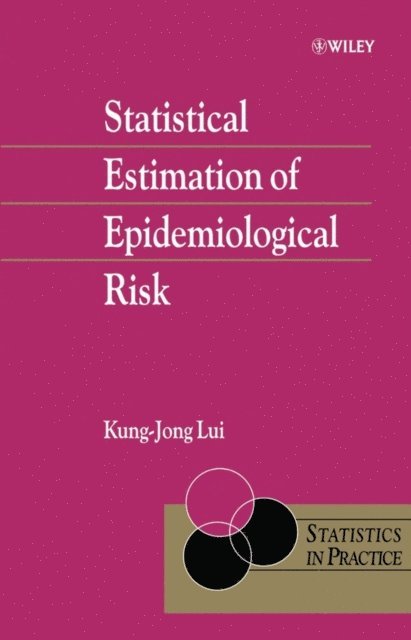
    Statistical Estimation of Epidemiological Risk

    AvKung-Jong Lui

    Inbunden, Engelska, 2004

    Del 14 i serien Statistics in Practice

    1 408 kr

    Beställningsvara. Skickas inom 5-8 vardagar. Fri frakt över 249 kr.

    Fler format och utgåvor

    E-bok

    1 641 kr

    Beskrivning

    Statistical Estimation of Epidemiological Risk provides coverage of the most important epidemiological indices, and includes recent developments in the field. A useful reference source for biostatisticians and epidemiologists working in disease prevention, as the chapters are self-contained and feature numerous real examples. It has been written at a level suitable for public health professionals with a limited knowledge of statistics. Other key features include: Provides comprehensive coverage of the key epidemiological indices.Includes coverage of various sampling methods, and pointers to where each should be used.Includes up-to-date references and recent developments in the field.Features many real examples, emphasising the practical nature of the book.Each chapter is self-contained, allowing the book to be used as a useful reference source.Includes exercises, enabling use as a course text.

    Produktinformation

    • Utgivningsdatum:2004-01-29
    • Mått:161 x 228 x 17 mm
    • Vikt:435 g
    • Format:Inbunden
    • Språk:Engelska
    • Serie:Statistics in Practice
    • Antal sidor:216
    • Förlag:John Wiley & Sons Inc
    • ISBN:9780470850718

    Utforska kategorier

    • Matematisk statistik inom Naturvetenskap och teknik
    • Epidemiologi och medicinsk statistik inom Medicin

    Mer om författaren

    KUNG-JONG LUI is a professor in the Department of Mathematics and Statistics at San Diego State University. Since he obtained his Ph.D. in biostatistics from UCLA in 1982, he has published more than 100 papers in peer-reviewed journals, including Biometrics, Statistics in Medicine, Biometrical Journal, Psychometrika, Communications in Statistics: Theory and Methods, Science, Proceedings of National Academy of Sciences, Controlled Clinical Trials, Journal of Official Statistics, IEEE Transactions on Reliability, Environmetrics, Test, Computational Statistics and Data Analysis, American Journal of Epidemiology, American Journal of Public Health, etc. He is a Fellow of the American Statistical Association, a life member of the International Chinese Statistical Association, and a member of the Western North American Region of the International Biometric Society.

    Recensioner i media

    "…a concise, organized, and well-written text that provides the derivations of statistical formulas underlying much epidemiological research and practice." (Journal of the American Statistical Association, December 2005) "...presents a considerable amount of recent research, much of which is the author's own..." (Royal Statistical Society, Vol.168, No.1, January 2005)"...systematically organised...an excellent reference..." (Short Book Review, Vol.24, No.3 December 2004)"...this book is strongly recommended..." (Statistical Methods in Medical Research, Vol 14 2005)

    Innehållsförteckning

    • About the author. Preface.1 Population Proportion or Prevalence.1.1 Binomial sampling.1.2 Cluster sampling.1.3 Inverse sampling.Exercises.References.2 Risk Difference.2.1 Independent binomial sampling.2.2 A series of independent binomial sampling procedures.2.2.1 Summary interval estimators.2.2.2 Test for the homogeneity of risk difference.2.3 Independent cluster sampling.2.4 Paired-sample data.2.5 Independent negative binomial sampling (inverse sampling).2.6 Independent poisson sampling.2.7 Stratified poisson sampling.Exercises.References.3 Relative Difference.3.1 Independent binomial sampling.3.2 A series of independent binomial sampling procedures.3.2.1 Asymptotic interval estimators.3.2.2 Test for the homogeneity of relative difference.3.3 Independent cluster sampling.3.4 Paired-sample data.3.5 Independent inverse sampling.Exercises.References.4 Relative Risk.4.1 Independent binomial sampling.4.2 A series of independent binomial sampling procedures.4.2.1 Asymptotic interval estimators.4.2.2 Test for the homogeneity of risk ratio.4.3 Independent cluster sampling.4.4 Paired-sample data.4.5 Independent inverse sampling.4.5.1 Uniformly minimum variance unbiased estimator of relative risk.4.5.2 Interval estimators of relative risk.4.6 Independent poisson sampling.4.7 Stratified poisson sampling.Exercises.References.5 Odds Ratio.5.1 Independent binomial sampling.5.1.1 Asymptotic interval estimators.5.1.2 Exact confidence interval.5.2 A series of independent binomial sampling procedures.5.2.1 Asymptotic interval estimators.5.2.2 Exact confidence interval.5.2.3 Test for homogeneity of the odds ratio.5.3 Independent cluster sampling.5.4 One-to-one matched sampling.5.5 Logistic modeling.5.5.1 Estimation under multinomial or independent binomial sampling.5.5.2 Estimation in the case of paired-sample data.5.6 Independent inverse sampling.5.7 Negative multinomial sampling for paired-sample data.Exercises.References.6 Generalized Odds Ratio.6.1 Independent multinomial sampling.6.2 Data with repeated measurements (or under cluster sampling).6.3 Paired-sample data.6.4 Mixed negative multinomial and multinomial sampling.Exercises.References.7 Attributable Risk.7.1 Study designs with no confounders.7.1.1 Cross-sectional sampling.7.1.2 Case–control studies.7.2 Study designs with confounders.7.2.1 Cross-sectional sampling.7.2.2 Case–control studies.7.3 Case–control studies with matched pairs.7.4 Multiple levels of exposure in case–control studies.7.5 Logistic modeling in case–control studies.7.5.1 Logistic model containing only the exposure variables of interest.7.5.2 Logistic regression model containing both exposure and confounding variables.7.6 Case–control studies under inverse sampling.Exercises.References.8 Number Needed to Treat.8.1 Independent binomial sampling.8.2 A series of independent binomial sampling procedures.8.3 Independent cluster sampling.8.4 Paired-sample data.Exercises.References.Appendix Maximum Likelihood Estimator and Large-Sample Theory.A.1: The maximum likelihood estimator, Wald’s test, the score test, and the asymptotic likelihood ratio test.A.2: The delta method and its applications.References.Answers to Selected Exercises.Index.