• Fri frakt över 249 kr
  • •
  • Snabba leveranser
  • •
  • Billiga böcker
Kundservice

Du är på sajten för privatpersoner.

Företag, bibliotek eller offentlig verksamhet?

Du handlar på classic.bokus.com, där alla dina funktioner finns intakta.
Till classic.bokus.com
Bokus logotyp. Gå till startsidan.
  • Erbjudanden
  • Student
  • Topplistor
  • Barn & ungdom
  • Bokus Play
  • E-böcker
  • Ljudböcker
  • Pocketböcker
  • Spel och pussel

Pocketfynda! Hundratals böcker för 49 kr/st →

Sidfot

Mina sidor

    Hjälp

    • Kundservice
    • Vanliga frågor och svar
    • Frakt och leverans
    • Retur vid ångerrätt
    • Reklamera vara
    • Betalning
    • Köpvillkor
    • Allmänna villkor
    • Information om webbplatsens tillgänglighet

    Om Bokus

    • Om oss
    • Pressrum
    • För studenter
    • För företag
    • För bibliotek och offentlig verksamhet
    • För leverantörer
    • Hållbarhet

    Populärt

    • Aktuella erbjudanden
    • Presentkort
    • Studentlitteratur
    • Nya böcker
    • Topplistor
    • Signerade böcker
    • Engelska böcker

    Inspiration

    • Boktips
    • BookTok
    • Barnbokskaraktärer
    • Populära författare
    Logotyp för Bokus
    Följ oss på Facebook (extern länk)Följ oss på Instagram (extern länk)Följ oss på YouTube (extern länk)Följ oss på TikTok (extern länk)
    bokus @ CookiesAnpassa cookiesIntegritetspolicyKöpvillkor
    Till Citymail hemsida (extern länk)Till Budbee hemsida (extern länk)Till Postnord hemsida (extern länk)Till Schenker hemsida (extern länk)Till Early Bird hemsida (extern länk)Till Walleys hemsida (extern länk)
    1. Naturvetenskap och teknik
    2. Matematik och naturvetenskap
    3. Matematik
    4. Optimering

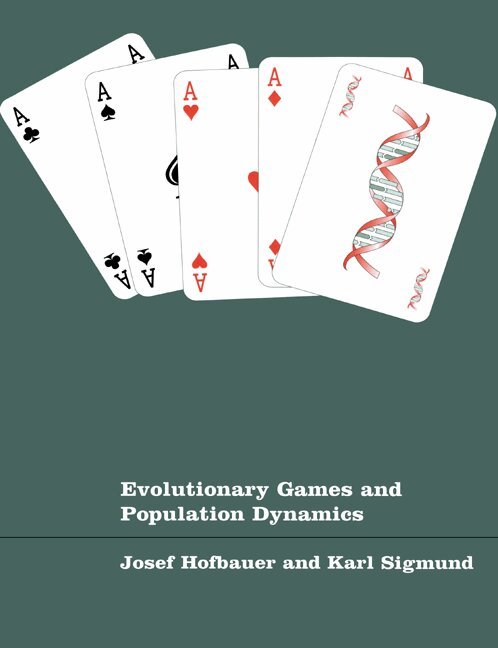
    Evolutionary Games and Population Dynamics

    AvJosef Hofbauer,Karl Sigmund

    Häftad, Engelska, 1998

    866 kr

    Beställningsvara. Skickas inom 7-10 vardagar. Fri frakt över 249 kr.

    Beskrivning

    Every form of behaviour is shaped by trial and error. Such stepwise adaptation can occur through individual learning or through natural selection, the basis of evolution. Since the work of Maynard Smith and others, it has been realised how game theory can model this process. Evolutionary game theory replaces the static solutions of classical game theory by a dynamical approach centred not on the concept of rational players but on the population dynamics of behavioural programmes. In this book the authors investigate the nonlinear dynamics of the self-regulation of social and economic behaviour, and of the closely related interactions between species in ecological communities. Replicator equations describe how successful strategies spread and thereby create new conditions which can alter the basis of their success, i.e. to enable us to understand the strategic and genetic foundations of the endless chronicle of invasions and extinctions which punctuate evolution. In short, evolutionary game theory describes when to escalate a conflict, how to elicit cooperation, why to expect a balance of the sexes, and how to understand natural selection in mathematical terms.

    Produktinformation

    • Utgivningsdatum:1998-05-28
    • Mått:189 x 246 x 19 mm
    • Vikt:630 g
    • Format:Häftad
    • Språk:Engelska
    • Antal sidor:352
    • Förlag:Cambridge University Press
    • ISBN:9780521625708

    Utforska kategorier

    • Optimering inom Naturvetenskap och teknik
    • Tillämpad matematik inom Naturvetenskap och teknik
    • Biovetenskap inom Naturvetenskap och teknik

    Recensioner i media

    '… as a mathematical text on an important set of topics in theoretical biology, the book is superb. It is well organised and beautifully written. In choosing from the rich menu of mathematical topics broadly relevant to ecology, behaviour, evolution, and even theoretical immunology, it shows good taste.' The Times Higher Education Supplement

    Innehållsförteckning

    • Introduction for game theorists; Introduction for biologists; Part I. Dynamical Systems And Lotka-Volterra Equations: 1. The logistic equation; 2. Lotka-Volterra for predator-prey systems; 3. Lotka-Volterra for two competitors; 4. Ecological equations for two species; 5. Lotka-Volterra for more than two populations; Part II. Game Dynamics And Replicator Equations: 6. Evolutionarily stable strategies; 7. Replicator equations; 8. Other game dynamics; 9. Adaptive dynamics; 10. Asymmetric conflicts; 11. More on bimatrix games; Part III. More On Lotka-Volterra And Replicator Dynamics: 12. Hypercircles and permanence; 13. Criteria for permanence; 14. Replicator networks; 15. Stability in n-species communities; 16. Some low-dimensional ecological systems; 17. Heteroclinic cycles and C-matrices; Part IV. Population Genetics: 18. Discrete dynamical systems in population genetics; 19. Continuous selection dynamics; 20. Mutation and recombination; 21. Fertility selection; 22. Game dynamics for Mendelian populations; Bibliography; Index.