• Fri frakt över 249 kr
  • •
  • Snabba leveranser
  • •
  • Billiga böcker
Kundservice

Du är på sajten för privatpersoner.

Företag, bibliotek eller offentlig verksamhet?

Du handlar på classic.bokus.com, där alla dina funktioner finns intakta.
Till classic.bokus.com
Bokus logotyp. Gå till startsidan.
  • Erbjudanden
  • Nyheter
  • Student
  • Topplistor
  • Barn & ungdom
  • Bokus Play
  • E-böcker
  • Pocketböcker
  • Spel & pussel

10% studentrabatt med kod TERM26

Sidfot

Mina sidor

    Hjälp

    • Kundservice
    • Vanliga frågor och svar
    • Frakt och leverans
    • Retur vid ångerrätt
    • Reklamera vara
    • Betalning
    • Köpvillkor
    • Allmänna villkor
    • Information om webbplatsens tillgänglighet

    Om Bokus

    • Om oss
    • Pressrum
    • För studenter
    • För företag
    • För bibliotek och offentlig verksamhet
    • För leverantörer
    • Hållbarhet

    Populärt

    • Aktuella erbjudanden
    • Presentkort
    • Studentlitteratur
    • Nya böcker
    • Topplistor
    • Signerade böcker
    • Engelska böcker

    Inspiration

    • Boktips
    • BookTok
    • Populära bokserier
    • Barnbokskaraktärer
    • Populära författare
    Logotyp för Bokus
    Följ oss på Facebook (extern länk)Följ oss på Instagram (extern länk)Följ oss på YouTube (extern länk)Följ oss på TikTok (extern länk)
    bokus @ CookiesAnpassa cookiesIntegritetspolicyKöpvillkor
    Till Citymail hemsida (extern länk)Till Budbee hemsida (extern länk)Till Postnord hemsida (extern länk)Till Schenker hemsida (extern länk)Till Early Bird hemsida (extern länk)Till Walleys hemsida (extern länk)
    1. Samhälle och politik
    2. Samhälle och kultur
    3. Kultur och medier
    4. Kulturvetenskap

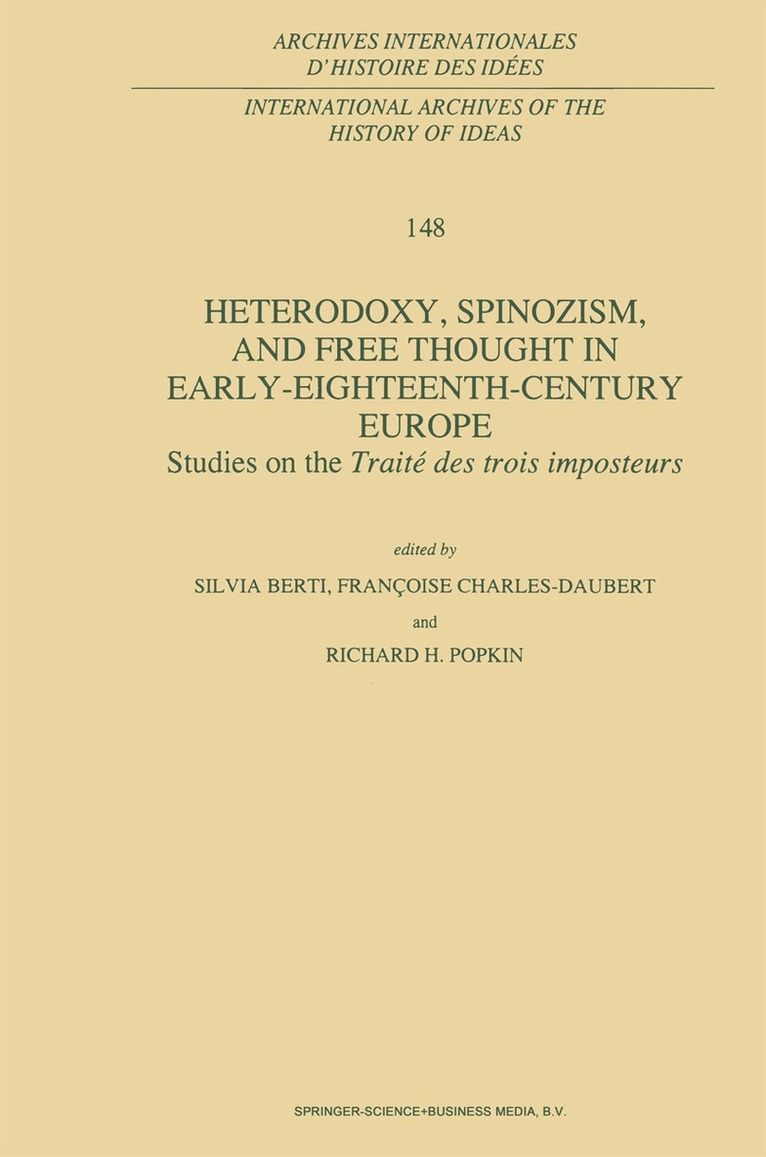
    Heterodoxy, Spinozism, and Free Thought in Early-Eighteenth-Century Europe

    Studies on the Traité des Trois Imposteurs

    AvSilvia Berti,Françoise Charles-Daubert

    Inbunden, Engelska, 1996

    Del i serien International Archives of the History of Ideas Archives internationales d'histoire des idées

    2 177 kr

    Beställningsvara. Skickas inom 10-15 vardagar. Fri frakt över 249 kr.

    Beskrivning

    'the oldest biography of Spinoza', La Vie de Mr. Spinosa, which in the manuscript copies is often followed by L'Esprit de M. Spinosa. Margaret Jacob, in her Radical Enlightenment, contended that the Traite was written by a radical group of Freemasons in The Hague in the early eighteenth century. Silvia Berti has offered evidence it was written by Jan Vroesen. Various discussions in the early eighteenth century consider many possi­ ble authors from the Renaissance onwards to whom the work might be attributed. The Trois imposteurs has attracted quite a bit of recent attention as one of the most significant irreligious clandestine writings available in the Enlightenment, which is most important for understanding the develop­ ment of religious scepticism, radical deism, and even atheism in the seventeenth and eighteenth centuries. Scholars for the last couple of decades have been trying to assess when the work was actually written or compiled and by whom. In view of the widespread distribution of manu­ scripts of the work all over Europe, they have also been seeking to find out who was influenced by the work, and what it represented for its time. Hitherto unknown manuscripts are being turned up in public and private libraries all over Europe and the United States.

    Produktinformation

    • Utgivningsdatum:1996-08-31
    • Mått:156 x 234 x 35 mm
    • Vikt:992 g
    • Format:Inbunden
    • Språk:Engelska
    • Serie:International Archives of the History of Ideas Archives internationales d'histoire des idées
    • Antal sidor:532
    • Upplaga:1996
    • Förlag:Kluwer Academic Publishers
    • ISBN:9780792341925

    Utforska kategorier

    • Kulturvetenskap inom Samhälle och politik
    • Filosofiska discipliner inom Filosofi och religion

    Innehållsförteckning

    • I. History and Interpretation of the ‘Traité des Trois Imposteurs’.- 1. L’Esprit de Spinosa: ses origines et sa première édition dans leur contexte spinozien.- 2. Une Histoire interminable: origines et développement du Traité des trois imposteurs.- 3. History and structure of our Traité des trois imposteurs.- 4. L’Esprit de Spinosa et les Traités des trois imposteurs: rappel des différentes familles et de leurs principales caractéristiques.- II. Around the ‘Traité’.- 5. Freethinking in early-eighteenth-century Protestant Germany: Peter Friedrich Arpe and the Traité des trois imposteurs.- 6. The English Deists and the Traité.- 7. Sallengre, La Monnoye, and the Traité des trois imposteurs.- 8. The politics of a publishing event: the Marchand milieu and The life and spirit of Spinoza of 1719.- 9. Impostors and Revolution: on the ‘Philadelphie’ 1796 edition of the Traité des trois imposteurs.- III. The Threads of a Tradition.- 10. An eighteenth-century interpretation of the Ethica: Henry de Boulainvilliers’s ‘Essai de métaphysique’.- 11. Legislators, impostors, and the politic origins of religion: English theories of ‘imposture’ from Stubbe to Toland.- 12. ‘Behold the fear of the Lord’: the Erastianism of Stillingfleet, Wolseley, and Tillotson.- 13. ‘Jesus Nazarenus legislator’: Adam Boreel’s defence of Christianity.- 14. Johan Adler Salvius’ Questions to Baruch de Castro concerning De tribus impostoribus.- 15. The struggle against unbelief in the Portuguese Jewish community of Amsterdam after Spinoza’s excommunication.- 16. Worse than the three impostors? towards an interpretation of Theodor Ludwig Lau’s Meditationes philosophicae de Deo, mundo, homine.