• Fri frakt över 249 kr
  • •
  • Snabba leveranser
  • •
  • Billiga böcker
Kundservice

Du är på sajten för privatpersoner.

Företag, bibliotek eller offentlig verksamhet?

Du handlar på classic.bokus.com, där alla dina funktioner finns intakta.
Till classic.bokus.com
Bokus logotyp. Gå till startsidan.
  • Erbjudanden
  • Nyheter
  • Student
  • Topplistor
  • Barn & ungdom
  • Bokus Play
  • E-böcker
  • Pocketböcker
  • Spel & pussel

10% rabatt på allt med kod: NYSTART10 →

Sidfot

Mina sidor

    Hjälp

    • Kundservice
    • Vanliga frågor och svar
    • Frakt och leverans
    • Retur vid ångerrätt
    • Reklamera vara
    • Betalning
    • Köpvillkor
    • Allmänna villkor
    • Information om webbplatsens tillgänglighet

    Om Bokus

    • Om oss
    • Pressrum
    • För studenter
    • För företag
    • För bibliotek och offentlig verksamhet
    • För leverantörer
    • Hållbarhet

    Populärt

    • Aktuella erbjudanden
    • Presentkort
    • Studentlitteratur
    • Nya böcker
    • Topplistor
    • Signerade böcker
    • Engelska böcker

    Inspiration

    • Boktips
    • BookTok
    • Populära bokserier
    • Barnbokskaraktärer
    • Populära författare
    Logotyp för Bokus
    Följ oss på Facebook (extern länk)Följ oss på Instagram (extern länk)Följ oss på YouTube (extern länk)Följ oss på TikTok (extern länk)
    bokus @ CookiesAnpassa cookiesIntegritetspolicyKöpvillkor
    Till Citymail hemsida (extern länk)Till Budbee hemsida (extern länk)Till Postnord hemsida (extern länk)Till Schenker hemsida (extern länk)Till Early Bird hemsida (extern länk)Till Walleys hemsida (extern länk)
    1. Samhälle och politik
    2. Sociologi och antropologi
    3. Antropologi

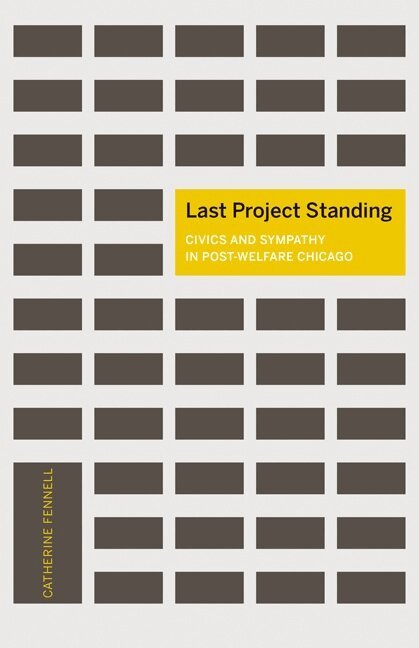
    Last Project Standing

    Civics and Sympathy in Post-Welfare Chicago

    AvCatherine Fennell

    Häftad, Engelska, 2015

    Del i serien Quadrant Book

    294 kr

    Beställningsvara. Skickas inom 5-8 vardagar. Fri frakt över 249 kr.

    Beskrivning

    In 1995 a half-vacant public housing project on Chicago’s Near West Side fell to the wrecking ball. The demolition and reconstruction of the Henry Horner housing complex ushered in the most ambitious urban housing experiment of its kind: smaller, mixed-income, and partially privatized developments that, the thinking went, would mitigate the insecurity, isolation, and underemployment that plagued Chicago's infamously troubled public housing projects. Focusing on Horner’s redevelopment, Catherine Fennell asks how Chicago’s endeavor transformed everyday built environments into laboratories for teaching urbanites about the rights and obligations of belonging to a city and a nation that seemed incapable of taking care of its most destitute citizens. Drawing on more than three years of ethnographic and archival research, she shows how collisions with everything from haywire heating systems and decaying buildings to silent neighbors became an education in the possibilities, but also the limits, of collective care, concern, and protection in the aftermath of welfare failure. As she documents how the materiality of both the unsuccessful older projects and the recently emerging housing fosters feelings of belonging and loss, her work engages larger debates in critical anthropology and poverty studies-and opens a vital new perspective on the politics of space, race, and development in urban America

    Produktinformation

    • Utgivningsdatum:2015-11-28
    • Mått:140 x 216 x 38 mm
    • Format:Häftad
    • Språk:Engelska
    • Serie:Quadrant Book
    • Antal sidor:320
    • Förlag:University of Minnesota Press
    • ISBN:9780816697373
    • Utmärkelser:Winner of Last Project Standing 2016

    Utforska kategorier

    • Antropologi inom Samhälle och politik
    • Diskriminering och rättvisa inom Samhälle och politik
    • Sociala grupper och identitet inom Samhälle och politik

    Mer om författaren

    Catherine Fennell is assistant professor of anthropology at Columbia University.

    Recensioner i media

    "Using the case of publicly subsidized housing and its residents in Chicago, Catherine Fennell brilliantly traces the architectures of public housing decay and the so-called solutions to them as affective possibilities. Political debates over how to house the urban poor unfold as gripping ethnographic realities here, urging us to think through the materiality of sympathy."-Vincanne Adams, University of California, San Francisco"This book is a must-read for those concerned with public housing and its aftermath. The author has captured stories rarely heard anywhere else."-Planning Magazine"An excellent, timely, and nuance ethnography that moves beyond the more familiar analysis of postwelfare urban inequalities. It is a valuable addition to the literature about urban poverty, urban planning, and the politics of race and class in the contemporary United States."-American Anthropologist"Fennell’s great achievement rests on her ability to capture those critiques of the new housing not as a nostalgia for the old-that kind of thing is the preserve of the social scientists and the museum-advocates in her narrative-but rather as a negotiation of the difference between sympathetic attachments and abstract, sentimentalized obligations to anonymous others."-Somatosphere"Last Project Standing will undoubtedly make a great impact on the ways that other urban anthropologists respond to the influences of interdisciplinary humanistic research methods."-Journal of the Illinois State Historical Society

    Innehållsförteckning

    • ContentsAcknowledgmentsIntroduction1. Across DamenPart I. Sympathy“Toward a Better Life”2. The Many Harms of Staying Here3. Project Heat and Sensory PoliticsPart II. CivicsRadio Rumors4. Experiments in Vulnerability5. The City, the Grassroots, the Poverty PimpsPart III. PublicsResurrections6. The Museum of ResilienceEpilogue: Raising Sympathetic PublicsNotesBibliographyIndex