• Fri frakt över 249 kr
  • •
  • Snabba leveranser
  • •
  • Billiga böcker
Kundservice

Du är på sajten för privatpersoner.

Företag, bibliotek eller offentlig verksamhet?

Du handlar på classic.bokus.com, där alla dina funktioner finns intakta.
Till classic.bokus.com
Bokus logotyp. Gå till startsidan.
  • Erbjudanden
  • Student
  • Topplistor
  • Barn & ungdom
  • Bokus Play
  • E-böcker
  • Ljudböcker
  • Pocketböcker
  • Spel & pussel

10% rabatt på allt med kod NYSTART10 →

Sidfot

Mina sidor

    Hjälp

    • Kundservice
    • Vanliga frågor och svar
    • Frakt och leverans
    • Retur vid ångerrätt
    • Reklamera vara
    • Betalning
    • Köpvillkor
    • Allmänna villkor
    • Information om webbplatsens tillgänglighet

    Om Bokus

    • Om oss
    • Pressrum
    • För studenter
    • För företag
    • För bibliotek och offentlig verksamhet
    • För leverantörer
    • Hållbarhet

    Populärt

    • Aktuella erbjudanden
    • Presentkort
    • Studentlitteratur
    • Nya böcker
    • Topplistor
    • Signerade böcker
    • Engelska böcker

    Inspiration

    • Boktips
    • BookTok
    • Populära bokserier
    • Barnbokskaraktärer
    • Populära författare
    Logotyp för Bokus
    Följ oss på Facebook (extern länk)Följ oss på Instagram (extern länk)Följ oss på YouTube (extern länk)Följ oss på TikTok (extern länk)
    bokus @ CookiesAnpassa cookiesIntegritetspolicyKöpvillkor
    Till Citymail hemsida (extern länk)Till Budbee hemsida (extern länk)Till Postnord hemsida (extern länk)Till Schenker hemsida (extern länk)Till Early Bird hemsida (extern länk)Till Walleys hemsida (extern länk)
    1. Samhälle och politik
    2. Samhälle och kultur
    3. Kultur och medier
    4. Kulturvetenskap

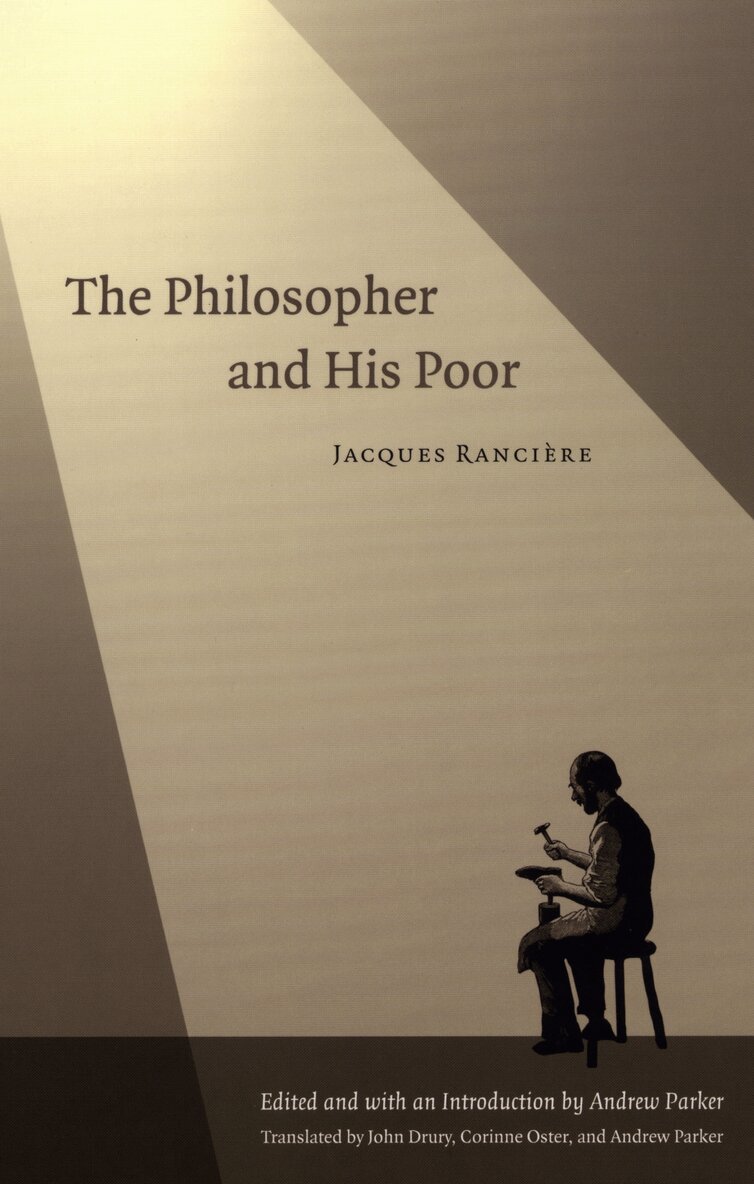
    Philosopher and His Poor

    AvJacques Rancière,Andrew Parker

    Häftad, Engelska, 2004

    289 kr

    Skickas . Fri frakt över 249 kr.

    Fler format och utgåvor

    E-bok

    441 kr

    Beskrivning

    What has philosophy to do with the poor? If, as has often been supposed, the poor have no time for philosophy, then why have philosophers always made time for them? Why is the history of philosophy-from Plato to Karl Marx to Jean-Paul Sartre to Pierre Bourdieu-the history of so many figures of the poor: plebes, men of iron, the demos, artisans, common people, proletarians, the masses? Why have philosophers made the shoemaker, in particular, a remarkably ubiquitous presence in this history? Does philosophy itself depend on this thinking about the poor? If so, can it ever refrain from thinking for them?Jacques RanciÈre’s The Philosopher and His Poor meditates on these questions in close readings of major texts of Western thought in which the poor have played a leading role-sometimes as the objects of philosophical analysis, sometimes as illustrations of philosophical argument. Published in France in 1983 and made available here for the first time in English, this consummate study assesses the consequences for Marx, Sartre, and Bourdieu of Plato’s admonition that workers should do “nothing else” than their own work. It offers innovative readings of these thinkers’ struggles to elaborate a philosophy of the poor. Presenting a left critique of Bourdieu, the terms of which are largely unknown to an English-language readership, The Philosopher and His Poor remains remarkably timely twenty years after its initial publication.

    Produktinformation

    • Utgivningsdatum:2004-04-23
    • Mått:140 x 235 x 17 mm
    • Vikt:395 g
    • Format:Häftad
    • Språk:Engelska
    • Antal sidor:280
    • Förlag:Duke University Press
    • ISBN:9780822332749
    • Översättare:John Drury, Corinne Oster, Andrew Parker

    Utforska kategorier

    • Kulturvetenskap inom Samhälle och politik
    • Filosofiska discipliner inom Filosofi och religion
    • Marxism och kommunism inom Samhälle och politik

    Mer om författaren

    Jacques RanciÈre is Emeritus Professor of Philosophy at the University of Paris–VIII (St. Denis). His many books include The Nights of Labor: The Workers’ Dream in Nineteenth-Century France; The Ignorant Schoolmaster: Five Lessons in Intellectual Emancipation;and Disagreement: Politics and Philosophy.Andrew Parker is Professor of English at Amherst College. He is a coeditor of Nationalisms and Sexualities and Performativity and Performance.

    Recensioner i media

    “Sure to provoke controversy, The Philosopher and His Poor is a virtuoso performance. I can’t think of anyone who has pursued the populist premise-the intuition that in this or that situation the grounding of truth or value is to be located in those most dispossessed-with anything approaching RanciÈre’s degree of articulateness or philosophical sophistication. I predict that this book will become a landmark.”-Bruce Robbins, author of Feeling Global: Internationalism in Distress “The Philosopher and His Poor is a remarkable work. Jacques RanciÈre demonstrates the recurrence throughout the history of western thought of a particular self-constituting move: the freedom and the right to think are premised upon a situating and excluding of those whose task is other than to think, what RanciÈre calls ‘the poor.’”-Derek Attridge, author of The Singularity of Literature

    Innehållsförteckning

    • Editor’s Preface viiEditor’s Introduction: Mimesis and the Division of Labor ixA Personal Itinerary xxvI. Plato's Lie 1. The Order of the City 3 2. The Order of Discourse 30II. Marx's Labor 3. The Shoemaker and the Knight 574. The Production of the Proletarian 705. The Revolution Conjured Away 906. The Risk of Art 105III. The Philosopher and the Sociologist 7. The Marxist Horizon 1278. The Philosopher’s Wall 1379. The Sociologist King 165For Those Who Want More 203Afterword to the English-Language Edition (2002) 219Notes 229