• Fri frakt över 249 kr
  • •
  • Snabba leveranser
  • •
  • Billiga böcker
Kundservice

Du är på sajten för privatpersoner.

Företag, bibliotek eller offentlig verksamhet?

Du handlar på classic.bokus.com, där alla dina funktioner finns intakta.
Till classic.bokus.com
Bokus logotyp. Gå till startsidan.
  • Erbjudanden
  • Nyheter
  • Student
  • Topplistor
  • Barn & ungdom
  • Bokus Play
  • E-böcker
  • Pocketböcker
  • Spel & pussel

10% rabatt på allt med kod NYSTART10 →

Sidfot

Mina sidor

    Hjälp

    • Kundservice
    • Vanliga frågor och svar
    • Frakt och leverans
    • Retur vid ångerrätt
    • Reklamera vara
    • Betalning
    • Köpvillkor
    • Allmänna villkor
    • Information om webbplatsens tillgänglighet

    Om Bokus

    • Om oss
    • Pressrum
    • För studenter
    • För företag
    • För bibliotek och offentlig verksamhet
    • För leverantörer
    • Hållbarhet

    Populärt

    • Aktuella erbjudanden
    • Presentkort
    • Studentlitteratur
    • Nya böcker
    • Topplistor
    • Signerade böcker
    • Engelska böcker

    Inspiration

    • Boktips
    • BookTok
    • Populära bokserier
    • Barnbokskaraktärer
    • Populära författare
    Logotyp för Bokus
    Följ oss på Facebook (extern länk)Följ oss på Instagram (extern länk)Följ oss på YouTube (extern länk)Följ oss på TikTok (extern länk)
    bokus @ CookiesAnpassa cookiesIntegritetspolicyKöpvillkor
    Till Citymail hemsida (extern länk)Till Budbee hemsida (extern länk)Till Postnord hemsida (extern länk)Till Schenker hemsida (extern länk)Till Early Bird hemsida (extern länk)Till Walleys hemsida (extern länk)
    1. Samhälle och politik
    2. Sociologi och antropologi
    3. Antropologi

    Strange Enemies

    Indigenous Agency and Scenes of Encounters in Amazonia

    AvAparecida Vilaça

    Häftad, Engelska, 2010

    Del i serien Cultures and Practice of Violence

    431 kr

    Beställningsvara. Skickas inom 5-8 vardagar. Fri frakt över 249 kr.

    Fler format och utgåvor

    E-bok

    631 kr

    Beskrivning

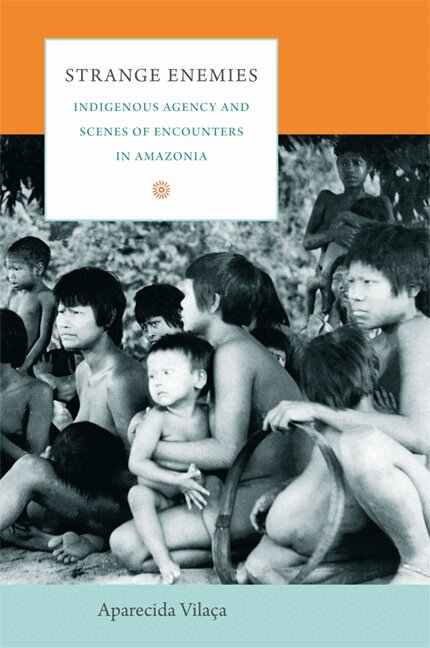
    In 1956, in the Brazilian state of RondÔnia, a group of Wari’ Indians had their first peaceful contact with whites: Protestant missionaries and officers from the national Indian Protection Service. On returning to their villages, the Wari’ announced, “We touched their bodies!” Meanwhile the whites reported to their own people that “the region’s most warlike tribe has entered the pacification phase!” Initially published in Brazil, Strange Enemies is an ethnographic narrative of the first encounters between these peoples with radically different worldviews.During the 1940s and 1950s, white rubber tappers invading the Wari’ lands raided the native villages, shooting and killing their victims as they slept. These massacres prompted the Wari’ to initiate a period of intense retaliatory warfare. The national government and religious organizations subsequently intervened, seeking to “pacify” the Indians. Aparecida VilaÇa was able to interview both Wari’ and non-Wari’ participants in these encounters, and here she shares their firsthand narratives of the dramatic events. Taking the Wari’ perspective as its starting point, Strange Enemies combines a detailed examination of these cross-cultural encounters with analyses of classic ethnological themes such as kinship, shamanism, cannibalism, warfare, and mythology.

    Produktinformation

    • Utgivningsdatum:2010-05-19
    • Mått:156 x 235 x 25 mm
    • Vikt:567 g
    • Format:Häftad
    • Språk:Engelska
    • Serie:Cultures and Practice of Violence
    • Antal sidor:392
    • Förlag:Duke University Press
    • ISBN:9780822345732
    • Översättare:David Rodgers

    Utforska kategorier

    • Antropologi inom Samhälle och politik
    • Politisk aktivism inom Samhälle och politik
    • Etnicitet inom Samhälle och politik

    Mer om författaren

    Aparecida VilaÇa is Associate Professor of Social Anthropology in the Graduate Program in Social Anthropology of the Museu Nacional, Universidade Federal de Rio de Janeiro. She is a co-editor of Native Christians: Modes and Effects of Christianity in the Americas.

    Recensioner i media

    “Thanks to the excellent anthropological work of Aparecida VilaÇa and colleagues studying Amazonia and Melanesia, it becomes increasingly apparent that the incorporation of otherness-in practices ranging from marriage and shamanism to warfare and cannibalism-is an essential condition of human being. It follows that the relationship between societies is an essential condition of their respective cultural orders as well as their historical development. Now VilaÇa has produced a landmark ethnography of these processes, with an unparalleled documentation from the inside of the assimilation of the outside, highlighted by a stunning analysis of the cultural reciprocities of the colonial encounter.”-Marshall Sahlins, author of The Western Illusion of Human Nature This work has profound and far-reaching implications for anthropologists and historians who examine the frontiers of colonialism and globalization. . . . This is contemporary ethnography at its best, skillfully weaving together nuanced theoretical arguments, rich prose and storytelling, and insights that can only be gained by immersion in local settings. . . . VilaÇa’s remarkable depiction of the coherence and resilience of native Amazonian peoples even in the face of catastrophic change is a must read for anyone interested in colonialism, globalization, and the place of indigenous peoples in the modern world.” - Michael Heckenberger (American Historical Review) “This intimate portrait of a remarkable people who insist on encountering modernity on their own terms challenges us to think beyond outmoded notions about acculturation and loss of tradition. Deftly weaving the insights of Amazonian perspectivism with history, myth, and personal experience, Aparecida VilaÇa shows how Wari’ choices to live with whites and adopt many of their ways are part of the logic of being indigenous. Empowerment derives from seeing the world through the eyes of others. Strange Enemies invites us to see the world through Wari’ eyes. The view is fascinating.”-Beth A. Conklin, author of Consuming Grief: Compassionate Cannibalism in an Amazonian Society “Strange Enemies is the best ethnography ever written about a first contact history and thus probably the single most anthropologically satisfying publication of any kind for thinking about this subject.” - Rupert Stasch (American Anthropologist) “Among the many works on first contact between Indians and non-Indians, Strange Enemies stands out for its illuminating focus on indigenous perspectives and its sophisticated analysis of how the Wari’ conceived of historical change.” - Christine Mathias (Ethnohistory) “[B]road scope makes Strange Enemies a book that should be read even by anthropologists who have little familiarity with Amazonia. It is a compelling example of the vital work that has been emerging from Amazonian anthropologists for the past decade. Like the best of that work, it offers us glimpses into worldviews and practices that are nothing if not mesmerizingly ‘far out.’ And it uses those worldviews and practices to develop insights and conclusions that are unexpected and exhilarating.” - Don Kulick (American Ethnologist) “Aparecida VilaÇa’s book, first published in Portuguese in 2006, is an excellent contribution to the anthropology of Amazonia and Melanesia. . . . VilaÇa’s book is recommended as important reading to anthropologists, students, and the general reader interested in understanding’ the Other’ in our modern world.” (Colonial Latin American Historical Review) “The book is a well-written, highly readable, profound and original ethnographic and analytic contribution to Amazonian ethnology and ‘first encounter’ literature, such that any divergence in interpretation will also need an extended argument: it should be read by everyone interested in the subject.”- Edwin Reesink (European Review of Latin American and Caribbean Studies)

    Innehållsförteckning

    • List of Illustrations xiAcknowledgments xiiiOrthography xviiIntroduction 1Part I. Other Becoming 1. The Foreigner 252. The Enemy 703. The White Enemy 110Part II. In Myth 4. The White Enemy 1355. The Foreigner, the Dead 1466. The Enemy 1647. The Brother-in-Law 175Part III. We Want People for Ourselves: PÁcification 8. The Motives of the Whites 1979. The Widening River: Contact with the OroNao of the Whites 21010. "The Enemy Says He's OroNao": Contact with the OroWaram, OroWaramXijien, and OroMon 22911. The Great Expedition: Contact with the OroNao', OroEo, and OroAt on the Negro and Ocaia Rivers 255Conclusion 301Notes 321Bibliography 341Index 357