• Fri frakt över 249 kr
  • •
  • Snabba leveranser
  • •
  • Billiga böcker
Kundservice

Du är på sajten för privatpersoner.

Företag, bibliotek eller offentlig verksamhet?

Du handlar på classic.bokus.com, där alla dina funktioner finns intakta.
Till classic.bokus.com
Bokus logotyp. Gå till startsidan.
  • Erbjudanden
  • Nyheter
  • Student
  • Topplistor
  • Barn & ungdom
  • Bokus Play
  • E-böcker
  • Pocketböcker
  • Spel & pussel

10% rabatt på allt med kod NYSTART10 →

Sidfot

Mina sidor

    Hjälp

    • Kundservice
    • Vanliga frågor och svar
    • Frakt och leverans
    • Retur vid ångerrätt
    • Reklamera vara
    • Betalning
    • Köpvillkor
    • Allmänna villkor
    • Information om webbplatsens tillgänglighet

    Om Bokus

    • Om oss
    • Pressrum
    • För studenter
    • För företag
    • För bibliotek och offentlig verksamhet
    • För leverantörer
    • Hållbarhet

    Populärt

    • Aktuella erbjudanden
    • Presentkort
    • Studentlitteratur
    • Nya böcker
    • Topplistor
    • Signerade böcker
    • Engelska böcker

    Inspiration

    • Boktips
    • BookTok
    • Populära bokserier
    • Barnbokskaraktärer
    • Populära författare
    Logotyp för Bokus
    Följ oss på Facebook (extern länk)Följ oss på Instagram (extern länk)Följ oss på YouTube (extern länk)Följ oss på TikTok (extern länk)
    bokus @ CookiesAnpassa cookiesIntegritetspolicyKöpvillkor
    Till Citymail hemsida (extern länk)Till Budbee hemsida (extern länk)Till Postnord hemsida (extern länk)Till Schenker hemsida (extern länk)Till Early Bird hemsida (extern länk)Till Walleys hemsida (extern länk)
    1. Psykologi och pedagogik
    2. Psykologi
    3. Psykologi: känslor

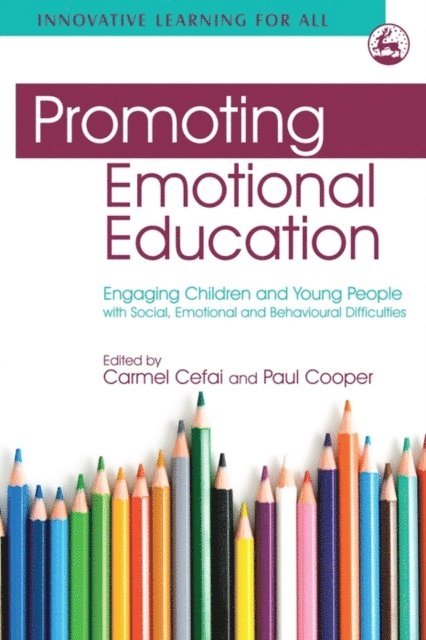
    Promoting Emotional Education

    Engaging Children and Young People with Social, Emotional and Behavioural Difficulties

    AvPaul Cooper,Carmel Cefai

    E-bok
    Engelska, 2009

    Del i serien Innovative Learning for All

    430 kr

    Läs direkt i Bokus Reader – eller ladda ned till din enhet

    Beskrivning

    Unlike IQ, emotional competence can be nurtured and developed, and is a key factor in physical and mental health, social competence, academic achievement and other aspects in the personal and social development of children and young people. Promoting Emotional Education connects with the contemporary shift from an exclusively academic focus towards a more balanced and broader approach to education, with an emphasis on both academic and emotional literacy. The book suggests adopting educational practices which encourage feelings of emotional security, promote trusting and supportive relationships and reflect students' views and feelings; essential qualities for healthy personal and social development in children and young people. The contributors emphasise evidence-based practice, proposing various student-centred and emotion-focused approaches and strategies which have proven to be effective in improving the social and academic behaviour of children and young people with social, emotional and behavioural difficulties. These include student voice approaches, peer-mediated support strategies, personal and social education, nurture groups and aggression replacement training amongst others. An illuminating read, this book will be of interest to school staff and professionals, psychologists, social workers, health workers, researchers and practitioners and anyone interested in developing innovative approaches to the promotion of emotional education among children and young people.

    Produktinformation

    • Utgivningsdatum:2009-08-15
    • Språk:Engelska
    • Filformat:EPUB
    • Kopieringsskydd:LCP
    • ISBN:9780857001887
    • Förlag:Jessica Kingsley Publishers
    • Serie:Innovative Learning for All

    Utforska kategorier

    • Psykologi: känslor inom Psykologi och pedagogik
    • Pedagogisk psykologi inom Psykologi och pedagogik
    • Utbildningsstrategier och utbildningspolitik inom Psykologi och pedagogik

    Mer om författaren

    Paul Cooper is Professor of Education at the School of Education, University of Leicester, UK. Paul is also Co-chair of ENSEC, and the ENSEC representative at the European Centre for Educational Resilience and Socio-Emotional Health, University of Malta. Carmel Cefai, is Director of the European Centre for Educational Resilience and Socio-Emotional Health and Lecturer in Psychology at the University of Malta. Carmel is also Co-chair of the European Network for Social and Emotional Competence (ENSEC).

    Recensioner i media

    [this book] is bang up to date with its subject. There's a growing library here but this is one of the best volumes because of its lucid, authoritative and informative content. It is a very practical book, full of suggestions for activities, while also looking at child-centred strategies and approaches.

    Innehållsförteckning

    • Introduction. Chapter 1. Emotional Education: Connecting With Students' Thoughts and Emotions. Carmel Cefai, University of Malta, and Paul Cooper, University of Leicester, UK. Part 1: Listening To Students' Voices. Chapter 2. The Perspectives of Young People With SEBD about Educational Provision. Frances Toynbee, Huntington School, York. Chapter 3. The Narratives of Secondary School Students with SEBD. Carmel Cefai and Paul Cooper. Chapter 4. The Perspectives of Ex-Students on Their Experiences at a School For SEBD. Damian Spiteri, College of Arts, Science and Technology, Malta. Chapter 5. The Perspectives of Students on Personal and Social Development in School. Mark G. Borg, University of Malta and Andrew Triganza Scott, PSD Teachers Association, Malta. Part 2: Mobilising Peer Support. Chapter 6. Peer Support Challenges School Bullying. Helen Cowie, University of Surrey, UK. Chapter 7. Classwide Peer Tutoring and Students With SEBD. Anastasia Karagiannakis and Ingrid Sladeczek, Both of Mcgill University, Canada. Chapter 8. Students with SEBD as Peer Helpers. Claire Beaumont, University of Laval, Quebec, Canada. Chapter 9. Circle Time and Socio-Emotional Competence in Children and Young People. Jenny Mosley, Quality Circle Time Consultancy. Part 3: Working With Students' Emotions. Chapter 10. Nurture Groups: An Evaluation of the Evidence. Paul Cooper. Chapter 11. Nurture Groups: Early Relationships and Mental Health. Marion Bennathan, Chair of the Nurture Group Network, UK. Chapter 12. Kangaroo Groups: An Adaptation of Nurture Groups. Caroline Couture, Université Du Québec A Trois-Rivières, Canada. Chapter 13: Aggression Replacement Training: Decreasing Behaviour Problems by Increasing Emotional Competence. Knut Gundersen and Frode Svartdal, Both of Diakonhjemmet University College Rogaland, Norway. Chapter 14. From the Needs of Children to the Need for Children: Contemporary Values and their Implications for the Social and Emotional Well Being of Children. Paul Cooper and Carmel Cefai. The Contributors. Index