• Fri frakt över 249 kr
  • •
  • Snabba leveranser
  • •
  • Billiga böcker
Kundservice

Du är på sajten för privatpersoner.

Företag, bibliotek eller offentlig verksamhet?

Du handlar på classic.bokus.com, där alla dina funktioner finns intakta.
Till classic.bokus.com
Bokus logotyp. Gå till startsidan.
  • Erbjudanden
  • Nyheter
  • Student
  • Topplistor
  • Barn & ungdom
  • Bokus Play
  • E-böcker
  • Pocketböcker
  • Spel & pussel

10% rabatt på allt med kod NYSTART10 →

Sidfot

Mina sidor

    Hjälp

    • Kundservice
    • Vanliga frågor och svar
    • Frakt och leverans
    • Retur vid ångerrätt
    • Reklamera vara
    • Betalning
    • Köpvillkor
    • Allmänna villkor
    • Information om webbplatsens tillgänglighet

    Om Bokus

    • Om oss
    • Pressrum
    • För studenter
    • För företag
    • För bibliotek och offentlig verksamhet
    • För leverantörer
    • Hållbarhet

    Populärt

    • Aktuella erbjudanden
    • Presentkort
    • Studentlitteratur
    • Nya böcker
    • Topplistor
    • Signerade böcker
    • Engelska böcker

    Inspiration

    • Boktips
    • BookTok
    • Populära bokserier
    • Barnbokskaraktärer
    • Populära författare
    Logotyp för Bokus
    Följ oss på Facebook (extern länk)Följ oss på Instagram (extern länk)Följ oss på YouTube (extern länk)Följ oss på TikTok (extern länk)
    bokus @ CookiesAnpassa cookiesIntegritetspolicyKöpvillkor
    Till Citymail hemsida (extern länk)Till Budbee hemsida (extern länk)Till Postnord hemsida (extern länk)Till Schenker hemsida (extern länk)Till Early Bird hemsida (extern länk)Till Walleys hemsida (extern länk)
    1. Samhälle och politik
    2. Samhälle och kultur
    3. Kultur och medier
    4. Referensverk och tvärvetenskap

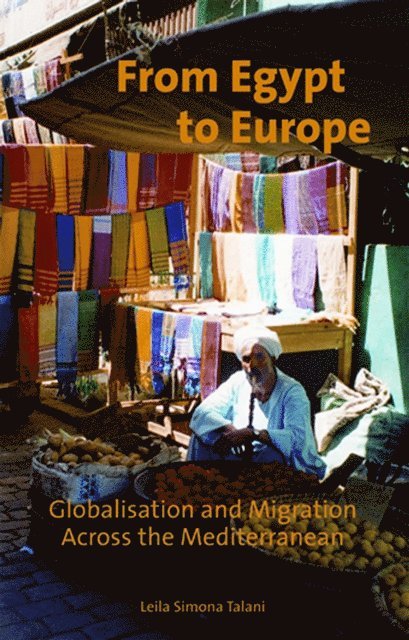
    From Egypt to Europe

    Globalisation and Migration Across the Mediterranean

    AvLeila Simona Talani

    E-bok
    PDF, Engelska, 2009

    2 113 kr

    Läs direkt i Bokus Reader – eller ladda ned till din enhet (PDF kräver ofta zoom och scroll på små skärmar).

    Fler format och utgåvor

    Inbunden

    1 952 kr

    Beskrivning

    How does the process of globalisation relate to the increase of migratory flows from less developed countries to western ones? This book explores the impact of globalisation upon migration from an international political economy perspective, paying particular attention to the dynamics of migration from the Middle East and North Africa area, especially Egypt, to the EU member countries. The theoretical aims of the book are to understand the problem of migration, both legal and illegal, in the context of globalisation, and to assess the relation between globalisation, marginalisation and the EU response to threats of mass immigration from less developed countries.

    Produktinformation

    • Utgivningsdatum:2009-11-30
    • Språk:Engelska
    • Antal sidor:288
    • Filformat:PDF
    • Kopieringsskydd:LCP
    • ISBN:9780857712769
    • Förlag:Bloomsbury Publishing PLC

    Utforska kategorier

    • Referensverk och tvärvetenskap inom Samhälle och politik
    • Migration inom Samhälle och politik
    • Statsvetenskap och politisk teori inom Samhälle och politik

    Mer om författaren

    Dr Simona Talani is a Lecturer in European Political Economy at the University of Bath, and a Research fellow at the London School of Economics.

    Innehållsförteckning

    • Introduction Chapter 1. Migration in theory: The state of the debate or the State in the debate? 1.1. Introduction 1.2. What is International Political Economy? 1.3. Mainstream versus critical IPE approaches: The State in thedebate 1.3.1 The political economy of immigration in the realisttradition 1.3.2 Liberal institutionalism and migration 1.3.3 The globalisation thesis: An introduction Chapter 2. The globalisation thesis within the globalisation debate 2.1. Introduction 2.2. A qualitative definition of globalisation 2.2.1 Globalisation and the State 2.2.1.1 Realist approaches: The globalisation myth andthe centrality of the State 2.2.1.2. Neo-institutionalist approaches: The transformation of the nation state in the global economy 2.2.1.3 Transnationalist approaches: The subordination of politics to economics 2.3. The new global division of labour and the increase of mass migration 2.4. Conclusion Chapter 3. Fortress Europe 3.1. Introduction 3.2. The evolution of 'Fortress Europe' 3.3. EU immigration models 3.4. Conclusion Chapter 4. Migration in practice: Egyptians did not emigrate! 4.1. Introduction 4.2. The policy of the Egyptian government 4.3. Egypt's migration dynamics 4.4. Egyptian migration today 4.5. Mapping the routes 4.5.1 The Spanish route 4.5.2 The Libyan route 4.5.3 The Turkish route 4.5.4 The Sarajevo route 4.5.5 Egypt as a transit country 4.6. Conclusion Chapter 5. Why do Egyptians migrate now?: The lack of integration in the MENA region 5.1. Introduction 5.2. The institutional steps towards more economic integration in theMENA region 5.3. Actual economic integration in the MENA region 5.3.1 Intraregional trade integration 5.3.2 Inter-Arab aid capital flows 5.4. Conclusion Chapter 6. Why do Egyptians migrate now?: The marginalisation of Egypt6.1. Introduction6.2. Steps towards an open and stable economy6.3. The marginalisation of Egypt6.3.1 Economic marginalisation 6.3.2 Other indicators of marginalisation 6.4. Conclusion Chapter 7. Who is the Egyptian migrant? 7.1. Introduction 7.2. The profi le of the Egyptian migrant: The 'homo economicus' 7.3. The profi le of the Moroccan migrant: From the homo economicus to the community-formation phase 7.4. Conclusion Chapter 8. What do Muslim migrants do in receiving countries? 8.1. Introduction 8.2. The integration of Muslim workers in the labour markets: General patterns in Europe 8.3. Egyptians abroad: brain drain or mass migration? 8.4. The insertion of migrants in the 'informal economy' and its consequences for receiving societies 8.5. Conclusion Chapter 9. 'Islamophobia' and social capital 9.1. Introduction9.2. 'Muslim voices': The enemy within 9.3. Instances of 'Islamophobia' before September 11 9.4. What is social capital? 9.5. The consequences of the lack of social capital among immigrant Muslim communities: the case of France 9.6. Conclusion