• Fri frakt över 249 kr
  • •
  • Snabba leveranser
  • •
  • Billiga böcker
Kundservice

Du är på sajten för privatpersoner.

Företag, bibliotek eller offentlig verksamhet?

Du handlar på classic.bokus.com, där alla dina funktioner finns intakta.
Till classic.bokus.com
Bokus logotyp. Gå till startsidan.
  • Erbjudanden
  • Nyheter
  • Student
  • Topplistor
  • Barn & ungdom
  • Bokus Play
  • E-böcker
  • Pocketböcker
  • Spel & pussel

10% rabatt på allt med kod: NYSTART10 →

Sidfot

Mina sidor

    Hjälp

    • Kundservice
    • Vanliga frågor och svar
    • Frakt och leverans
    • Retur vid ångerrätt
    • Reklamera vara
    • Betalning
    • Köpvillkor
    • Allmänna villkor
    • Information om webbplatsens tillgänglighet

    Om Bokus

    • Om oss
    • Pressrum
    • För studenter
    • För företag
    • För bibliotek och offentlig verksamhet
    • För leverantörer
    • Hållbarhet

    Populärt

    • Aktuella erbjudanden
    • Presentkort
    • Studentlitteratur
    • Nya böcker
    • Topplistor
    • Signerade böcker
    • Engelska böcker

    Inspiration

    • Boktips
    • BookTok
    • Populära bokserier
    • Barnbokskaraktärer
    • Populära författare
    Logotyp för Bokus
    Följ oss på Facebook (extern länk)Följ oss på Instagram (extern länk)Följ oss på YouTube (extern länk)Följ oss på TikTok (extern länk)
    bokus @ CookiesAnpassa cookiesIntegritetspolicyKöpvillkor
    Till Citymail hemsida (extern länk)Till Budbee hemsida (extern länk)Till Postnord hemsida (extern länk)Till Schenker hemsida (extern länk)Till Early Bird hemsida (extern länk)Till Walleys hemsida (extern länk)
    1. Samhälle och politik
    2. Politik och statsskick
    3. Statsvetenskap och politisk teori

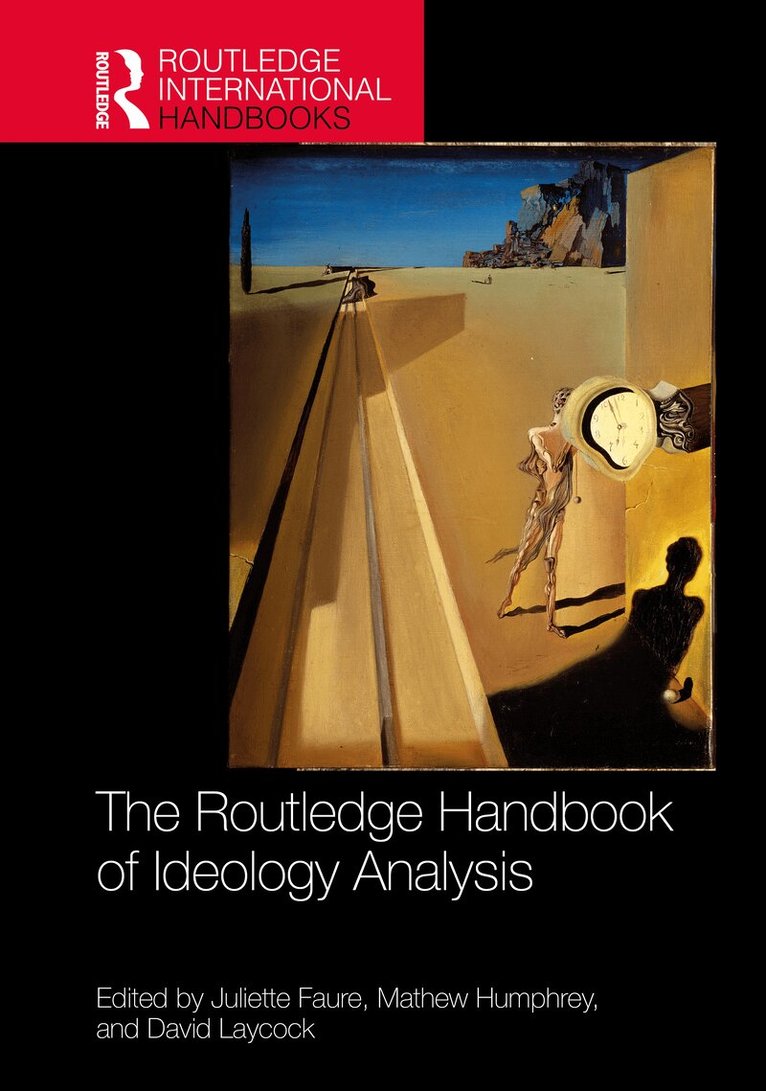
    Routledge Handbook of Ideology Analysis

    AvJuliette Faure,Mathew Humphrey

    Inbunden, Engelska, 2026

    Del i serien Routledge International Handbooks

    3 656 kr

    Beställningsvara. Skickas inom 10-15 vardagar. Fri frakt över 249 kr.

    Beskrivning

    This handbook offers a key interdisciplinary reference to advance ideology analysis.Expert contributors from the social sciences and humanities focus on the sources and construction of ideology and related processes of ideological transmission across time and space in political and social realms. Authors examine diverse forms of ideological activity, focusing on their interplay with institutions, organisations and cultural practices at macro, meso and micro levels. Chapters analyse vectors of ideological creation and transmission such as political parties, social movements, think tanks, organised groups and traditional and social media, as well as historical writing, literature and the visual arts. This volume demonstrates how a variety of complementary methods can aid our understanding of ideological creation, transmission and reception across macro, meso and micro fields.The Routledge Handbook of Ideology Analysis is an authoritative reference for students and scholars in political and social theory, political science, sociology and anthropology, cultural studies, literature, communications and history.The Routledge Handbook of Ideology Analysis is part of the mini-series ‘Routledge Handbooks on Political Ideologies, Practices and Interpretations’ edited by Michael Freeden.

    Produktinformation

    • Utgivningsdatum:2026-03-31
    • Mått:174 x 246 x 32 mm
    • Vikt:1 210 g
    • Format:Inbunden
    • Språk:Engelska
    • Serie:Routledge International Handbooks
    • Antal sidor:548
    • Förlag:Taylor & Francis Ltd
    • ISBN:9781032534350

    Utforska kategorier

    • Statsvetenskap och politisk teori inom Samhälle och politik
    • Politiska ideologier och rörelser inom Samhälle och politik
    • Filosofiska discipliner inom Filosofi och religion

    Mer om författaren

    Juliette Faure is Professor of Political Science at the University of Lille, France.Mathew Humphrey is Professor of Political Theory at the University of Nottingham, UK.David Laycock is Emeritus Professor of Political Science at Simon Fraser University, Canada.

    Recensioner i media

    “This comprehensive collection of cutting-edge work confirms what its authors have been telling us for decades: reports of the end of ideology are greatly exaggerated. The category remains descriptive of how politics happens across diverse settings and provides a crucial conceptual framework for understanding contemporary political actors, institutions and movements. The wide-ranging, grounded, and theoretically innovative chapters collected here are a remarkable resource for thinking, research and teaching. This could not have come at better time.”Darin Barney, McGill University, Canada“This is a remarkably strong volume, invaluable for anyone interested in the history, sociology, and theory of contemporary ideologies. The texts gathered here shed new light on the ways ideologies are produced, disseminated, and received. In a world where ideas truly matter, this book makes a vital contribution to our collective capacity to navigate it.”Samuel Hayat, Sciences Po Paris, France“Ideology analysis has been a fertile and versatile field in the study of politics. This wide-ranging and cutting-edge volume beautifully demonstrates its continued vitality. It will be essential reading for students of politics in all its dimensions.”Cécile Laborde, University of Oxford, UK“Ideologies abound in the contemporary world but can rarely be reduced to a few canonical texts. This volume shows us how to study them as elements in a wider ecology of institutions, organisations and communications, from parties and think-tanks to workplaces and digital platforms. An invaluable contribution to renewing the field.” Jonathan White, London School of Economics and Political Science, UK

    Innehållsförteckning

    • Introduction Section I: Theory and methods of analysis 1 The three traditions of ideological analysis and the levels-of-analysis problem 2 Ideology writ large: macroscopic compass or flawed totality 3 Analysing the ideologies of radical groups 4 Tools and debates in computational studies of online circulation of ideology: The case of the French radical right Section II: Historiography of ideological change 5 Liberalism and capitalist development: Outline for a comparative intellectual history 6 Plebeian internationalism: Building the “Universal Republic” in 19th-century social movements 7 Towards an environmental and contextualist history of anarchist ideology: Preventing the (over)greening of anarchism Section III: Defining and identifying ideologies8 Ideology, discourse, strategy: What exactly is populism? 9 Anti- racist ideology 10 Ideology, genealogy and the function of performative violence in antisemitism 11 The radical right and the ideologies of post- postmodern conservatism Section IV: Institutions and networks as ideological vectors 12 The role of advocacy think tanks: The war of ideas through research 13 Political parties as vehicles of ideologies 14 News, ideology and climate change: “You cannot begrudge people for wanting to feel better” 15 The International of Conservative Intellectuals: Transnational networks, illiberal inputs and ideological flexibility 16 Political elites, ideas and public policy: How ideologies and ideational transmission shape policy stability and change Section V: Exploring places of latent ideology 17 Ideology in the workplace: A psychological perspective on the hyper-normalisation of neoliberal beliefs 18 Analysing ideology in visual messages 19 The political psychology of ideology: Examining the palliative effects of ideology in the public 20 Non-human ideology: Samuel Johnson and animal studies Section VI: Technology and futurity 21 New and emerging technologies as the locus of ideology 22 Transhumanism as ideology 23 Science fiction and/as ideology Section VII: Ideological development across the continents 24 Populism, ideology and politics in Latin America 25 Ideological engineering in the evolution of China’s “Common values of all mankind” in the era of Xi Jinping 26 A meso- level sociology of philosophy approach to modern Confucianism 27 The rise of Hindutva: Contemporary political ideology in India 28 Political elite discourses polarise attitudes toward immigration along ideological lines: A comparative longitudinal analysis of Europe in the 21st century 29 Countering the myth of Russia’s “ideological vacuum”: Three alternative ways of doing ideology in post-Soviet times 30 The Christian Right in the United States: Mobilisation and ideology 31 Rethinking political corruption and ideology within African communalism