• Fri frakt över 249 kr
  • •
  • Snabba leveranser
  • •
  • Billiga böcker
Kundservice

Du är på sajten för privatpersoner.

Företag, bibliotek eller offentlig verksamhet?

Du handlar på classic.bokus.com, där alla dina funktioner finns intakta.
Till classic.bokus.com
Bokus logotyp. Gå till startsidan.
  • Erbjudanden
  • Nyheter
  • Student
  • Topplistor
  • Barn & ungdom
  • Bokus Play
  • E-böcker
  • Pocketböcker
  • Spel & pussel

10% rabatt på allt med kod: NYSTART10 →

Sidfot

Mina sidor

    Hjälp

    • Kundservice
    • Vanliga frågor och svar
    • Frakt och leverans
    • Retur vid ångerrätt
    • Reklamera vara
    • Betalning
    • Köpvillkor
    • Allmänna villkor
    • Information om webbplatsens tillgänglighet

    Om Bokus

    • Om oss
    • Pressrum
    • För studenter
    • För företag
    • För bibliotek och offentlig verksamhet
    • För leverantörer
    • Hållbarhet

    Populärt

    • Aktuella erbjudanden
    • Presentkort
    • Studentlitteratur
    • Nya böcker
    • Topplistor
    • Signerade böcker
    • Engelska böcker

    Inspiration

    • Boktips
    • BookTok
    • Populära bokserier
    • Barnbokskaraktärer
    • Populära författare
    Logotyp för Bokus
    Följ oss på Facebook (extern länk)Följ oss på Instagram (extern länk)Följ oss på YouTube (extern länk)Följ oss på TikTok (extern länk)
    bokus @ CookiesAnpassa cookiesIntegritetspolicyKöpvillkor
    Till Citymail hemsida (extern länk)Till Budbee hemsida (extern länk)Till Postnord hemsida (extern länk)Till Schenker hemsida (extern länk)Till Early Bird hemsida (extern länk)Till Walleys hemsida (extern länk)
    1. Samhälle och politik
    2. Samhälle och kultur
    3. Sociala grupper och identitet
    4. Genusvetenskap

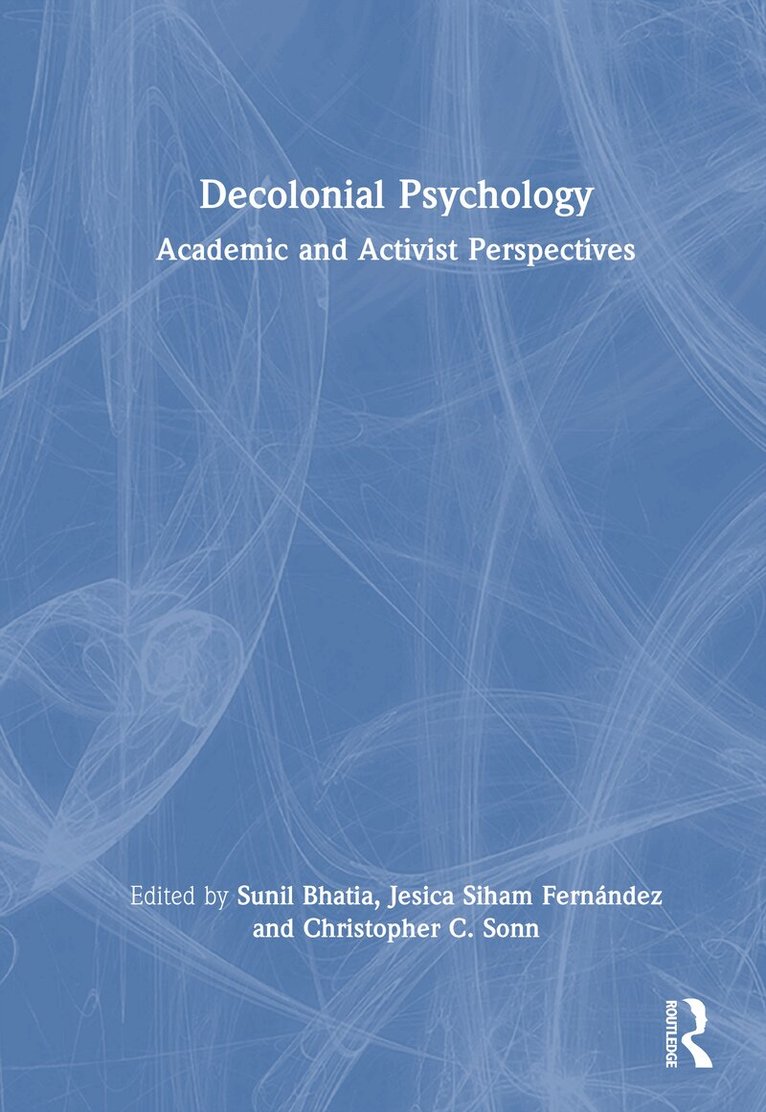
    Decolonial Psychology

    Academic and Activist Perspectives

    AvSunil Bhatia,Jesica Siham Fernández

    Inbunden, Engelska, 2025

    2 355 kr

    Beställningsvara. Skickas inom 10-15 vardagar. Fri frakt över 249 kr.

    Beskrivning

    This cutting-edge book re-imagines what a truly decolonial psychology could look like. It explores questions of what counts as psychological knowledge and whose knowledge is valid, and who controls the production of knowledge in psychology. This book builds on the expanding knowledge base in decolonial psychology to meaningfully address the varied social and psychological trajectories of decolonization and liberation.Featuring a wide range of international contributors, this book is grounded in an ethic of inclusion and includes contributions from researchers as well as contributions from those who engage in decolonial work outside of academia. It considers how the discipline of psychology could be transformed and how it can embrace a decolonial resistance with ideas about justice, freedom, and liberation. Drawing together a variety of expertise and ways of knowing that centers psychological research from the Global South, this book explores how we can decolonize the field and curriculum of psychology, imagining new future possibilities for the discipline.Accessibly and compellingly written, this will be essential reading for students and researchers interested in decolonizing psychology. It will be especially relevant for upper-level undergraduate and postgraduate students of cultural psychology, social psychology, and community psychology, as well as researchers, psychologists, and activists working with marginalized communities looking for ways to produce socially just knowledge.

    Produktinformation

    • Utgivningsdatum:2025-11-21
    • Mått:178 x 254 x 20 mm
    • Vikt:690 g
    • Format:Inbunden
    • Språk:Engelska
    • Antal sidor:264
    • Förlag:Taylor & Francis Ltd
    • ISBN:9781032794693

    Utforska kategorier

    • Genusvetenskap inom Samhälle och politik
    • Psykologiska teorier och skolor inom Psykologi och pedagogik
    • Genuspsykologi inom Psykologi och pedagogik

    Mer om författaren

    Sunil Bhatia is Professor of Human Development at Connecticut College, USA.Jesica Siham Fernández is an Assistant Professor in the Department of Ethnic Studies at Santa Clara University, USA.Christopher C. Sonn is Professor of Psychology at Victoria University, Australia.

    Recensioner i media

    "This is groundbreaking work of excellent scholarship that is consistently attentive to the community pertinent psychological issues and indeed the topical and relevant themes of liberation, geospatial realities, well-being, healing, love, relationalities, indigeneity, epistemology, pedagogy, and methodologies. It deploys decoloniality in its reconstitution of psychology to reflect concrete historical and contemporary lifeworlds of diverse people. I have nothing but praise for both the editors and the contributors for delivering this masterpiece. Decolonial Psychology: Academic and Activist Perspectives is a long overdue magisterial work of decolonization of knowledge in psychology making it combative and helpful to oppressed societies and peoples' struggles for re-existence. Reading this handbook is a journey in unlearning and relearning."Sabelo J. Ndlovu-Gatsheni, Professor of History and Canada Research Chair, University of Calgary, Canada"Decolonial Psychology: Academic and Activist Perspectives serves as both, an introduction, and an extension of psychology from the Global South. It is an essential textbook for those in psychology and related disciplines, as well for those interested in decoloniality."Nelson Maldonado-Torres, Department of Philospophy, University of Connecticut, USA"If you find you have a 'touch' of GFD (global fascist despair), Decolonial Psychology: Academic and Activist Perspectives is written for you. Aloe for the critical psychologists' soul, i encourage you to read/teach/take the volume to bed. The chapters remind us that psychologists who are dedicated to decolonial methods, excavating buried and stolen knowledges, re-imagining psychology as liberatory, are not alone. We are immersed in a rich, expansive and exhilarating chosen academic family/global movement of writers/theorists/researchers/teachers/activists dedicated to theory, inquiry, healing, solidarities and joy – within Psychology! Drawing from Global North and South, articulating colonial deposits, radical imaginaries, provocative forms of epistemic justice and aesthetic awakenings, the volume reminds of us of the critical psychological projects that have been pursued, by our ancestors, in hell/at the margins/in deeply oppressive conditions - with a cocktail of love, wisdom and rage; the work that is being launched collaboratively in dangerous and demanding circumstances and the work that must be done to nourish the liberatory not yet as critically engaged scholar activists in a global chain of possibilities. The best medicine for despair may be friends, books, radical ideas, knowing from where we come and imagining where we are headed - together."Michelle Fine, Distinguished Professor of Critical Psychology and Urban Education, The Graduate Center, CUNY, USA"Decolonial Psychology: Academic and Activist Perspectives showcases the diverse efforts that challenge the dominant Euro-American psychological frameworks that perpetuate colonial legacies. It critiques the prevailing Euro-American models, which often ignore the experiences of the Global South and underrepresented groups, reinforcing colonial logic. It highlights the ethical imperative to include diverse perspectives in psychological research and practice as current practices often overlook the lived realities of marginalized communities. It would serve as a valuable resource for reimagining psychology as a discipline that prioritizes healing and collective well-being over individual achievement. It calls for a transformative approach that embraces diverse epistemologies, ultimately striving for a more humane and inclusive psychological practice that honors the complexities of human experiences across different geographies. An outstanding volume that richly illustrates the tremendous possibilities of decolonial psychology."Girishwar Misra, Ph.D., Ex Vice Chancellor, Mahatma Gandhi Antarrashtriya Hindi Vishwavidyalaya, India"A candid, yet devastatingly honest revelation of the array of psychologies that have been practiced widely across a broad swathe of physical and social geographies in the majority world, yet have endured erasure, silencing or subordination. Bhatia, Fernández and Sonn reflect and refract a contemporary genre of critical thinking and practice amongst scholars and practitioners of decolonial psychology, who are unapologetic about surfacing the manner in which this psychology manifests in the long wake of coloniality, on the margins, in the borderlands, and from the majority world. Undaunted by the historical weight of dominant Western and Northern epistemes, they uncover the myriad of ways in which psychology, in these contexts, generates new knowledges as a form of social history from below; can retrieve and draw on the indigenous and localized lived experiences of those for whom it is meant to be a benefit; and ultimately, can transcend the institutional strictures of universities to become a truly decolonial practice that moves from a form of thinking to a mode of active doing and being in the world. This book is a must read and a call to action for all those interested in decolonial psychology, a psychology that is alive and open to become less bounded by Western epistemes and social histories, and a psychology that can be refigured, reshaped and reclaimed to become a more expansive archive of knowledge and practice that is reflective of a more inclusive and egalitarian polity."Garth Stevens, Professor of Psychology and Deputy Vice-Chancellor, University of the Witwatersrand, Johannesburg, South Africa"This volume continues the work of scholars and activists from colonized worlds to circulate liberatory knowledge of resistance, survival and healing" Clare Land, Moondani Balluk Academic Unit, Victoria University, Australia

    Innehållsförteckning

    • 1. Introduction: Expanding geographies of decolonial psychologySunil Bhatia, Jesica Fernandez, Christopher C. SonnDecolonizing the Curriculum of Psychology: Concepts, Stories, Lives, and Possibilities 2. Embracing Social and Emotional Wellbeing Can Create Transformational Change in PsychologyBelle Selkirk, Joanna Alexi, Tanja, Hirvonen, Pat Dudgeon3. Decolonizing psychology education in the Indonesian context: Toward a socio-historically engaged pedagogyMonica E. Madyaningrum, Albertus Harimurti4. Co-Creating Transdisciplinary Decolonial CurriculaNuria Ciofalo, Chela Sandoval, PJ DiPietro, Susan James, Karen Jarratt-Snider, Jenny Escobar5. Decolonial Alchemy: From Oppression to LiberationAndi Lee, Mercedes Santana, Shelly Harrell, Lillian Comas-Diaz6. Decolonial Voices in Education: Resistance, Critical Epistemology and Shaping of the Psychology of Education in India Chetan SinhaIndigenous Retrieval and Community Building Across Self, Body, Place: Psychology of Healing Resistance, and Relationality 7. Indigenous Healing Psychology from ancestral community bases of the Pitaguary and Jenipapo Kaninde people in Northeast BrazilJames Ferreira Moura Júnior, Larissa Niemann Pellicer, Sandra Patricia Acosta Salazar, Antonio Ailton de Sousa Lima, Juliana Murta de Lima, Marina Pereira Passos Campos, Socorro Taynara Araújo Carvalho, Rosa Pitaguary, Juliana Alves Jenipapo Kaninde8. Decolonial Love in Action: Centering Spiritual Solidarity in Restorative and Transformative JusticeJenny Escobar9. THE BLACK MAP PROJECT: An Online Installation of Afrodynamic Healing WaysBritton Williams10. “Al-Umm Bitlim”: A Life -Source and Life -Force Amid Grief, Loss, and DeathHana Masud11. Interstitial Onto-Epistemologies in Liberatory Praxis & Clinical PracticeZenobia Morrill12. Wangi Bangala: Baskets of Listening and RespectMary Goslett, Belle SelkirkDisrupting Methods: Going Beyond the University 13. The intersections of ethnicity, exposure to extreme temperature and mortality under a decolonial spotlightBridgette Masters-Awatere, Darelle Howard, Shaun Awatere, Bill Cochrane, Kendon Bell14. Centring Land In Decolonising Iterations Of Psychology: Making The Case From South AfricaNicholas Malherbe, Shahnaaz Suffla, Mohamed Seedat15. Narratives of young people in Lahore navigating multiple belongings, expectations, and aspirations in the process of ‘becoming’Irum Maqbool16. The Forgotten Ones: On memorialising the life of Nokukhanya LuthuliPuleng Segalo, Tinyiko Chauke17. Archiving Lebanese women in diaspora: The necessity of decolonial frameworksJanan Shouhayib18. (Mis)recognition, (De)coloniality and Climate Psychology: implications for marginalised youth climate activismBrendon Barnes