• Fri frakt över 249 kr
  • •
  • Snabba leveranser
  • •
  • Billiga böcker
Kundservice

Du är på sajten för privatpersoner.

Företag, bibliotek eller offentlig verksamhet?

Du handlar på classic.bokus.com, där alla dina funktioner finns intakta.
Till classic.bokus.com
Bokus logotyp. Gå till startsidan.
  • Erbjudanden
  • Nyheter
  • Student
  • Topplistor
  • Barn & ungdom
  • Bokus Play
  • E-böcker
  • Pocketböcker
  • Spel & pussel

10% rabatt på allt med kod NYSTART10 →

Sidfot

Mina sidor

    Hjälp

    • Kundservice
    • Vanliga frågor och svar
    • Frakt och leverans
    • Retur vid ångerrätt
    • Reklamera vara
    • Betalning
    • Köpvillkor
    • Allmänna villkor
    • Information om webbplatsens tillgänglighet

    Om Bokus

    • Om oss
    • Pressrum
    • För studenter
    • För företag
    • För bibliotek och offentlig verksamhet
    • För leverantörer
    • Hållbarhet

    Populärt

    • Aktuella erbjudanden
    • Presentkort
    • Studentlitteratur
    • Nya böcker
    • Topplistor
    • Signerade böcker
    • Engelska böcker

    Inspiration

    • Boktips
    • BookTok
    • Populära bokserier
    • Barnbokskaraktärer
    • Populära författare
    Logotyp för Bokus
    Följ oss på Facebook (extern länk)Följ oss på Instagram (extern länk)Följ oss på YouTube (extern länk)Följ oss på TikTok (extern länk)
    bokus @ CookiesAnpassa cookiesIntegritetspolicyKöpvillkor
    Till Citymail hemsida (extern länk)Till Budbee hemsida (extern länk)Till Postnord hemsida (extern länk)Till Schenker hemsida (extern länk)Till Early Bird hemsida (extern länk)Till Walleys hemsida (extern länk)
    1. Psykologi och pedagogik
    2. Psykologi
    3. Barnpsykologi och utvecklingspsykologi

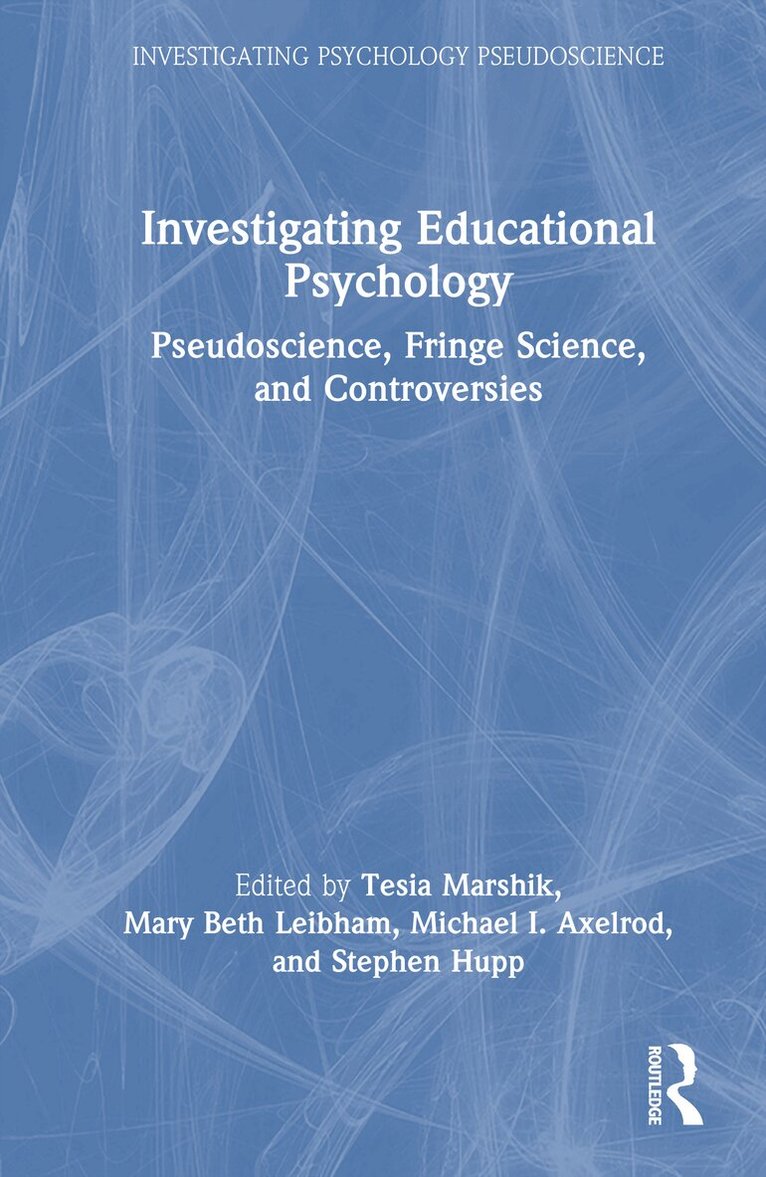
    Investigating Educational Psychology

    Pseudoscience, Fringe Science, and Controversies

    AvTesia Marshik,Mary Beth Leibham

    Inbunden, Engelska, 2026

    Del i serien Investigating Psychology Pseudoscience

    2 355 kr

    Slutsåld

    Beskrivning

    Investigating Educational Psychology explores the field of educational psychology through the lens of pseudoscience and fringe science.The field of education is particularly susceptible to pseudoscientific fads that remain persistent despite a lack of supporting evidence. In this book a panel of experts honor the role of science in the field, whilst also exploring and guarding against the harmful effects of pseudoscience. They examine a range of topics, including single-sex schooling, cognitive development, social-emotional development, learning styles and theories, literacy, video games and youth aggression, ability grouping, and assessment. Each chapter analyzes several claims within an area and equips the reader with the skills needed to differentiate between pseudoscientific and evidence-based approaches in both study and practice.The book offers an important supplement for both undergraduate and graduate educational psychology courses. It will also be useful for practicing educational psychologists and teachers, as well as anyone interested in pseudoscience within the education sector.

    Produktinformation

    • Utgivningsdatum:2026-11-23
    • Mått:152 x 229 x undefined mm
    • Format:Inbunden
    • Språk:Engelska
    • Serie:Investigating Psychology Pseudoscience
    • Antal sidor:222
    • Förlag:Taylor & Francis Ltd
    • ISBN:9781032835754

    Utforska kategorier

    • Barnpsykologi och utvecklingspsykologi inom Psykologi och pedagogik
    • Socialpsykologi och gruppsykologi inom Psykologi och pedagogik
    • Kognitiv psykologi inom Psykologi och pedagogik

    Mer om författaren

    Tesia Marshik is Professor of Psychology at the University of Wisconsin – La Crosse, USA.Mary Beth Leibham is Professor of Psychology at the University of Wisconsin – Eau Claire, USA.Michael I. Axelrod is Professor of Psychology at the University of Wisconsin – Eau Claire, USA.Stephen Hupp is Professor of Clinical Child & School Psychology at Southern Illinois University Edwardsville, USA.

    Innehållsförteckning

    • Other WorksList of ContributorsPrefaceAcknowledgementsChapter 1: The Problem of Misinformation in EducationTesia MarshikChapter 2: Single-Sex SchoolingErin Pahlke and Katherine NagelChapter 3: Cognitive Development Occurs in StagesGrace Murray Willer, Shannon R. Zentall, Bradley J. MorrisChapter 4: Desirable Difficulties and Social-Emotional DevelopmentApril Bleske-RechekChapter 5: Learning StylesJoshua A. CuevasChapter 6: Balanced Literacy vs. Structured LiteracyMatthew K. Burns, Florence Bason, and Lauren KernChapter 7: Behavioral Learning TheoriesScott Bellini, Devin I. Byers, Lindsey Camden, Danielle Gesell, Grace Mummert, Madison O. Dahl, and Hannah L. PawlowskiChapter 8: Multitasking and Brain Training Megan A. Sumeracki and Cynthia L. NebelChapter 9: Typed vs. Handwritten NotesDavid J. Therriault and Lise AbramsChapter 10: Correcting MisconceptionsPaul Kirschner and Pedro de BruyckereChapter 11: Violent Video Games and Youth AggressionWayne A. Warburton, Courtney Plante, Craig A. Anderson, Zoe Dalziel, Laetitia Carlile-Purcarea, and Brenton BellChapter 12: Growth Mindset and GritP. L. ThomasChapter 13: Ability Grouping and Student Learning Andrew L. Wiley, Dimitris Anastasiou, and Rachel KorankyeChapter 14: Fidget Devices and DoodlingKathleen AspirantiChapter15: AssessmentSharon Nichols and Ian Thacker