• Fri frakt över 249 kr
  • •
  • Snabba leveranser
  • •
  • Billiga böcker
Kundservice

Du är på sajten för privatpersoner.

Företag, bibliotek eller offentlig verksamhet?

Du handlar på classic.bokus.com, där alla dina funktioner finns intakta.
Till classic.bokus.com
Bokus logotyp. Gå till startsidan.
  • Erbjudanden
  • Nyheter
  • Student
  • Topplistor
  • Barn & ungdom
  • Bokus Play
  • E-böcker
  • Pocketböcker
  • Spel & pussel

10% rabatt på allt med kod: NYSTART10 →

Sidfot

Mina sidor

    Hjälp

    • Kundservice
    • Vanliga frågor och svar
    • Frakt och leverans
    • Retur vid ångerrätt
    • Reklamera vara
    • Betalning
    • Köpvillkor
    • Allmänna villkor
    • Information om webbplatsens tillgänglighet

    Om Bokus

    • Om oss
    • Pressrum
    • För studenter
    • För företag
    • För bibliotek och offentlig verksamhet
    • För leverantörer
    • Hållbarhet

    Populärt

    • Aktuella erbjudanden
    • Presentkort
    • Studentlitteratur
    • Nya böcker
    • Topplistor
    • Signerade böcker
    • Engelska böcker

    Inspiration

    • Boktips
    • BookTok
    • Populära bokserier
    • Barnbokskaraktärer
    • Populära författare
    Logotyp för Bokus
    Följ oss på Facebook (extern länk)Följ oss på Instagram (extern länk)Följ oss på YouTube (extern länk)Följ oss på TikTok (extern länk)
    bokus @ CookiesAnpassa cookiesIntegritetspolicyKöpvillkor
    Till Citymail hemsida (extern länk)Till Budbee hemsida (extern länk)Till Postnord hemsida (extern länk)Till Schenker hemsida (extern länk)Till Early Bird hemsida (extern länk)Till Walleys hemsida (extern länk)
    1. Psykologi och pedagogik
    2. Pedagogik
    3. Pedagogisk teori och filosofi
    • Nyhet

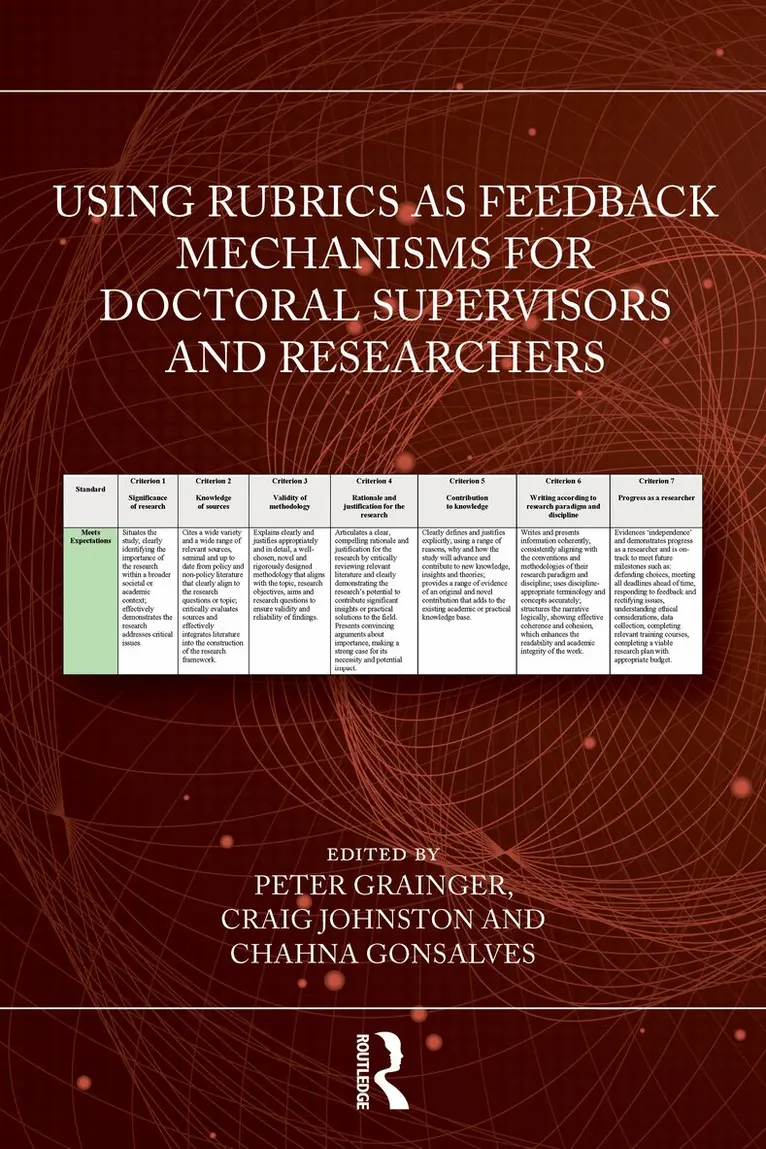
    Using Rubrics as Feedback Mechanisms for Doctoral Supervisors and Researchers

    AvPeter Grainger,Craig Johnston

    Häftad, Engelska, 2026

    443 kr

    Beställningsvara. Skickas inom 10-15 vardagar. Fri frakt över 249 kr.

    Beskrivning

    This book examines the use of formative rubrics as a feedback mechanism in doctoral education, redefining rubrics as formative assessment artefacts as well as summative scoring methods. Grainger, Johnston and Gonsalves bring together insights from globally recognised experts to position rubrics as formative assessment criteria-based tools that provide feedback to guide both supervisors and students.Featuring example rubrics and drawing on research findings, the book includes chapters on using rubrics to guide student self-reflection and as a scaffold for doctoral learning dialogue, social pressures in thesis examination and the use of generative AI in formative assessment. The content shows how rubrics can function as a key mechanism for clarifying behavioural expectations, guiding doctoral candidates, potentially reducing student attrition and ensuring timely completions.An essential resource for doctoral supervisors, the book is also a worthwhile read for doctoral students interested in using rubrics to improve their writing via structured feedback.

    Produktinformation

    • Utgivningsdatum:2026-09-16
    • Mått:156 x 234 x 11 mm
    • Vikt:370 g
    • Format:Häftad
    • Språk:Engelska
    • Antal sidor:180
    • Förlag:Taylor & Francis Ltd
    • ISBN:9781041142140

    Utforska kategorier

    • Pedagogisk teori och filosofi inom Psykologi och pedagogik
    • Examination och betygsättning inom Psykologi och pedagogik
    • Högskola och universitet inom Psykologi och pedagogik

    Mer om författaren

    Peter Grainger (PhD) is a Senior Lecturer in Education at the University of the Sunshine Coast, Australia. He is a prolific publisher of assessment related research, especially around the design and efficacy of rubrics in undergraduate and postgraduate education contexts, including doctoral education. His recent research focuses on feedback literacy of doctoral students and supervisors and the potential of formative assessment criteria-based tools (FACTs) to act as additional feedback mechanisms.Craig Johnston (PhD) is an early career researcher at the University of the Sunshine Coast, Australia. His most recent research focuses on assessment rubrics, particularly the ways in which generative artificial intelligence (AI) can be used to as an alternate formative feedback tool for students.Chahna Gonsalves (PhD) is a Senior Lecturer in Marketing (Education), at King’s College London, UK, where her research and scholarship focus on assessment and feedback, generative AI, communication, and message impact. Chahna is the Department Education Lead and a Senior Fellow of Advance HE.

    Recensioner i media

    "This superbly edited collection by Grainger, Johnston and Gonsalves is authored by international experts in the field of assessment. Providing a blueprint for change in the way we consider, design and apply rubrics to doctoral education is a much needed and timely contribution to the debate about the modern PhD"- Karen Clegg, Reader in Doctoral Education in the School for Arts and Creative Technologies at the University of York and Co-PI/Director of the Next Generation Research SuperVision Project (RSVP), U.K.

    Innehållsförteckning

    • Chapter 1 Introduction: A need for reform?Peter GraingerChapter 2 Adapting doctoral assessment to the pedagogy of the doctoral journey while maintaining diversityPam DenicoloChapter 3 Reimagining rubrics in doctoral education: From evaluation instruments to tools for teaching, learning, and supervisionHeidi Andrade and Elie ChingYen YuChapter 4 Making connections: a UK perspective on how rubric-specific formative feedback can improve the doctoral researcher experience and outcomesGillian HoustonChapter 5 It’s all about me: Guiding self-reflection of doctoral students to a state of critical being Christine Edwards-LeisChapter 6 Making the rules visible: Hidden curricula, epistemic validity, and the design of doctoral rubricsChahna GonsalvesChapter 7 Making visible quality standards for theses in higher educationMichelle JacobsenChapter 8 Testing a formative feedback rubric as a means of scaffolding and engineering generative AI responses for doctoral candidatesCraig Johnston and Suzanne BarryChapter 9 Evaluating a formative rubric for doctoral education: Insights from the F.A.C.T.Peter Grainger, Christine Edwards-Leis, Joseph Scott, Michael Carey, Melinda DeanChapter 10 Conclusion: Rubrics, doctoral assessment, and the future of doctoratenessAnders Jönsson and Ernesto Panadero