• Fri frakt över 249 kr
  • •
  • Snabba leveranser
  • •
  • Billiga böcker
Kundservice

Du är på sajten för privatpersoner.

Företag, bibliotek eller offentlig verksamhet?

Du handlar på classic.bokus.com, där alla dina funktioner finns intakta.
Till classic.bokus.com
Bokus logotyp. Gå till startsidan.
  • Erbjudanden
  • Nyheter
  • Student
  • Topplistor
  • Barn & ungdom
  • Bokus Play
  • E-böcker
  • Pocketböcker
  • Spel & pussel

10% rabatt på allt med kod: NYSTART10 →

Sidfot

Mina sidor

    Hjälp

    • Kundservice
    • Vanliga frågor och svar
    • Frakt och leverans
    • Retur vid ångerrätt
    • Reklamera vara
    • Betalning
    • Köpvillkor
    • Allmänna villkor
    • Information om webbplatsens tillgänglighet

    Om Bokus

    • Om oss
    • Pressrum
    • För studenter
    • För företag
    • För bibliotek och offentlig verksamhet
    • För leverantörer
    • Hållbarhet

    Populärt

    • Aktuella erbjudanden
    • Presentkort
    • Studentlitteratur
    • Nya böcker
    • Topplistor
    • Signerade böcker
    • Engelska böcker

    Inspiration

    • Boktips
    • BookTok
    • Populära bokserier
    • Barnbokskaraktärer
    • Populära författare
    Logotyp för Bokus
    Följ oss på Facebook (extern länk)Följ oss på Instagram (extern länk)Följ oss på YouTube (extern länk)Följ oss på TikTok (extern länk)
    bokus @ CookiesAnpassa cookiesIntegritetspolicyKöpvillkor
    Till Citymail hemsida (extern länk)Till Budbee hemsida (extern länk)Till Postnord hemsida (extern länk)Till Schenker hemsida (extern länk)Till Early Bird hemsida (extern länk)Till Walleys hemsida (extern länk)
    1. Kultur
    2. Scenkonst och film
    3. Film

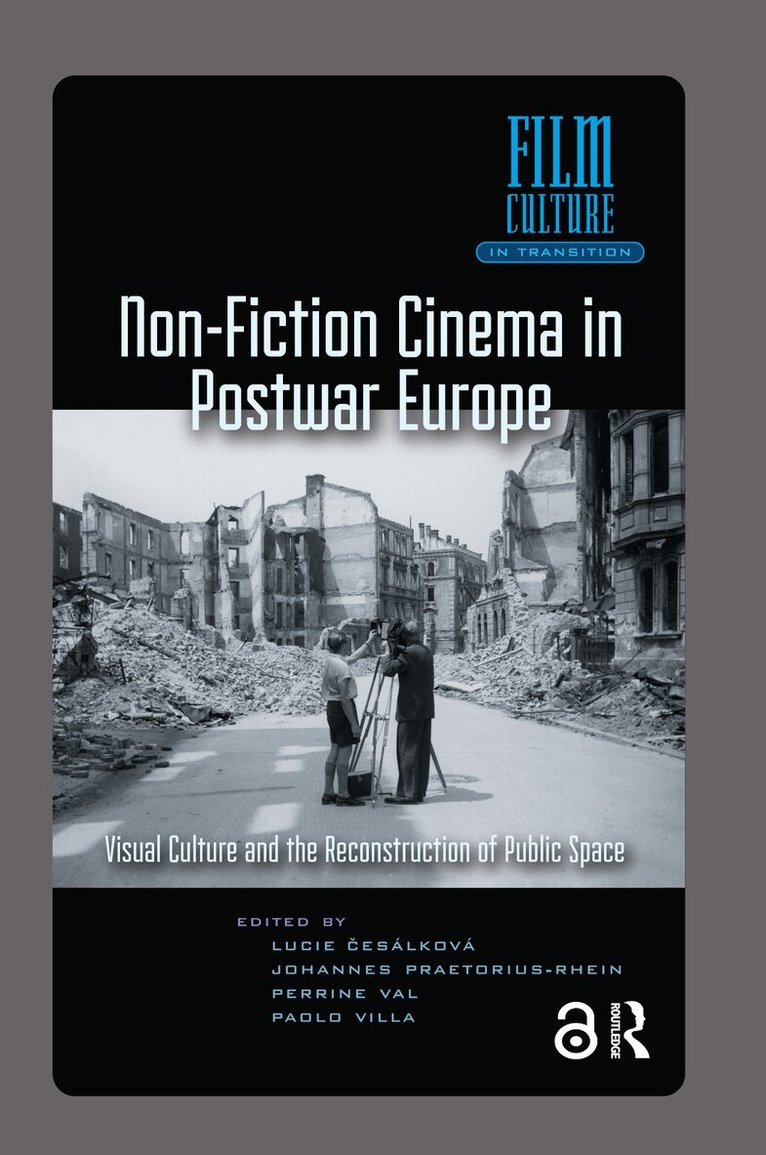
    Non-Fiction Cinema in Postwar Europe

    Visual Culture and the Reconstruction of Public Space

    AvLucie Cesalkova,Johannes Praetorius-Rhein

    Häftad, Engelska, 2025

    Del i serien Film Culture in Transition

    701 kr

    Beställningsvara. Skickas inom 10-15 vardagar. Fri frakt över 249 kr.

    Beskrivning

    After WWII, cinema was everywhere: in movie theatres, public squares, factories, schools, trial courts, trains, museums, and political meetings. Seen today, documentaries and newsreels, as well as the amateur production, show the kaleidoscopic portrait of a changing Europe. How did these cinematic images contribute to shaping the new societies emerging from the ashes of war, both in the Western and in the Eastern bloc? Why were they so crucial in framing and regulating new places and practices, political systems, economic dynamics, educational frameworks, and memory communities? This edited volume explores the multiple ways nonfiction cinema reconfigured public spaces, collective participation, democratisation, and governmentality between 1944 and 1956. Looking back at it through a transnational perspective and the critical category of spatiality, nonfiction cinema appears in a new light: simultaneously as a specifically situated and as a highly mobile medium, it was a fundamental agent in reshaping Europe’s shared identity and culture in a defining decade.

    Produktinformation

    • Utgivningsdatum:2025-12-01
    • Mått:156 x 234 x 27 mm
    • Vikt:722 g
    • Format:Häftad
    • Språk:Engelska
    • Serie:Film Culture in Transition
    • Antal sidor:518
    • Förlag:Taylor & Francis Ltd
    • ISBN:9781041183624

    Utforska kategorier

    • Film inom Kultur
    • Kulturvetenskap inom Samhälle och politik
    • Europas historia inom Historia och arkeologi

    Mer om författaren

    Lucie Cesalkova is an Associate Professor at the Department of Film Studies, Charles University, and an editor at Prague’s National Film Archive. At the Institute of Contemporary History, CAS, she was the Principal Investigator of the HERA funded international project Visual Culture of Trauma, Obliteration, and Reconstruction in Post-World War II Europe. In her research she focuses on nonfiction and documentary film, educational and advertising film, on film exhibition and moviegoing. Johannes Praetorius-Rhein is a research associate at the Konrad Wolf Film University of Babelsberg (Potsdam) and an adjunct lecturer at Goethe-University Frankfurt am Main. Previously, he was a researcher at the Goethe-University for the ViCTOR-E-project. His research focuses on postwar cinema, Jewish film history, and producer studies. Perrine Val is a film historian. She is a lecturer at the Université Paul Valéry-Montpellier 3. Her research focuses on transnational cinematographic exchanges during the Cold War. She published a book based on her Ph.D. thesis about the cinematographic relationships between France and the GDR, entitled Les relations cinématographiques entre la France et la RDA: entre camaraderie, bureaucratie et exotisme (1946–1992) (Villeneuve d’Asq: Presses Universitaires du Septentrion, 2021). Paolo Villa is a researcher at the University of Parma and a former postdoc toral fellow at the Universities of Udine and Pavia-Cremona. In addition to articles in journals and edited volumes, he authored a book on art documentaries in Italy, La camera di Stendhal. Il film sull’arte in Italia (1945–1970).

    Innehållsförteckning

    • Preface: (Re)Building Europe Through Cinema (Studies), Section 1 Locating Non-Fiction Film, Section 2 Reconstructing Realities, Section 3 Spaces of Cultural Trauma, Section 4 Creating New Paths, List of Abbreviations, Bibliography, Index