• Fri frakt över 249 kr
  • •
  • Snabba leveranser
  • •
  • Billiga böcker
Kundservice

Du är på sajten för privatpersoner.

Företag, bibliotek eller offentlig verksamhet?

Du handlar på classic.bokus.com, där alla dina funktioner finns intakta.
Till classic.bokus.com
Bokus logotyp. Gå till startsidan.
  • Erbjudanden
  • Nyheter
  • Student
  • Topplistor
  • Barn & ungdom
  • Bokus Play
  • E-böcker
  • Pocketböcker
  • Spel & pussel

Må bättre, för mindre! Upp till 50% rabatt på hälsoböcker

Sidfot

Mina sidor

    Hjälp

    • Kundservice
    • Vanliga frågor och svar
    • Frakt och leverans
    • Retur vid ångerrätt
    • Reklamera vara
    • Betalning
    • Köpvillkor
    • Allmänna villkor
    • Information om webbplatsens tillgänglighet

    Om Bokus

    • Om oss
    • Pressrum
    • För studenter
    • För företag
    • För bibliotek och offentlig verksamhet
    • För leverantörer
    • Hållbarhet

    Populärt

    • Aktuella erbjudanden
    • Presentkort
    • Studentlitteratur
    • Nya böcker
    • Topplistor
    • Signerade böcker
    • Engelska böcker

    Inspiration

    • Boktips
    • BookTok
    • Populära bokserier
    • Barnbokskaraktärer
    • Populära författare
    Logotyp för Bokus
    Följ oss på Facebook (extern länk)Följ oss på Instagram (extern länk)Följ oss på YouTube (extern länk)Följ oss på TikTok (extern länk)
    bokus @ CookiesAnpassa cookiesIntegritetspolicyKöpvillkor
    Till Citymail hemsida (extern länk)Till Budbee hemsida (extern länk)Till Postnord hemsida (extern länk)Till Schenker hemsida (extern länk)Till Early Bird hemsida (extern länk)Till Walleys hemsida (extern länk)
    1. Naturvetenskap och teknik
    2. Geovetenskap
    3. Miljövetenskap och miljöpolitik

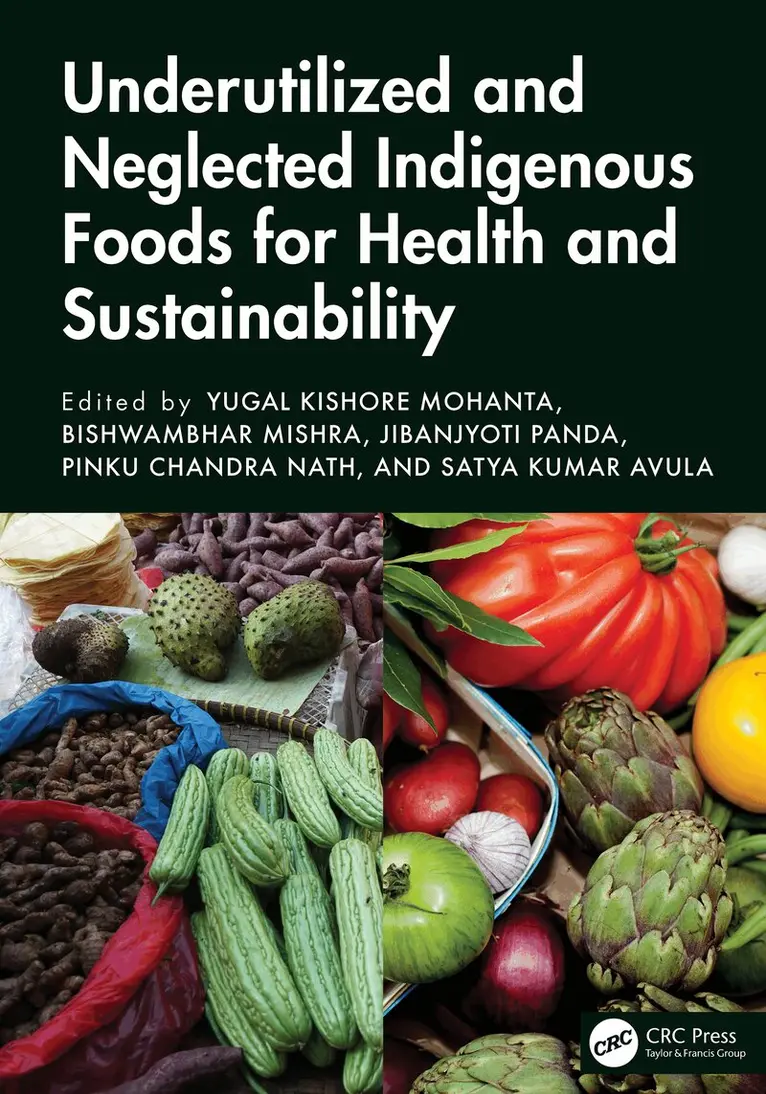
    Underutilized and Neglected Indigenous Foods for Health and Sustainability

    AvYugal Kishore Mohanta,Bishwambhar Mishra

    Inbunden, Engelska, 2026

    1 761 kr

    Slutsåld

    Beskrivning

    Underutilized and Neglected Indigenous Foods for Health and Sustainability explores the hidden potential of traditional food systems that have long been overlooked in modern diets. Drawing on scientific insights, cultural knowledge, and sustainability perspectives. This book highlights nutrient-rich, climate-resilient crops that can play a vital role in addressing global challenges such as malnutrition, biodiversity loss, and food insecurity. By reconnecting readers with indigenous foods and the communities that preserve them, it offers a compelling vision for a healthier, more sustainable future—one rooted in diversity, resilience, and respect for local knowledge.Features· Explores a wide range of underutilized and neglected indigenous foods and their nutritional benefits· Highlights the role of traditional crops in promoting health and preventing malnutrition· Examines sustainability aspects, including climate resilience and biodiversity conservation· Integrates scientific research with indigenous knowledge and cultural practices· Presents case studies and real-world examples from different regions· Brief the role of consumer awareness and behavioural change in sustainable food practice

    Produktinformation

    • Utgivningsdatum:2026-11-24
    • Mått:178 x 254 x undefined mm
    • Format:Inbunden
    • Språk:Engelska
    • Antal sidor:284
    • Förlag:Taylor & Francis Ltd
    • ISBN:9781041216971

    Utforska kategorier

    • Miljövetenskap och miljöpolitik inom Naturvetenskap och teknik
    • Lantbruksteknik inom Naturvetenskap och teknik
    • Agronomi och lantbruk inom Naturvetenskap och teknik

    Mer om författaren

    Dr. Yugal Kishore Mohanta is currently serving as Assistant Professor in the Department of Applied Biology at University of Science and Technology Meghalaya (USTM), India. With a M.Sc., Ph.D. and post-doctoral training, his specialisations lie in nanobiotechnology, microbiology, and sustainable-development oriented research. Dr. Mohanta leads the “NanoBioTraK_Lab”, supported by a DST-ANRF grant (2022–2024), Govt. of India and Research Networking Project-2024 sponsored by XJENZA MALTA, Govt. of Malta, where his team works on developing bio-functional nanomaterials including nano-antimicrobials and nano-nutraceuticals from natural bioresources for applications in food, agriculture, medicine, and environmental sustainability. A prolific researcher, he has authored over 130+ peer-reviewed articles in SCIE-indexed journals, 44+ book chapters, filed 4 Indian patents, edited 10+ books published by reputed publishing houses such as CRC Press, Elsevier and Springer Nature, and contributed multiple book chapters. His work has earned significant recognition in 2025 that he was ranked among the “Top 2% Scientists in the World” by Stanford University (USA), underscoring his global impact in the field of strategic nanobiotechnology. Beyond lab-based research, Dr. Mohanta embraces translational science, where translating lab discoveries into real-world solutions for sustainable development. Dr. Mohanta stands out as a researcher-educator bridging nanotechnology, microbiology and sustainability, making significant contributions at both national and global levels.Dr. Bishwambhar Mishra brings over a decade of experience in teaching and research and is currently an Assistant Professor in the Department of Biotechnology at Chaitanya Bharathi Institute of Technology in Hyderabad, India. His primary research areas include industrial microbiology and nanobiotechnology, with a focus on their applications. His work is aimed at harnessing the potential of microorganisms to address pressing global challenges such as environmental sustainability, food security, and resource management. Dr. Mishra has made significant contributions to the scientific community, authoring 92 research publications in high-impact, SCIE-indexed journals, with his work garnering more than 2,300+ citations with h-index of 25, and an i10-index of 52. These publications reflect the high calibre of his research, spanning various interdisciplinary domains. In addition to his extensive publication record, he has authored 3 books that further advance knowledge in the field. Dr. Mishra has served as a reviewer for over 100 prestigious international journals, including those published by renowned publishers such as RSC, ACS, Taylor & Francis, Springer, Elsevier, Wiley, Frontiers, and MDPI. His expertise is further recognized through his role as Topical Editor and Editorial board member of SCIE-indexed journals, where he plays a critical role in shaping scientific discourse and guiding future research.Mr. Jibanjyoti Panda is currently working as a pre-doctoral scientist at the Department of Wildlife and Biodiversity Conservation, Maharaja Sriram Chandra Bhanja Deo University, Baripada, Mayurbhanj 757003, Odisha, India. With his MS & M.Phil. training, he possesses more than 10 years of research experience in the domains of microbiology, biotechnology, natural products, fermented food, waste valorization, mushroom biology, and SDGs. Furthermore, Mr. Panda has extensive experience in mushroom technology, encompassing field surveys, collection, isolation, spawning, cultivation, mushroom bioactive, and nutraceuticals. He has also worked on numerous research projects funded by both the Government of Odisha and the Government of India, including those from the Department of Biotechnology (DBT) and the Department of Science and Technology (DST). He has effectively published more than 60 scientific publications (SCIE) garnering 1000+ citations and h-index 17 and one edited book in CRC Press.Dr. Pinku Chandra Nath presently, working as an Assistant Professor, Department of Bioengineering, School of Engineering and Architecture, Techno India University, Tripura, India. He has more than 8 years research experience in the area of waste bioremediation, food fortification, environmental biotechnology, algal technology, food safety, food microbiology and food chemistry. He has published 45 papers in international peer-reviewed journals, 4 Indian patents, 2 edited books, and 35 book chapters with an h-index of 21, i10-index of 30, google scholar citations 1941, and cumulative impact factor more than 180, first/corresponding author (>80%). Additionally, he has served as a reviewer for over 30 international peer-reviewed journals from Springer, Elsevier, Wiley, Frontiers, and MDPI.Dr. Satya Kumar Avula is currently a Senior Scientist in Organic Chemistry at the Natural & Medical Sciences Research Centre (NMSRC), University of Nizwa, Oman. Earlier in his career, he worked as a Postdoctoral Researcher (2012–2013) at the University of KwaZulu-Natal (UKZN), Durban, South Africa. His research focuses on chemical transformations and the total stereoselective synthesis of natural products. Dr. Avula is an active member of both the American Chemical Society and the Royal Society of Chemistry. He has an extensive publication record, having authored and co-authored over 95 scientific articles, reviews, and patents in peer-reviewed international journals, along with two books and several patents. In addition to his research, Dr. Avula supervises Master’s, Ph.D., and postdoctoral researchers in the fields of organic, bio-organic, and medicinal chemistry

    Innehållsförteckning

    • Preface. Acknowledgement. About the Editors. List of Contributors. 1. Rediscovering Forgotten Foods: The Role of Indigenous Crops in Global Nutrition. 2. From Forest to Fork: Traditional Knowledge and Indigenous Food Systems. 3. Nutritional Powerhouses: Health benefits of underutilized Foods. 4. Flaxseeds as an Underutilized Nutritional Resource: Health Benefits and Functional Components. 5. Indian Plum (Flacourtia jangomas (Lour.) Raeusch.): An Underutilized Climate-Resilient Superfruit for Nutritional Security and Sustainable Development. 6. Climate-Resilient and Resource-Efficient: Sustainability of Indigenous Crops. 7. Reclaiming Indigenous Food: Climate Resilient and Resource Efficient Solutions from the Central India Tribal Region. 8. Indigenous Food Systems and Traditional Ecological Knowledge: Pathways to Food Sovereignty and Sustainable Nutrition. 9. Geographical Influence on Honey Flavor: How Climate and Region Shape the Taste of Monofloral Honey. 10. Popular Varieties of Monofloral Honey for Indigenous Nutrition. 11. Microbial Nutraceuticals as Functional Foods: Indigenous knowledge integrating with modern science. 12. Indigenous Leafy Greens: Nutraceutical and Medicinal Potential in Regional Diets of North-East India. 13. Linking Indigenous Foods with Sustainable Diets and the SDGs. 14. Reviving Indigenous foods: The Role of Consumer Awareness and Behavioural Change in Sustainable Food Practices. Index.