• Fri frakt över 249 kr
  • •
  • Snabba leveranser
  • •
  • Billiga böcker
Kundservice

Du är på sajten för privatpersoner.

Företag, bibliotek eller offentlig verksamhet?

Du handlar på classic.bokus.com, där alla dina funktioner finns intakta.
Till classic.bokus.com
Bokus logotyp. Gå till startsidan.
  • Erbjudanden
  • Student
  • Topplistor
  • Barn & ungdom
  • Bokus Play
  • E-böcker
  • Ljudböcker
  • Pocketböcker
  • Spel och pussel

Pocketfynda! Hundratals böcker för 49 kr/st →

Sidfot

Mina sidor

    Hjälp

    • Kundservice
    • Vanliga frågor och svar
    • Frakt och leverans
    • Retur vid ångerrätt
    • Reklamera vara
    • Betalning
    • Köpvillkor
    • Allmänna villkor
    • Information om webbplatsens tillgänglighet

    Om Bokus

    • Om oss
    • Pressrum
    • För studenter
    • För företag
    • För bibliotek och offentlig verksamhet
    • För leverantörer
    • Hållbarhet

    Populärt

    • Aktuella erbjudanden
    • Presentkort
    • Studentlitteratur
    • Nya böcker
    • Topplistor
    • Signerade böcker
    • Engelska böcker

    Inspiration

    • Boktips
    • BookTok
    • Barnbokskaraktärer
    • Populära författare
    Logotyp för Bokus
    Följ oss på Facebook (extern länk)Följ oss på Instagram (extern länk)Följ oss på YouTube (extern länk)Följ oss på TikTok (extern länk)
    bokus @ CookiesAnpassa cookiesIntegritetspolicyKöpvillkor
    Till Citymail hemsida (extern länk)Till Budbee hemsida (extern länk)Till Postnord hemsida (extern länk)Till Schenker hemsida (extern länk)Till Early Bird hemsida (extern länk)Till Walleys hemsida (extern länk)
    1. Naturvetenskap och teknik
    2. Teknik och industri
    3. Tillverkningsteknik

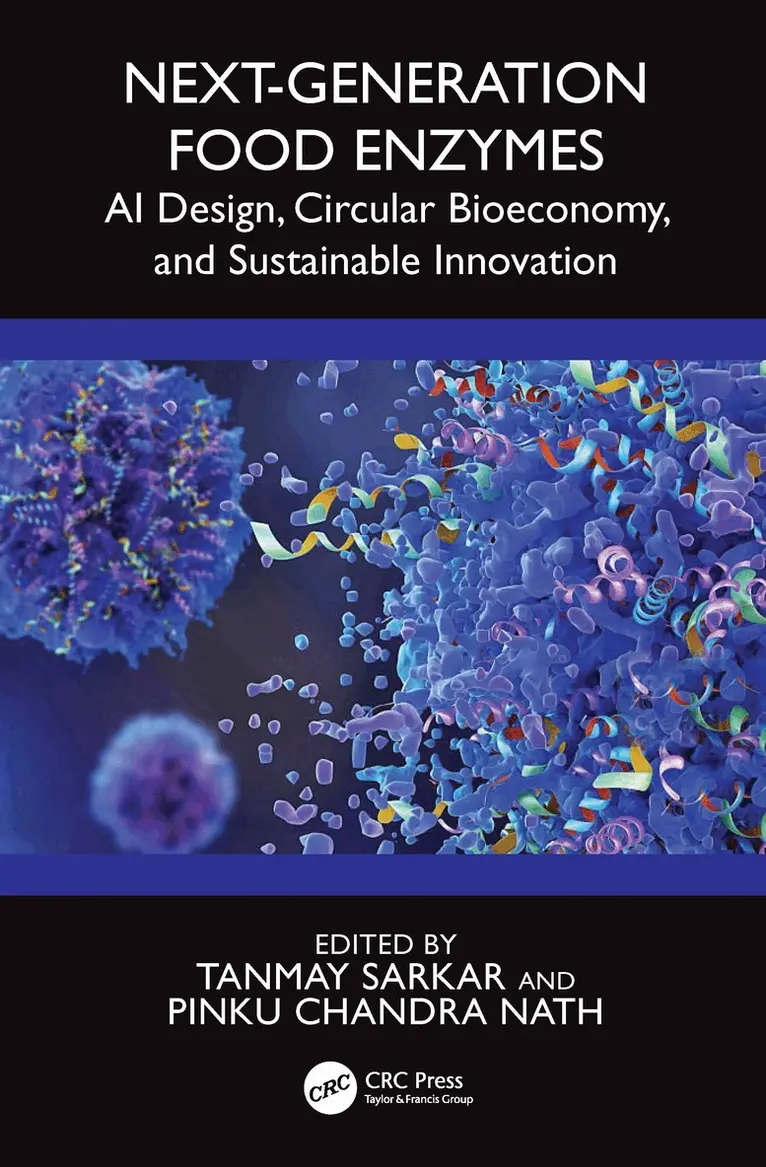
    Next-Generation Food Enzymes

    AI Design, Circular Bioeconomy, and Sustainable Innovation

    AvTanmay Sarkar,Pinku Chandra Nath

    Inbunden, Engelska, 2026

    2 551 kr

    Kommande

    Beskrivning

    Next-Generation Food Enzymes explores advanced enzyme technologies driven by Artificial Intelligence to enhance food processing efficiency, promote sustainability, and support a circular bioeconomy through eco-friendly biocatalytic innovations. It promotes sustainable innovation by reducing resource dependency and greenhouse gas emissions associated with traditional food manufacturing. The book integrates three cutting-edge domains: artificial intelligence in enzyme design, circular bioeconomy principles, and sustainable food innovation. It systematically covers fundamental enzymology (Chapters 1- 2), technological methodologies (Chapters 3-5), practical applications in waste valorization and product development (Chapters 6-11), and forward-looking considerations including personalized nutrition and regulatory frameworks (Chapters 12-15). This comprehensive structure successfully bridges theoretical foundations with industrial implementation.Key Features:Presents cutting-edge insights into AI-driven enzyme design and its transformative role in sustainable food processingExplains how enzyme technologies contribute to the circular bioeconomy by converting food and agricultural waste into valuable productsCovers real-world case studies and practical applications of enzymes in foods such as dairy, bakery, and beveragesAnalyses the environmental and economic benefits of replacing chemical catalysts with bio-based enzyme systems

    Produktinformation

    • Utgivningsdatum:2026-11-11
    • Mått:178 x 254 x undefined mm
    • Format:Inbunden
    • Språk:Engelska
    • Antal sidor:336
    • Förlag:Taylor & Francis Ltd
    • ISBN:9781041296010

    Utforska kategorier

    • Tillverkningsteknik inom Naturvetenskap och teknik
    • Referensverk och tvärvetenskap inom Samhälle och politik
    • Biokemisk teknik inom Naturvetenskap och teknik

    Mer om författaren

    Dr. Tanmay Sarkar is currently working as a Lecturer in the Government of West Bengal. He has received his Bachelor of Technology, Master of Technology, and PhD in Engineering from Jadavpur University, Kolkata, India. With 9 years of experience in both teaching and research, his areas of interest include bioactive components from natural sources, ethnic foods, mathematical modeling, and phytochemicals. He is an editor for several SCI, SCIE, and Scopus-indexed journals and has edited 12 books with Elsevier, Springer, and Wiley. Dr. Sarkar has been classified among the top 2% of global highly-cited researchers published by Stanford University, USA.Dr. Pinku Chandra Nath (H-Index: 19) graduated in Process and Food Engineering from Central Agricultural University (CAU) Imphal, India. He completed his master’s from Assam University Silchar (AUS), India and PhD from National Institute of Technology Agartala (NITA), Tripura, India. Presently, Dr. Nath has been working as an Assistant Professor Department of Bioengineering, Techno India University, India since 2024. He has more than 6 years research experience in the area of process development for value-added products from waste, formulation development and quality analysis of food products, production of bio-products using algal platform, and reaction engineering aspects on biodegradation studies at various reactors. He has published more than 35 papers in international peer-reviewed journals (Q1/Q2/Q3), 2 patents, 2 edited book, and more than 25 book chapters with an h-index of 19, i10-index of 23, google scholar citations more than 1350, and cumulative impact factor more than 160, first/corresponding author (>80%).

    Innehållsförteckning

    • Reimagining Enzymes for the Future of Food. Fundamentals and Frontiers of Food Enzymology. Artificial Intelligence and Machine Learning in Enzyme Discovery. Directed Evolution and Protein Engineering for Food Applications. Computational Approaches for Enzyme Optimization and Design. Enzymatic Valorization of Food Waste and By-products. Enzymes in the Circular Food Bioeconomy. Life Cycle Assessment of Enzymatic Processes in Food Systems. Enzymes for Plant-Based and Hybrid Food Innovation. Enzymatic Modulation of Texture, Flavor, and Nutrient Profiles. Clean-Label and Sustainable Processing through Enzymatic Technologies. Enzyme–Microbiome Interactions in Human Nutrition. Personalized Nutrition through Tailored Enzymatic Solutions. Regulatory, Safety, and Ethical Aspects of Enzyme Applications. Food Directions: Autonomous and Self-Evolving Enzyme Systems in Food Science.