• Fri frakt över 249 kr
  • •
  • Snabba leveranser
  • •
  • Billiga böcker
Kundservice

Du är på sajten för privatpersoner.

Företag, bibliotek eller offentlig verksamhet?

Du handlar på classic.bokus.com, där alla dina funktioner finns intakta.
Till classic.bokus.com
Bokus logotyp. Gå till startsidan.
  • Erbjudanden
  • Nyheter
  • Student
  • Topplistor
  • Barn & ungdom
  • Bokus Play
  • E-böcker
  • Pocketböcker
  • Spel & pussel

Må bättre, för mindre! Upp till 50% rabatt på hälsoböcker

Sidfot

Mina sidor

    Hjälp

    • Kundservice
    • Vanliga frågor och svar
    • Frakt och leverans
    • Retur vid ångerrätt
    • Reklamera vara
    • Betalning
    • Köpvillkor
    • Allmänna villkor
    • Information om webbplatsens tillgänglighet

    Om Bokus

    • Om oss
    • Pressrum
    • För studenter
    • För företag
    • För bibliotek och offentlig verksamhet
    • För leverantörer
    • Hållbarhet

    Populärt

    • Aktuella erbjudanden
    • Presentkort
    • Studentlitteratur
    • Nya böcker
    • Topplistor
    • Signerade böcker
    • Engelska böcker

    Inspiration

    • Boktips
    • BookTok
    • Populära bokserier
    • Barnbokskaraktärer
    • Populära författare
    Logotyp för Bokus
    Följ oss på Facebook (extern länk)Följ oss på Instagram (extern länk)Följ oss på YouTube (extern länk)Följ oss på TikTok (extern länk)
    bokus @ CookiesAnpassa cookiesIntegritetspolicyKöpvillkor
    Till Citymail hemsida (extern länk)Till Budbee hemsida (extern länk)Till Postnord hemsida (extern länk)Till Schenker hemsida (extern länk)Till Early Bird hemsida (extern länk)Till Walleys hemsida (extern länk)
    1. Psykologi och pedagogik
    2. Pedagogik
    3. Skolan och förskolan

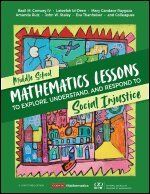
    Middle School Mathematics Lessons to Explore, Understand, and Respond to Social Injustice

    AvBasil M. Conway,Lateefah Id-Deen

    Häftad, Engelska, 2022

    Del i serien Corwin Mathematics Series

    452 kr

    Skickas . Fri frakt över 249 kr.

    Beskrivning

    "If you teach middle school math and have wanted to promote social justice, but haven’t been sure how to get started, you need to check out this book. It incorporates lessons you can use immediately as well as how to foster the kind of classroom community where students will thrive. It’s the kind of book you’ll want to have alongside you to support you throughout your journey."

    Robert Kaplinsky
    Author and Consultant
    Long Beach, CA

    Empower young adolescents to be the change—join the teaching mathematics for social justice movement!

    Students of all ages and intersecting identities—through media and their lived experiences— bear witness to and experience social injustices and movements around the world for greater justice. However, when people think of social justice, mathematics rarely comes to mind. With a user-friendly design, this book brings middle school mathematics content to life by connecting it to issues students see or experience.

    Developed for use by Grades 6-8 educators, the contributed model lessons in this book walk teachers through the process of applying critical frameworks to instruction, using standards-based mathematics to explore, understand, and respond to social injustices. Learn to plan daily instruction that engages young adolescents in mathematics explorations through age-appropriate, culturally relevant topics such as health and economic inequality, human and civil rights, environmental justice, and accessibility. Features include:

    • Content cross-referenced by mathematical concept and social issues
    • Connection to Learning for Justice’s social justice standards
    • Downloadable teacher materials and lesson resources
    • Guidance for lessons driven by young adolescents’ unique passions and challenges
    • Connections between research and practice

    Written for teachers committed to developing equitable and empowering practices through the lens of mathematics content and practice standards as well as social justice standards, this book will help connect content to young adolescents’ daily lives, strengthen their mathematical understanding, and expose them to issues that will support them in becoming active agents of change and responsible leaders.

    Produktinformation

    • Utgivningsdatum:2022-09-09
    • Mått:215 x 279 x 27 mm
    • Vikt:1 130 g
    • Format:Häftad
    • Språk:Engelska
    • Serie:Corwin Mathematics Series
    • Antal sidor:392
    • Upplaga:1
    • Förlag:SAGE Publications
    • ISBN:9781071845523

    Utforska kategorier

    • Skolan och förskolan inom Psykologi och pedagogik
    • Pedagogisk metodik inom Psykologi och pedagogik
    • Undervisning i specifika ämnen inom Psykologi och pedagogik

    Mer om författaren

    Basil Conway IV is an associate professor of mathematics education in the College of Education and Health Professions at Columbus State University and serves as the mathematics education graduate programs director. He serves on numerous doctoral committees as both a chair and methodologist. He earned his BS, MS, and PhD. in mathematics education from Auburn University in 2005, 2012, and 2015, respectively. He also completed his MS in statistical science at Colorado State University in 2010.Basil previously spent 10 years teaching in public middle and high schools before he became a teacher educator. During this time, he also worked as an instructor at a local junior college. Over the past 17 years of service in teaching mathematics and future teachers of mathematics, he has served in various local mathematics education leadership positions and organizations including Transforming East Alabama Mathematics (TEAM-Math), Auburn University’s Teacher Leader Academy, East Alabama Council for Teachers of Mathematics, Woodrow Wilson Fellow, National Mathematics and Science Initiative, and A+ College Ready. He has published works related to teaching mathematics for social justice in numerous books and journals and has a special interest in statistics education.Basil’s lens for teaching and student learning draws heavily from Vygotsky’s theory of social constructivism in which language and culture play essential roles in human intellectual development. Thus, he believes the co-construction of knowledge is paramount in the development of students’ social, religious, and mathematical identities. He believes teachers, parents, other students, cultural norms, and other cultural communicative devices play a critical role in shaping students’ knowledge of themselves, faith, and mathematics.Lateefah Id-Deen is an assistant professor for mathematics education in the Bagwell College of Education at Kennesaw State University. She earned her bachelor’s degree from the University of Arkansas Pine Bluff, a master’s degree from Iowa State University, and a doctorate in curriculum, instruction, and teacher education from Michigan State University, with foci in mathematics education and urban education.She has written several articles and book chapters that examine historically marginalized students’ perspectives on their experiences in mathematics classrooms and ways to support educators in hearing and developing practice in relation to students’ expressed interests. She investigates social justice pedagogies and culturally responsive instructional practices that promote student–teacher relationships, affirm mathematics identities, and cultivate belongingness to support students’ learning experiences in mathematics classrooms. She has engaged in projects that support Black girls’ schooling experiences. She also works with curriculum developers, schools, and districts that want to incorporate culturally relevant and anti-racist mathematics instructional strategies in mathematics classrooms. Her work reflects her passion for creating equitable learning environments for historically marginalized students in mathematics classrooms. Connect with her on Twitter @Prof_IdDeenL.Mary Candace Raygoza (she/her/hers) is a STEMinist (STEM and feminist!) teacher educator. She is an associate professor of teacher education at Saint Mary’s College of California and teaches courses including Humanizing Education Methods, Teaching for Social Justice, and Praxis Seminar. She is the lead investigator on a National Science Foundation grant to design the STEM Teachers for Justice, Community, and Leadership teaching pathway at Saint Mary’s. Mary earned a bachelor’s degree in sociology with an education minor at University of California, Berkeley and a full mathematics teaching credential and MEd, followed by a PhD in urban schooling, at University of California, Los Angeles. Her scholarship explores teaching mathematics for social justice and critical, justice-oriented, anti-racist teacher education.Mary is a former high school mathematics teacher in East Los Angeles, where she taught algebra and geometry, with a commitment to teaching about the social and political world through mathematics and supporting students to develop as researchers and change agents through youth participatory action research. Mary believes in fostering teachers to develop as transformative leaders who will create a more just world in solidarity with youth and communities.Amanda Ruiz was born in Long Beach and raised in Huntington Beach, California. She left Southern California for the Bay Area to attend University of California, Berkeley, where she created her own major focused on social movements. After some experience working in secondary education and a realization that mathematics is a social justice issue, Amanda went back to school to pursue a degree in mathematics. She received a master’s degree in mathematics from San Francisco State University and then her PhD in mathematics from Binghamton University in 2013. After a year as a teaching and research postdoctoral fellow in the Mathematics Department at Harvey Mudd College, Amanda joined the University of San Diego where she is now an associate professor of mathematics.Amanda’s PhD thesis was on realization spaces of phased matroids. While her prior research is predominantly in combinatorics and matroid theory, her research has more recently expanded to include pedagogical work. She is particularly interested in using mathematics to study issues of social justice and investigating pedagogies that make mathematical spaces more inclusive, where those traditionally underrepresented in mathematics can thrive.John W. Staley, Ph.D., has been involved in mathematics education for over 35 years as a secondary mathematics teacher, adjunct professor, district and national leader, and consultant. During his career he has presented at state, national, and international conferences; served on many committees and task forces; facilitated workshops and professional development sessions on a variety of topics; and received the Presidential Award for Excellence in Teaching Mathematics and Science. A past president for NCSM, the mathematics education leadership organization, and past chair of the U.S. National Commission on Mathematics Instruction, he continues to serve on several advisory boards and is a co-founder of Math Milestones. He is a coauthor for Middle School (2023) and High School (2022) Mathematics Lessons to Explore, Understand, and Respond to Social Injustice (Corwin/NCTM), Catalyzing Change in High School Mathematics: Initiating Critical Conversations (NCTM), and Framework for Leadership in Mathematics Education (NCSM). John’s current passion and work focuses on projects that involve changing the narrative about who is seen as being doers, learners, and teachers of mathematics, especially for African American boys and men; student readiness for Algebra and success during the transition years; and building mathematics education leaders at all levels.  Follow at X @jstaley06 to learn more about his work. Eva Thanheiser is a mathematics teacher educator. She is a professor of mathematics education at Portland State University in Portland, Oregon. Eva teaches mathematics content courses for elementary and middle school teachers. She contextualizes much of the mathematics content in social and political contexts.She is the lead investigator on two National Science Foundation grants, one to connect elementary mathematics to the world and another focused on anti-bias mathematics education at the K–12 level. Eva started her studies in Germany and finished a master’s in mathematics in 1998 at Kansas University and a PhD in mathematics education in 2005 at the joint doctoral program between the University of California San Diego and San Diego State University. Eva’s scholarship explores teaching mathematics for social justice and anti-bias mathematics education.Eva has received the Early Career Award from the Association of Mathematics Teacher Educators (AMTE) as well as the Sigma Xi Outstanding Researcher Award. She has served in leadership roles at AMTE and the Psychology of Mathematics Education– North America as well as on editorial boards of the Mathematics Teacher Educator and the Journal of Research in Mathematics Education.

    Recensioner i media

    A wonderful collection of lessons, submitted by teachers, to help students of all ages see topics they care about, and use mathematics as a tool for progress in the world.

    Innehållsförteckning

    • PrefaceIntroductionChapter 1: What Is Social Justice and Why Does It Matter in Teaching Mathematics?Chapter 2: Building and Sustaining a Beloved Community in the Middle School Mathematics ClassroomChapter 3: Fostering a Classroom to Teach Mathematics for Social JusticeChapter 4: Instructional Tools for the Social Justice Mathematics LessonChapter 5: Teaching the Social Justice Mathematics LessonChapter 6: The Number SystemLesson 6.1 Food Apartheid: Graphing and Understanding Access to Healthy FoodLesson 6.2 Cor(o)ner Stores and Food ApartheidLesson 6.3 Billionaire PowerLesson 6.4 Middle School Math to Explore People Represented in Our World and CommunityChapter 7: Ratios and Proportional RelationshipsLesson 7.1 Hey Google, Who′s a MathematicianLesson 7.2 The True Cost of that $29 T-shirt in the Store WindowLesson 7.3 Majority and PowerLesson 7.4 Smoking and Vaping: Targeting of Marginalized Communities by the Tobacco IndustryLesson 7.5 Health Race and RatiosLesson 7.6 Health Inequalities: COVID and Other Health ConditionsChapter 8: Algebra: Expressions, Equations, and FunctionsLesson 8.1 Gerrymandering of Voting DistrictsLesson 8.2 National Team Pay InvestigationLesson 8.3 The Black Vote in America: Impact of the 1965 Voting Rights ActChapter 9: Statistics and ProbabilityLesson 9.1 Playing with DataLesson 9.2 The Mathematics of Toxic AirLesson 9.3 Gender Pay GapLesson 9.4 How Many Meals Can Minimum Wage BuyChapter 10: GeometryLesson 10.1 Map ProjectionsLesson 10.2 3D Modeling for WaterLesson 10.3 Water is LifeLesson 10.4 Accessible PlaygroundLesson 10.5 Investigating Areas to Determine FairnessChapter 11: Advice From the FieldChapter 12: Creating Social Justice Mathematics Lessons for Your Own ClassroomAppendix A: Additional ResourcesAppendix B: Lesson ResourcesAppendix C: Essential Middle Grades ConceptsAppendix D: Social Justice Topics, Standards, and Grade Level OutcomesAppendix E: Lessons by Essential Middle Grades Concepts, Social Justice Grades 6–8 Outcomes, and Social Justice TopicsAppendix F: Social Justice Mathematics Lesson PlannerReferences