• Fri frakt över 249 kr
  • •
  • Snabba leveranser
  • •
  • Billiga böcker
Kundservice

Du är på sajten för privatpersoner.

Företag, bibliotek eller offentlig verksamhet?

Du handlar på classic.bokus.com, där alla dina funktioner finns intakta.
Till classic.bokus.com
Bokus logotyp. Gå till startsidan.
  • Erbjudanden
  • Nyheter
  • Student
  • Topplistor
  • Barn & ungdom
  • Bokus Play
  • E-böcker
  • Pocketböcker
  • Spel & pussel

10% rabatt på allt med kod: NYSTART10 →

Sidfot

Mina sidor

    Hjälp

    • Kundservice
    • Vanliga frågor och svar
    • Frakt och leverans
    • Retur vid ångerrätt
    • Reklamera vara
    • Betalning
    • Köpvillkor
    • Allmänna villkor
    • Information om webbplatsens tillgänglighet

    Om Bokus

    • Om oss
    • Pressrum
    • För studenter
    • För företag
    • För bibliotek och offentlig verksamhet
    • För leverantörer
    • Hållbarhet

    Populärt

    • Aktuella erbjudanden
    • Presentkort
    • Studentlitteratur
    • Nya böcker
    • Topplistor
    • Signerade böcker
    • Engelska böcker

    Inspiration

    • Boktips
    • BookTok
    • Populära bokserier
    • Barnbokskaraktärer
    • Populära författare
    Logotyp för Bokus
    Följ oss på Facebook (extern länk)Följ oss på Instagram (extern länk)Följ oss på YouTube (extern länk)Följ oss på TikTok (extern länk)
    bokus @ CookiesAnpassa cookiesIntegritetspolicyKöpvillkor
    Till Citymail hemsida (extern länk)Till Budbee hemsida (extern länk)Till Postnord hemsida (extern länk)Till Schenker hemsida (extern länk)Till Early Bird hemsida (extern länk)Till Walleys hemsida (extern länk)
    1. Samhälle och politik
    2. Samhälle och kultur
    3. Kultur och medier
    4. Referensverk och tvärvetenskap

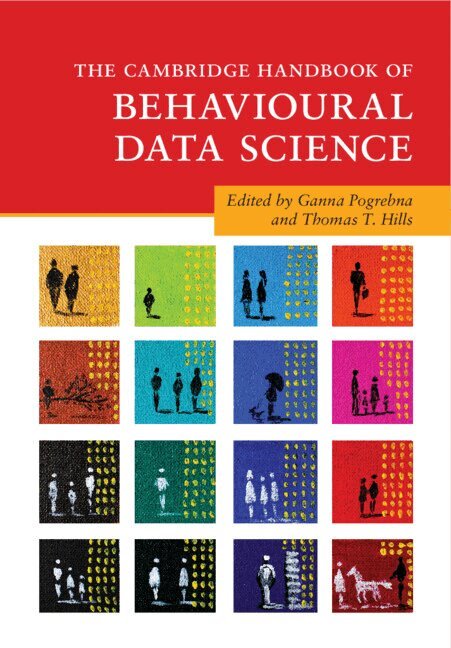
    The Cambridge Handbook of Behavioural Data Science

    AvGanna Pogrebna,Thomas T. Hills

    Häftad, Engelska, 2026

    Del i serien Cambridge Handbooks in Psychology

    969 kr

    Beställningsvara. Skickas inom 10-15 vardagar. Fri frakt över 249 kr.

    Beskrivning

    The Cambridge Handbook of Behavioural Data Science offers an essential exploration of how behavioural science and data science converge to study, predict, and explain human, algorithmic, and systemic behaviours. Bringing together scholars from psychology, economics, computer science, engineering, and philosophy, the Handbook presents interdisciplinary perspectives on emerging methods, ethical dilemmas, and real-world applications. Organised into modular parts-Human Behaviour, Algorithmic Behaviour, Systems and Culture, and Applications-it provides readers with a comprehensive, flexible map of the field. Covering topics from cognitive modelling to explainable AI, and from social network analysis to ethics of large language models, the Handbook reflects on both technical innovations and the societal impact of behavioural data, and reinforces concepts in online supplementary materials and videos. The book is an indispensable resource for researchers, students, practitioners, and policymakers who seek to engage critically and constructively with behavioural data in an increasingly digital and algorithmically mediated world.

    Produktinformation

    • Utgivningsdatum:2026-06-18
    • Mått:178 x 254 x 42 mm
    • Vikt:1 527 g
    • Format:Häftad
    • Språk:Engelska
    • Serie:Cambridge Handbooks in Psychology
    • Antal sidor:834
    • Förlag:Cambridge University Press
    • ISBN:9781108940566

    Utforska kategorier

    • Referensverk och tvärvetenskap inom Samhälle och politik
    • Sociologi inom Samhälle och politik
    • Tillämpad datateknik inom Data och IT

    Mer om författaren

    Ganna Pogrebna is Professor at the University of Sydney Business School and lead of the Behavioural Data Science group at the Alan Turing Institute. She is a behavioural data science pioneer, author, educator, and expert in artificial intelligence and strategic decision-making. Her work explores how emerging technologies transform industries, customer experiences, and business models. She advises businesses and governments on AI adoption, innovation strategies, and building digital trust. Thomas T. Hills is Professor in the Department of Psychology at the University of Warwick. He studies how humans search, explore, and navigate complex environments across memory, decision-making, and creativity. His research integrates experiments, big data, network science, and AI to understand cognitive behaviour and societal evolution. He published widely on language, culture, and scientific communication. He is the author of Behavioral Network Science: Language, Mind, and Society (2024).

    Recensioner i media

    'The Cambridge Handbook of Behavioural Data Science is an essential resource for anyone seeking to bridge the gap between behavioural insight and data-driven inference. Its interdisciplinary scope, conceptual clarity and real-world applications make it a powerful tool for researchers, educators and practitioners alike. I highly recommend it as a foundational guide to this emerging, impactful field.' Cleotilde Gonzalez, Carnegie Mellon University

    Innehållsförteckning

    • The Cambridge handbook of behavioural data science; Preface; List of contributors; Handbook abstract; Introduction: how to read this book; Part I. Introduction to Behavioural Data Science: 1. History of behavioural data science: successes and challenges; 2. Overview of behavioural data science; 3. Behavioural data science: framework and topology of methods; Part II. Human Behaviour: 4. Behavioural data science for understanding human decisions, choices, and judgement; 5. Psychological theories of decision making under risk; 6. Prediction oriented behavioural research and its relationship to classical decision research; 7. The ABCs of behavioural influence; 8. Word and sentence embedding methods for studying human behaviour; 9. Predictive Bayesian Modelling in cognitive sciences; 10. Human aspects of AI-related risks: a behavioural data science approach; Part III. Algorithmic Behaviour: 11. Generative AI and behavioural data science; 12. How successful are existing algorithms in explaining and predicting human behaviour?; 13. Emotion and Big Data: The Elephant in the Room?; 14. Smart Bots? A Behavioural Approach to Measure The 'Intelligence' of Conversational AI Pre-Chat GPT; 15. Chatgpt & CO – exploring conversational abilities of large language models from a behavioural perspective; 16. Machine behaviour; 17. Modelling choice behaviour using artificial intelligence; 18. anthropomorphic learning: hybrid modelling approaches combining decision theory and machine learning; Part IV. Systems and Culture: 19. Systems, culture, and human-machine teaming; 20. Cognitive networks as models of cognition and behaviour: an introduction; 21. Agent-based modelling in social networks; 22. Modelling context-dependent behaviour; 23. A short primer on historical natural language processing; 24. Behavioural data in complex economic and business systems; 25. Applications of statistical mechanics and cyber-physical systems to behaviour; 26. Systems behaviour for sustainable AI; 27. Systems behaviour and experimentation; 28. Quantum mechanics of human perception, behaviour and decision-making: a do-it-yourself model kit for modelling optical illusions and opinion formation in social networks; Part V. Applications: 29. Applications of behavioural data science; 30. Pro-social nudging; 31. Social media analytics; 32. Quantifying luck; 33. Quantifying the connection between scenic beauty and reported health using deep learning and econometrics; 34. Money, methodology, and happiness: using big data to study causal relationships between income and well-being; 35. Human-data interaction: the case of databox; 36. Natural language processing in behavioural data science: using computational linguistics to understand and model behaviour; 37. Understanding collective behaviour using online data and mobile phones; 38. Burstier events: analysing human memory over a century of events using the New York; 39. Behavioural data science in financial services; 40. XR, VR, and AR applications in behavioural data science; 41. On cryptoasset traders' behaviour; 42. Behavioural data science of cybersecurity; 43. Behavioural data science ethics and governance pre-AI act: From research data ethics principles to practice: data trusts as a governance tool; 44. Behavioural data science ethics and governance post-AI act: responsible approach to network and collective choice modelling; Part VI. Concluding Remarks: List of main abbreviations and acronyms; Glossary.