• Fri frakt över 249 kr
  • •
  • Snabba leveranser
  • •
  • Billiga böcker
Kundservice

Du är på sajten för privatpersoner.

Företag, bibliotek eller offentlig verksamhet?

Du handlar på classic.bokus.com, där alla dina funktioner finns intakta.
Till classic.bokus.com
Bokus logotyp. Gå till startsidan.
  • Erbjudanden
  • Nyheter
  • Student
  • Topplistor
  • Barn & ungdom
  • Bokus Play
  • E-böcker
  • Pocketböcker
  • Spel & pussel

10% rabatt på allt med kod NYSTART10 →

Sidfot

Mina sidor

    Hjälp

    • Kundservice
    • Vanliga frågor och svar
    • Frakt och leverans
    • Retur vid ångerrätt
    • Reklamera vara
    • Betalning
    • Köpvillkor
    • Allmänna villkor
    • Information om webbplatsens tillgänglighet

    Om Bokus

    • Om oss
    • Pressrum
    • För studenter
    • För företag
    • För bibliotek och offentlig verksamhet
    • För leverantörer
    • Hållbarhet

    Populärt

    • Aktuella erbjudanden
    • Presentkort
    • Studentlitteratur
    • Nya böcker
    • Topplistor
    • Signerade böcker
    • Engelska böcker

    Inspiration

    • Boktips
    • BookTok
    • Populära bokserier
    • Barnbokskaraktärer
    • Populära författare
    Logotyp för Bokus
    Följ oss på Facebook (extern länk)Följ oss på Instagram (extern länk)Följ oss på YouTube (extern länk)Följ oss på TikTok (extern länk)
    bokus @ CookiesAnpassa cookiesIntegritetspolicyKöpvillkor
    Till Citymail hemsida (extern länk)Till Budbee hemsida (extern länk)Till Postnord hemsida (extern länk)Till Schenker hemsida (extern länk)Till Early Bird hemsida (extern länk)Till Walleys hemsida (extern länk)
    1. Naturvetenskap och teknik
    2. Teknik och industri
    3. Tillverkningsteknik

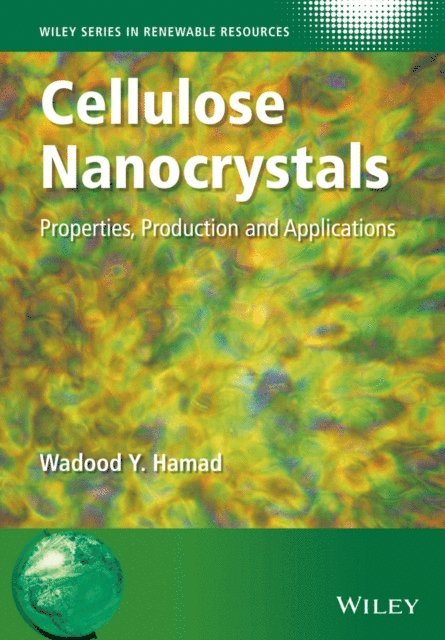
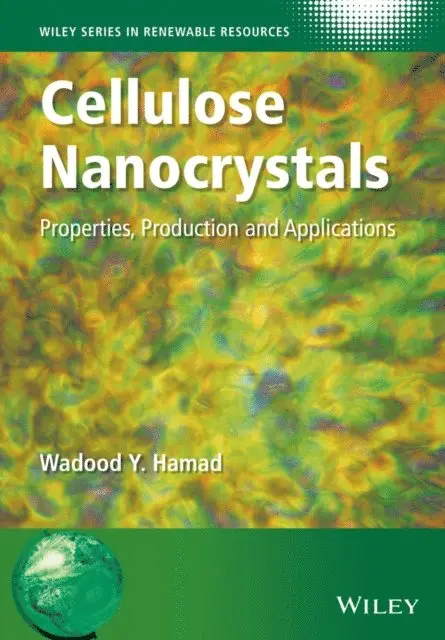
    Cellulose Nanocrystals

    Properties, Production and Applications

    AvWadood Y. Hamad

    Inbunden, Engelska, 2017

    Del i serien Wiley Series in Renewable Resource

    1 151 kr

    Tillfälligt slut

    Fler format och utgåvor

    E-bok

    1 767 kr

    E-bok

    1 767 kr

    Beskrivning

    Research into cellulose nanocrystals is currently in an exponential growth phase, with research into potential applications now strengthened by recent advances in nanomanufacturing. The possibility of routine commercial production of these advanced materials is now becoming a reality.Cellulose Nanocrystals: Properties, Production and Applications provides an in-depth overview of the materials science, chemistry and physics of cellulose nanocrystals, and the technical development of advanced materials based on cellulose nanocrystals for industrial and medical applications. Topics covered include: A comprehensive treatment of the structure, morphology and synthesis of cellulose nanocrystals.The science and engineering of producing cellulose nanocrystals and the challenges involved in nanomanufacturing on a large industrial scale.Surface/interface modifications of cellulose nanocrystals for the development of novel biomaterials with attractive structural and functional properties.The scientific bases for developing cellulose-based nanomaterials with advanced functionalities for industrial/medical applications and consumer products.Discussions on the (i) reinforcing potential of cellulose nanocrystals in polymer nanocomposites, (ii) utilization of these nanocrystals as efficient templates for developing tunable photonic materials, as well as (iii) applications in sustainable electronics and biomedicine.Cellulose Nanocrystals: Properties, Production and Applications will appeal to audiences in the physical, chemical and biological sciences as well as engineering disciplines. It will be of critical interest to industrialists seeking to develop sustainable new materials for the advanced industrial economies of the 21st century, ranging from adaptive "smart" packaging materials, to new chiral, mesoporous materials for optoelectronics and photonics, to high-performance nanocomposites for structural applications.

    Produktinformation

    • Utgivningsdatum:2017-04-07
    • Mått:158 x 231 x 23 mm
    • Vikt:612 g
    • Format:Inbunden
    • Språk:Engelska
    • Serie:Wiley Series in Renewable Resource
    • Antal sidor:320
    • Förlag:John Wiley & Sons Inc
    • ISBN:9781119968160

    Utforska kategorier

    • Tillverkningsteknik inom Naturvetenskap och teknik
    • Maskinteknik och material inom Naturvetenskap och teknik

    Mer om författaren

    Wadood Hamad is Principal Scientist and Research Leader at FPInnovations, as well as Adjunct Professor at the University of British Columbia's Department of Chemistry. FPInnovations is one of the leading Research institutes exploring the industrial manufacturing and applications of cellulose nanocrystals (CNC), and has been a principal driver in the commercial viability of CNC. Dr Hamad's research team is currently focussed on to thematic areas: (i) CNC processing and characterization, and (ii) material synthesis and product development of advanced functional platforms based on CNC. Dr Hamad has been responsible for key developments around CNC synthesis and manufacturing, and holds over 20 patents for CNC applications in polymer nanocomposites, photonics, flexible electronics and optoelectronics, and over 100 peer-reviewed scientific publications appearing in Nature, Nature Communications, Advanced Materials, and elsewhere.

    Recensioner i media

    The monograph is an important and timely publication. It presents the state of technical knowledge and understanding about cellulose, the production process to extract cellulose nanocrystals from natural sources of cellulose, the characterization of the nanocrystals and the assessment of their potential application in industrial products and processes. It is a timely publication because cellulose nanocrystals are a key member of the family of cellulosic nanomaterials which are rapidly moving from a focus of scientific research towards commercial production and their introduction into commercial applications. Clive Willis, PhD (from the Foreword) Director General (2003 2005), NanoQuebec ISO Technical Committee 229 on Nanotechnology

    Innehållsförteckning

    • Series Preface xiiiForeword xvProloguex viii1 New Frontiers for Material Development and the Challenge of Nanotechnology 11.1 Perspectives on Nanotechnology 11.2 Societal Ramifications of Nanotechnology 31.3 Bio-inspired Material Development: The Case for Cellulose Nanocrystals 51.4 A Glance at Bio-inspired Hierarchical Materials 91.5 Concluding Thoughts 13Notes 132 Assembly and Structure in Native Cellulosic Fibers 162.1 Physical and Chemical Characteristics of the Cellulose Molecule 162.1.1 The Origin of Cellulose 162.1.2 The Chemistry of Cellulose 182.1.3 The Physics of Cellulose 202.2 Morphology and Structure of Native Cellulosic Fibers 222.3 Physical and Mechanical Properties of Native Cellulosic Fibers 252.3.1 Anisotropy of the Fiber Cell Wall 252.3.2 Mechanical Properties of Cellulosic Fibers 29Notes 323 Hydrolytic Extraction of Cellulose Nanocrystals 333.1 Introduction 333.2 The Liberation of CNCs Using Acid Hydrolysis 353.3 Reaction Kinetics of CNC Extraction 383.3.1 Effects of H2 SO4 Hydrolysis Conditions and Sulfation on CNC Yield of Extraction 383.3.2 H2 SO4 Hydrolysis Reproducibility and Yield Optimization 463.3.3 Commentary on Hydrochloric Acid-Hydrolyzed CNCs 483.3.4 CNC Stability and Post H2 SO4-Hydrolysis Aging 493.4 Processing Considerations for Sustainable and Economical Manufacture of CNCs 503.5 Micro/Nano Cellulosics Other Than CNCs 533.5.1 Microfibrillated Cellulose 533.5.2 Microcrystalline Cellulose 573.5.3 Bacterial Cellulose 60Notes 624 Properties of Cellulose Nanocrystals 654.1 Morphological Characteristics of CNCs 654.2 Structural Organization of CNCs 684.3 Solid-State Characteristics of CNCs 744.3.1 X-Ray Diffractometric Analysis of CNCs 764.3.2 CNCs Phase Structure Based on SS-NMR 814.3.3 Concluding Remarks 874.4 CNCs Chiral Nematic Phase Properties 874.4.1 Ionic Strength Effect on Chiral Phase Separation 884.4.2 Temperature Effect on Chiral Phase Separation 914.4.3 Suspension Concentration Effect on Chiral Phase Separation 924.4.4 Magnetic Field Effect on Chiral Phase Separation 944.4.5 Sonication Effect on Physicochemical Properties 944.5 Shear Rheology of CNC Aqueous Suspensions 954.5.1 Basic Rheological Behavior of CNC Aqueous Suspensions 954.5.2 Sonication Effects on the Microstructure and Rheological Properties of CNCs Suspensions 984.5.3 Concentration Effects on the Microstructure and Rheological Properties of CNC Suspensions 1004.5.4 Temperature Effects on the Microstructure and Rheological Properties of CNC Suspensions 1064.5.5 CNCs Surface Charge Effects on the Microstructure and Rheological Properties of CNC Suspensions 1124.5.6 Ionic Strength Effects on the Microstructure and Rheological Properties of CNC Suspensions 1184.5.7 Aging and Yielding Characteristics of CNC Suspensions 1234.5.8 Concluding Remarks 1284.6 Thermal Stability of CNCs 129Notes 1345 Applications of Cellulose Nanocrystals 1385.1 Prelude 1385.2 The Reinforcing Potential of CNCs in Polymer Nanocomposites 1405.2.1 Basic Concepts in Composites 1405.2.2 Generic Methods for Surface Functionalization 1425.2.3 Why CNCs for Reinforcement? 1475.2.4 Performance of CNCs in Compatible Polymer Systems 1505.2.5 Nanocomposites Prepared by Postpolymerization Compounding of CNCs and Thermoplastic Polymers 1545.2.6 Controlling Nanocomposite Crystallinity and Plasticity via In Situ Polymerization Methodologies in the Presence of CNCs 1655.2.7 CNCs in Thermosetting Polymers: Tailoring Cross-Linking Density and Toughness 1725.2.8 Comments on Modeling the Mechanical Response of CNC-Reinforced Nanocomposites 1775.2.9 Conclusions and Critical Insights 1815.3 CNC-Stabilized Emulsions, Gels, and Hydrogels 1845.3.1 Pickering Emulsions 1845.3.2 High Internal Phase Emulsions 1875.3.3 pH-Responsive Gels and Flocculants 1895.3.4 Hydrogels 1905.4 Controlled Self-Assembly of Functional Cellulosic Materials 1945.4.1 Flexible CNC Films with Tunable Optical Properties 1945.4.2 Mesoporous Photonic Cellulose Films 1975.5 Toward Bio-inspired Photonic and Electronic Materials 2025.5.1 Mesoporous Photonic Materials from Cellulose Nanomaterial Liquid Crystal Templates 2025.5.2 Actuators and Sensors 2175.5.3 Sustainable Electronics Based on CNCs 2255.5.4 Conclusions and Outlook 2325.6 CNCs in Biomedicine and Pharmaceuticals 2335.7 Environmental, Health, and Safety Considerations of CNCs 2355.8 Perspectives and Challenges 238Notes 239Epilogue—The Never-Ending Evolution of Scientific Insights 248Bibliography 252Subject Index 288