• Fri frakt över 249 kr
  • •
  • Snabba leveranser
  • •
  • Billiga böcker
Kundservice

Du är på sajten för privatpersoner.

Företag, bibliotek eller offentlig verksamhet?

Du handlar på classic.bokus.com, där alla dina funktioner finns intakta.
Till classic.bokus.com
Bokus logotyp. Gå till startsidan.
  • Erbjudanden
  • Student
  • Topplistor
  • Barn & ungdom
  • Bokus Play
  • E-böcker
  • Ljudböcker
  • Pocketböcker
  • Spel & pussel

10% rabatt på allt med kod NYSTART10 →

Sidfot

Mina sidor

    Hjälp

    • Kundservice
    • Vanliga frågor och svar
    • Frakt och leverans
    • Retur vid ångerrätt
    • Reklamera vara
    • Betalning
    • Köpvillkor
    • Allmänna villkor
    • Information om webbplatsens tillgänglighet

    Om Bokus

    • Om oss
    • Pressrum
    • För studenter
    • För företag
    • För bibliotek och offentlig verksamhet
    • För leverantörer
    • Hållbarhet

    Populärt

    • Aktuella erbjudanden
    • Presentkort
    • Studentlitteratur
    • Nya böcker
    • Topplistor
    • Signerade böcker
    • Engelska böcker

    Inspiration

    • Boktips
    • BookTok
    • Populära bokserier
    • Barnbokskaraktärer
    • Populära författare
    Logotyp för Bokus
    Följ oss på Facebook (extern länk)Följ oss på Instagram (extern länk)Följ oss på YouTube (extern länk)Följ oss på TikTok (extern länk)
    bokus @ CookiesAnpassa cookiesIntegritetspolicyKöpvillkor
    Till Citymail hemsida (extern länk)Till Budbee hemsida (extern länk)Till Postnord hemsida (extern länk)Till Schenker hemsida (extern länk)Till Early Bird hemsida (extern länk)Till Walleys hemsida (extern länk)
    1. Samhälle och politik
    2. Sociologi och antropologi
    3. Antropologi

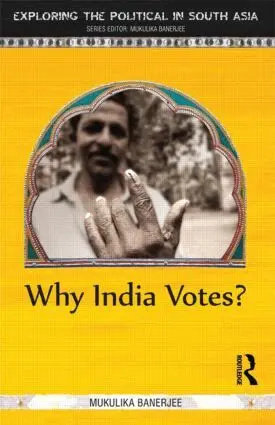
    Why India Votes?

    AvMukulika Banerjee

    Häftad, Engelska, 2014

    Del i serien Exploring the Political in South Asia

    666 kr

    Beställningsvara. Skickas inom 10-15 vardagar. Fri frakt över 249 kr.

    Fler format och utgåvor

    Inbunden

    2 951 kr

    E-bok

    788 kr

    E-bok

    790 kr

    Beskrivning

    Why India Votes? offers a fascinating account of the Indian electorate through a series of comprehensive ethnographic explorations conducted across the country — Delhi, Uttar Pradesh, Bihar, West Bengal, Chhattisgarh, Madhya Pradesh, Tamil Nadu, Kerala, Maharashtra, Gujarat, and Rajasthan. It probes the motivations of ordinary voters, what they think about politicians, the electoral process, democracy and their own role within it. This book will be useful to scholars and students of political science, anthropology and sociology, those in media and politics, and those interested in elections and democracy as also the informed general reader.

    Produktinformation

    • Utgivningsdatum:2014-03-14
    • Mått:138 x 216 x 28 mm
    • Vikt:394 g
    • Format:Häftad
    • Språk:Engelska
    • Serie:Exploring the Political in South Asia
    • Antal sidor:326
    • Förlag:Taylor & Francis Ltd
    • ISBN:9781138019713

    Utforska kategorier

    • Antropologi inom Samhälle och politik
    • Sociologi inom Samhälle och politik
    • Val och folkomröstningar inom Samhälle och politik

    Mer om författaren

    Mukulika Banerjee is Associate Professor, Department of Anthropology, and Director of the South Asia Centre, London School of Economics and Political Science.

    Recensioner i media

    ‘With a new approach to anthropology, Mukulika Banerjee combines intensive field work at local level with statistical materials at the national level. This is a unique study both for India and for democracies in general. It will inform and enlighten us all for years to come. If you are into India, get into this book.’ — Meghnad Desai, Emeritus Professor, Department of Economics, London School of Economics and Political Science‘"Why India Votes?" is a very good question indeed. Banerjee's enquiries are always interesting and illuminating, sometimes startling, and are laid out with great skill in this excellent book.’ — Jonathan Spencer, Professor of the Anthropology of South Asia and Head of School of Social and Political Science, University of Edinburgh‘This book revitalises the great tradition of political anthropology . . . by combining ethnographic methods with detailed comparative studies within one of the world's largest and most internally diverse societies. It should be read by all scholars of India and all scholars of democratic politics anywhere.’ — Arjun Appadurai, Goddard Professor of Media, Culture, and Communication, New York University"Banerjee (anthropology, London School of Economics and Political Science, UK) offers an anthropologist’s analysis of Indians’ high electoral turnout (60 percent) despite poverty and illiteracy. India’s rural poor actually vote somewhat more than the urban middle class. Banerjee disdains Western analyses that use quantified surveys to discern rational patterns but fail to capture the “messiness” of political life. Instead, she had 12 ethnographers do “thick description” across India during the 2009 general election, interviewing voters in depth. Non-Western feelings about democracy and voting, she claims, are varied and do not fit Western categories. Consistently, Banerjee finds that Indians, especially lower castes and Dalits, love feeling free and equal, however briefly, when politicians have to court them face-to-face. They know that politicians do little for them, but they enjoy the rallies, candidates’ charisma and handshakes, colorful posters, and the little payoffs candidates hand out. Elections are fun and serve an entertainment function that affirms life and citizenship that the US could use. Messy, yes, but India’s “vote your caste” jest shows a rational/instrumental streak. In 2014, voters fed up with the Indian National Congress Party's failures on the economy and corruption shifted massively to Narendra Modi’s Bharatiya Janata Party, just like a Western electorate." --M. G. Roskin, Lycoming CollegeSumming Up: Recommended. Graduate, research, and professional collections. - CHOICE

    Innehållsförteckning

    • Glossary . Foreword Jonathan Spencer. Acknowledgements 1. Introduction 2. The Campaign 3. Political Language 4. The Polling Station 5. Why Do People Vote? 6. Conclusion. Appendices . Bibliography . About the Author. Index