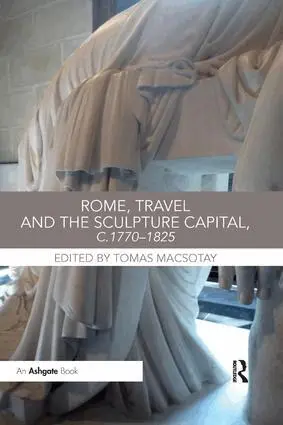
Häftad, Engelska, 2018
Rome, Travel and the Sculpture Capital, c.1770–1825
780 kr
Beställningsvara. Skickas inom 10-15 vardagar. Fri frakt över 249 kr.
Beskrivning
Produktinformation
- Utgivningsdatum: 2018-08-14
- Mått: 156 x 234 x 31 mm
- Vikt: 550 g
- Format: Häftad
- Språk: Engelska
- Antal sidor: 274
- Förlag: Taylor & Francis Ltd
- ISBN: 9781138353275
Utforska kategorier
Mer om författaren
Tomas Macsotay is a Ramón y Cajal Research Fellow at the Universitat Pompeu Fabra, Barcelona. He is the author of The Profession of Sculpture in the Paris Académie (2014) and the co-editor of Morceaux. Die bildhauerischen Aufnahmestücke europäischer Kunstakademien im 18. und 19. Jahrhundert (2016).
Recensioner i media
‘Rome, Travel and the Sculpture Capital, c. 1770–1825 offers a fresh approach to the study of patrons, artists and markets for Roman sculpture in the late eighteenth and early nineteenth centuries. Instead of focusing on the agency of the traditional cast of powerful tastemakers and artists, such as Antonio Canova, Bertel Thorvaldsen and Johann Winckelmann, the volume emphasizes the shifting status of travellers, trade routes, political systems and institutions that underpinned the production, consumption and reception of marble sculpture in Rome. The book thus points to areas of contingency and flux that have been otherwise obscured by the unquestionably canonical status of Rome as a "sculpture capital" during the period. […] Rome, Travel, and the Sculpture Capital, c. 1770–1825 helps to advance and complicate our understanding of Rome’s reputation as a center of neoclassical art and grand tourism that has long been enshrined in studies related to the history of sculpture. Its focus on complex systems and networks of artists, patrons and other local conditions provides an exciting path for future directions in the study of Roman sculpture.’ Katie Hornstein, review in Sculpture Journal (27.3, 2018, pp. 377–79)‘This important collection of essays by an international team of scholars sheds new light on Rome’s emergence as an international center of sculptural production and consumption at the period spanning the end of the eighteenth-century through the defeat of Napoleon. Their research takes us inside the studios of artistic giants like Canova and Thorvaldsen as well as a host of lesser-known figures who made Rome Europe’s sculpture capital par excellence. Together, the authors reveal the Eternal City as a cosmopolitan community of patrons and practitioners whose interactions led to technical breakthroughs, stylistic innovations, and lofty claims for the centrality of sculpture to modern life.’ Jeffrey Collins, Bard Graduate Center, USA‘Comprised of archivally rich analyses, this volume traces the myriad forces that ensured Rome's ascendance as the capital of European sculpture in the late-eighteenth and early-nineteenth centuries. Essays chart an expanded topography of sculptural networks, drawing together luminaries like Canova, Cavaceppi, and Flaxman; the specialized tradesmen and assistants whose work was integral to the business of sculpture; and aesthetic interlocutors in the guise of patrons, scholars, and museum personnel. Bringing new life to the material and theoretical lives of sculpture, its makers and audiences, the volume significantly expands our appreciation of the interlinked histories of sculptural restoration, production, and consumption that underwrote a Roman dialectic of ancient and modern.’ Sarah Betzer, University of Virginia, USA
Betyg & recensioner
0 recensioner
Inga recensioner tillgängliga.