• Fri frakt över 249 kr
  • •
  • Snabba leveranser
  • •
  • Billiga böcker
Kundservice

Du är på sajten för privatpersoner.

Företag, bibliotek eller offentlig verksamhet?

Du handlar på classic.bokus.com, där alla dina funktioner finns intakta.
Till classic.bokus.com
Bokus logotyp. Gå till startsidan.
  • Erbjudanden
  • Student
  • Topplistor
  • Barn & ungdom
  • Bokus Play
  • E-böcker
  • Ljudböcker
  • Pocketböcker
  • Spel och pussel

Pocketfynda! Hundratals böcker för 49 kr/st →

Sidfot

Mina sidor

    Hjälp

    • Kundservice
    • Vanliga frågor och svar
    • Frakt och leverans
    • Retur vid ångerrätt
    • Reklamera vara
    • Betalning
    • Köpvillkor
    • Allmänna villkor
    • Information om webbplatsens tillgänglighet

    Om Bokus

    • Om oss
    • Pressrum
    • För studenter
    • För företag
    • För bibliotek och offentlig verksamhet
    • För leverantörer
    • Hållbarhet

    Populärt

    • Aktuella erbjudanden
    • Presentkort
    • Studentlitteratur
    • Nya böcker
    • Topplistor
    • Signerade böcker
    • Engelska böcker

    Inspiration

    • Boktips
    • BookTok
    • Barnbokskaraktärer
    • Populära författare
    Logotyp för Bokus
    Följ oss på Facebook (extern länk)Följ oss på Instagram (extern länk)Följ oss på YouTube (extern länk)Följ oss på TikTok (extern länk)
    bokus @ CookiesAnpassa cookiesIntegritetspolicyKöpvillkor
    Till Citymail hemsida (extern länk)Till Budbee hemsida (extern länk)Till Postnord hemsida (extern länk)Till Schenker hemsida (extern länk)Till Early Bird hemsida (extern länk)Till Walleys hemsida (extern länk)
    1. Samhälle och politik
    2. Samhälle och kultur
    3. Kultur och medier
    4. Medievetenskap

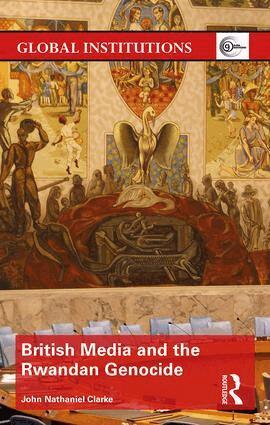
    British Media and the Rwandan Genocide

    AvJohn Nathaniel Clarke

    Inbunden, Engelska, 2017

    Del i serien Global Institutions

    2 713 kr

    Beställningsvara. Skickas inom 10-15 vardagar. Fri frakt över 249 kr.

    Fler format och utgåvor

    Häftad

    784 kr

    E-bok

    906 kr

    Beskrivning

    Throughout the 1990s, humanitarian interventionism sat at a crossroads, where ideas about rights and duties within and beyond borders collided with an international reality of civil conflict where the most basic human rights were violated in the most brutal manner. This growing awareness of humanitarian crises has been enabled by a more globalized media which increasingly shapes public perceptions of distant crises, public opinion, and political decision-making. Clarke examines the extent to which the public discourse, and particular concepts, including those of an ethical and legal nature, influenced British newspaper coverage of the 1994 crisis in Rwanda, and, in turn, the extent to which that coverage influenced the British Parliament’s response to the crisis. Through his development and application of a broader methodological approach that combines both quantitative and qualitative analyses, the book offers a fuller understanding of the relationship between media coverage, parliamentary debate, and policy formulation, and the central role that the globalized media plays in this process. Integrating ethics, law and empirical analysis of the media to obtain a more cohesive understanding of the chemistry of the media-public policy nexus, this work will be of interest to graduates and scholars in a range of areas, including Genocide Studies, the Responsibility to Protect, the Media & Politics and International Relations.

    Produktinformation

    • Utgivningsdatum:2017-09-19
    • Mått:138 x 216 x 22 mm
    • Vikt:460 g
    • Format:Inbunden
    • Språk:Engelska
    • Serie:Global Institutions
    • Antal sidor:286
    • Förlag:Taylor & Francis Ltd
    • ISBN:9781138937321

    Utforska kategorier

    • Medievetenskap inom Samhälle och politik
    • Afrikas historia inom Historia och arkeologi
    • Folkmord och etnisk rensning inom Historia och arkeologi

    Mer om författaren

    John Nathaniel Clarke is currently the Head of Mission of the Office of the Quartet and has served with the United Nations in a variety of political, humanitarian and developmental roles. He completed a PhD at Cambridge University (Peterhouse) and held a Post-doctoral fellowship at Yale University.

    Recensioner i media

    "...one of the great things about Clarke’s book: he does open a long line of questions for possible future inquiry. Application of his methodology to news coverage of other humanitarian crises may also yield important results. Such findings could change how the media deals with stereotyping, pressuring governments, and perceptions of objectivity." - Samantha Stevens, Concordia University, in the Journal of Communication 2019"...a complex and considered study, which adds much to our understanding of media responses to the Rwandan tragedy and should ultimately become an important read for those with an interest in a variety of related fields. ...scholars with an interest in a variety of fields—media and human rights, international relations, British politics—will find this book to be a worthwhile addition to their library." - David Patrick, The International Journal of Press/Politics."As Clarke emphasizes in his book, the liberal interventionist ideals of the decade he captures may not have endured; nonetheless, this work illustrates the value of methodological research to challenge the historical narratives they wove. Such methodologies could be used to challenge other assumptions or examine falsehoods." - Catherine Bond in African Affairs 2022.

    Innehållsförteckning

    • Part IIntroduction1. Ideas, the media, and humanitarian interventionPart II 2. The media’s coverage of Rwanda, 19943. Media coverage of Phase 1 (Pre-crisis) and Phase 2 (Genocide)4. Media coverage of Phase 3 (Refugee Crisis) and Phase 4 (Post-crisis)Part III5. The parliamentary response to Rwanda 6. The media and Parliament7. ConclusionAppendix: Coding scheme for analysisSelect bibliography