E-bok, Engelska, 2007
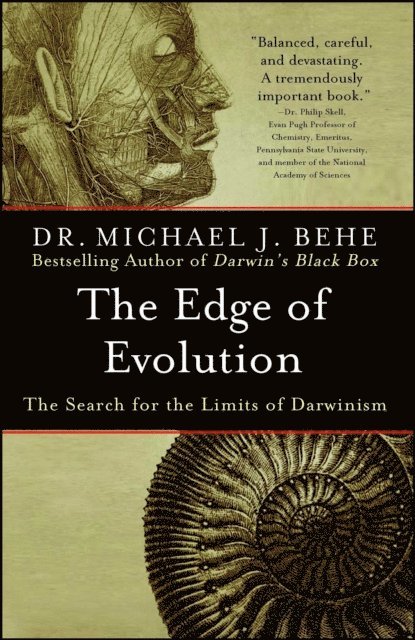
Edge of Evolution
199 kr
Läs direkt i Bokus Reader – eller ladda ned till din enhet
Beskrivning
When Michael J. Behe''s first book, Darwin''s Black Box, was published in 1996, it launched the intelligent design movement. Critics howled, yet hundreds of thousands of readers -- and a growing number of scientists -- were intrigued by Behe''s claim that Darwinism could not explain the complex machinery of the cell.
Now, in his long-awaited follow-up, Behe presents far more than a challenge to Darwinism: He presents the evidence of the genetics revolution -- the first direct evidence of nature''s mutational pathways -- to radically redefine the debate about Darwinism.
How much of life does Darwin''s theory explain? Most scientists believe it accounts for everything from the machinery of the cell to the history of life on earth. Darwin''s ideas have been applied to law, culture, and politics.
But Darwin''s theory has been proven only in one sense: There is little question that all species on earth descended from a common ancestor. Overwhelming anatomical, genetic, and fossil evidence exists for that claim. But the crucial question remains: How did it happen? Darwin''s proposed mechanism -- random mutation and natural selection -- has been accepted largely as a matter of faith and deduction or, at best, circumstantial evidence. Only now, thanks to genetics, does science allow us to seek direct evidence. The genomes of many organisms have been sequenced, and the machinery of the cell has been analyzed in great detail. The evolutionary responses of microorganisms to antibiotics and humans to parasitic infections have been traced over tens of thousands of generations.
As a result, for the first time in history Darwin''s theory can be rigorously evaluated. The results are shocking. Although it can explain marginal changes in evolutionary history, random mutation and natural selection explain very little of the basic machinery of life. The "edge" of evolution, a line that defines the border between random and nonrandom mutation, lies very far from where Darwin pointed. Behe argues convincingly that most of the mutations that have defined the history of life on earth have been nonrandom.
Although it will be controversial and stunning, this finding actually fits a general pattern discovered by other branches of science in recent decades: The universe as a whole was fine-tuned for life. From physics to cosmology to chemistry to biology, life on earth stands revealed as depending upon an endless series of unlikely events. The clear conclusion: The universe was designed for life.
Now, in his long-awaited follow-up, Behe presents far more than a challenge to Darwinism: He presents the evidence of the genetics revolution -- the first direct evidence of nature''s mutational pathways -- to radically redefine the debate about Darwinism.
How much of life does Darwin''s theory explain? Most scientists believe it accounts for everything from the machinery of the cell to the history of life on earth. Darwin''s ideas have been applied to law, culture, and politics.
But Darwin''s theory has been proven only in one sense: There is little question that all species on earth descended from a common ancestor. Overwhelming anatomical, genetic, and fossil evidence exists for that claim. But the crucial question remains: How did it happen? Darwin''s proposed mechanism -- random mutation and natural selection -- has been accepted largely as a matter of faith and deduction or, at best, circumstantial evidence. Only now, thanks to genetics, does science allow us to seek direct evidence. The genomes of many organisms have been sequenced, and the machinery of the cell has been analyzed in great detail. The evolutionary responses of microorganisms to antibiotics and humans to parasitic infections have been traced over tens of thousands of generations.
As a result, for the first time in history Darwin''s theory can be rigorously evaluated. The results are shocking. Although it can explain marginal changes in evolutionary history, random mutation and natural selection explain very little of the basic machinery of life. The "edge" of evolution, a line that defines the border between random and nonrandom mutation, lies very far from where Darwin pointed. Behe argues convincingly that most of the mutations that have defined the history of life on earth have been nonrandom.
Although it will be controversial and stunning, this finding actually fits a general pattern discovered by other branches of science in recent decades: The universe as a whole was fine-tuned for life. From physics to cosmology to chemistry to biology, life on earth stands revealed as depending upon an endless series of unlikely events. The clear conclusion: The universe was designed for life.
Produktinformation
- Utgivningsdatum: 2007-06-05
- Språk: Engelska
- Filformat: EPUB
- Kopieringsskydd: LCP
- ISBN: 9781416559047
- Förlag: Free Press
Utforska kategorier
Betyg & recensioner
0 recensioner
Inga recensioner tillgängliga.