• Fri frakt över 249 kr
  • •
  • Snabba leveranser
  • •
  • Billiga böcker
Kundservice

Du är på sajten för privatpersoner.

Företag, bibliotek eller offentlig verksamhet?

Du handlar på classic.bokus.com, där alla dina funktioner finns intakta.
Till classic.bokus.com
Bokus logotyp. Gå till startsidan.
  • Erbjudanden
  • Nyheter
  • Student
  • Topplistor
  • Barn & ungdom
  • Bokus Play
  • E-böcker
  • Pocketböcker
  • Spel & pussel

10% rabatt på allt med kod: NYSTART10 →

Sidfot

Mina sidor

    Hjälp

    • Kundservice
    • Vanliga frågor och svar
    • Frakt och leverans
    • Retur vid ångerrätt
    • Reklamera vara
    • Betalning
    • Köpvillkor
    • Allmänna villkor
    • Information om webbplatsens tillgänglighet

    Om Bokus

    • Om oss
    • Pressrum
    • För studenter
    • För företag
    • För bibliotek och offentlig verksamhet
    • För leverantörer
    • Hållbarhet

    Populärt

    • Aktuella erbjudanden
    • Presentkort
    • Studentlitteratur
    • Nya böcker
    • Topplistor
    • Signerade böcker
    • Engelska böcker

    Inspiration

    • Boktips
    • BookTok
    • Populära bokserier
    • Barnbokskaraktärer
    • Populära författare
    Logotyp för Bokus
    Följ oss på Facebook (extern länk)Följ oss på Instagram (extern länk)Följ oss på YouTube (extern länk)Följ oss på TikTok (extern länk)
    bokus @ CookiesAnpassa cookiesIntegritetspolicyKöpvillkor
    Till Citymail hemsida (extern länk)Till Budbee hemsida (extern länk)Till Postnord hemsida (extern länk)Till Schenker hemsida (extern länk)Till Early Bird hemsida (extern länk)Till Walleys hemsida (extern länk)
    1. Naturvetenskap och teknik
    2. Matematik och naturvetenskap
    3. Biologi
    4. Biokemi

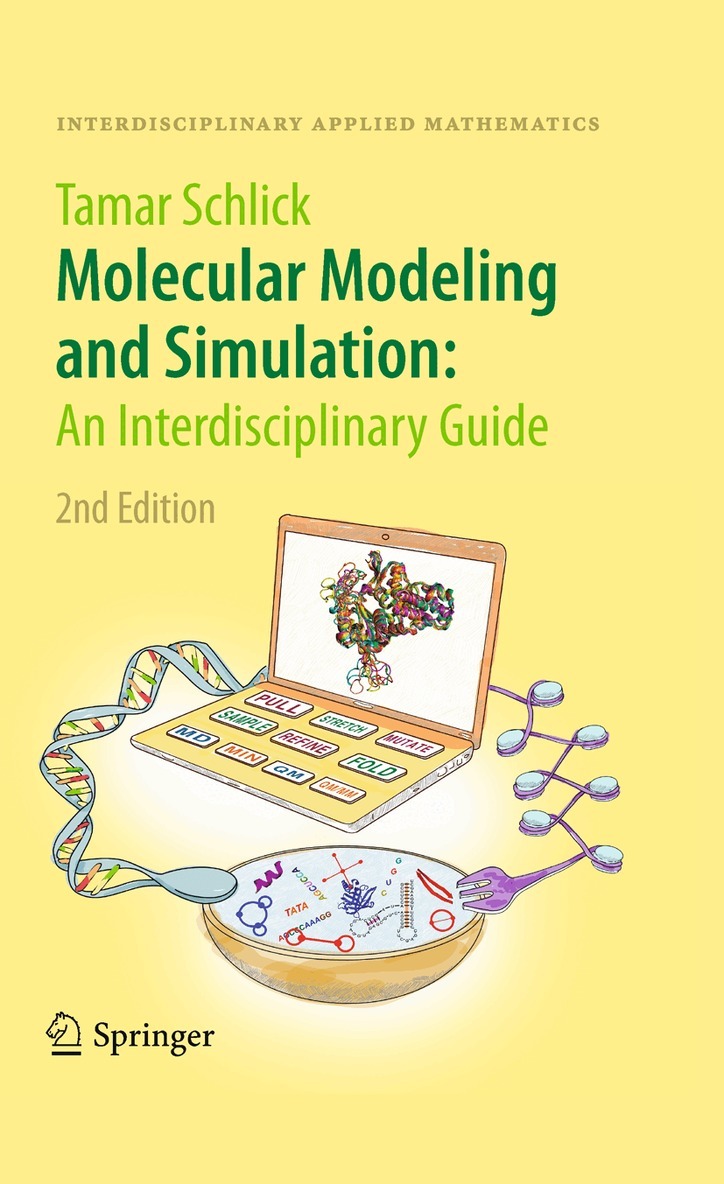
    Molecular Modeling and Simulation: An Interdisciplinary Guide

    An Interdisciplinary Guide

    AvTamar Schlick

    Inbunden, Engelska, 2010

    Del 21 i serien Interdisciplinary Applied Mathematics

    1 518 kr

    Beställningsvara. Skickas inom 10-15 vardagar. Fri frakt över 249 kr.

    Fler format och utgåvor

    E-bok

    1 941 kr

    Beskrivning

    This book evolved from an interdisciplinary graduate course entitled 'Molecular Modeling' developed at New York University. Its primary goal is to stimulate excitement for molecular modeling research while providing grounding in the discipline. Scientists who wish to enter, or become familiar with, the field of biomolecular modeling and simulation may benefit from the broad coverage of problems and approaches.

    Produktinformation

    • Utgivningsdatum:2010-08-25
    • Mått:155 x 235 x 44 mm
    • Vikt:1 449 g
    • Format:Inbunden
    • Språk:Engelska
    • Serie:Interdisciplinary Applied Mathematics
    • Antal sidor:723
    • Upplaga:2
    • Förlag:Springer-Verlag New York Inc.
    • ISBN:9781441963505

    Utforska kategorier

    • Biokemi inom Naturvetenskap och teknik
    • Tillämpad matematik inom Naturvetenskap och teknik
    • Biokemisk teknik inom Naturvetenskap och teknik

    Recensioner i media

    From the reviews: HAROLD A. SCHERAGA, CORNELL UNIVERSITY "The interdisciplinary structural biology community has waited long for a book of this kind which provides an excellent introduction to molecular modeling." J. ANDREW McCAMMON, HOWARD HUGHES MEDICAL INSTITUTE, UNIVERSITY OF CALIFORNIA AT SAN DIEGO "A uniquely valuable introduction to the modeling of biomolecular structure and dynamics. A rigorous and up-to-date treatment of the foundations, enlivened by engaging anecdotes and historical notes." J.J. COLLINS, BOSTON UNIVERSITY "I am often asked by physicists, mathematicians and engineers to recommend a book that would be useful to get them started in computational molecular biology. I am also often approached by my colleagues in computational biology to recommend a solid textbook for a graduate course in the area. Tamar Schlick has written the book that I will be recommending to both groups. Tamar has done an amazing job in writing a book that is both suitably accessible for beginners, and suitably rigorous for experts." BIOINFORMATICS "It is a fantastic graduate textbook to get into structural biology. The 14 chapters offer keys to understand the broader context of this field and the impact it can have on our everyday life for example through medical applications...The main achievement of the book is that even the most sophisticated problems are part of a gradual approach...certainly efficient...The book will obviously be of great interest to students and teachers but it should also be very valuable for research scientists, especially newcomers to the field of molecular modeling, as a reference book and a point of entry in the more specialized literature." BIOTECH INTERNATIONAL [BTI]: " ... The text emphasises that the field is changing very rapidly and that it is full of exciting discoveries. Many of these findings have lead to medical and technological breakthroughs. This book stimulates this excitement, while still providing students many computational details ... It should appeal to beginning graduate students in medical schools, and in many scientific departments such as biology, chemistry, physics, mathematics, and computer science. MATHEMATICAL REVIEWS Review by Henry van den Bedem, University of Alabama-Birmingham "The book is unique in that it combines introductory molecular biology with advanced topics in modern simulation algorithms in no more than 600 pages. ... For those seeking more detail, the author provides 1000+ references, and additionally includes reading lists complementing the main text. This is an excellent introductory text that is a pleasure to read." ZENTRALBLATT MATH Review by Ivan Krivy, University of Ostrava, Czech Republic "This book provides an excellent introduction to the modeling of biomolecular structures and dynamics. It is subdivided into three parts covering relatively broad topics: (1) molecular structure and modeling, inclusive of current problems and state of computation (Chapters 1-6); (2) molecular mechanics: force field origin, composition, and evaluation techniques (Chapters 7-9); and (3) simulation techniques: conformational sampling by geometry optimization, Monte Carlo, and molecular dynamics approaches (Chapter 10-13). The last chapter (Chapter 14) is devoted to discussing the similarity and diversity problems in chemical design. The book's appendices complement the material in the main text through homework assignments, reading lists, and other information useful for teaching molecular modeling.\par The book is intended for students of an interdisciplinary graduate course in molecular modeling as well as for researchers (physicists, mathematicians and engineers) to get them started in computational molecular biology." "Molecular modeling ... is now an important branch of modern biochemistry. ... Schlick has brought her unique interdisciplinary expertise to the subject. ... One of the most distinguished characteristics of the book is that it makes the reading really fun ... and the material accessible. ... a crystal clear logical presentation ... . Schlick has added a unique title to the collection of mathematical biology textbooks ... . a valuable introduction to the field of computational molecular modeling. It is a unique textbook ... ." (Hong Qian, SIAM Reviews, Vol. 47 (4), 2005) "The text is beautifully illustrated with many color illustrations. Even part of the text is typeset in color. Not only the illustrations interrupt the very readable text, there are also many box-insertions ... . So, if you read this as a teacher, you will find enough material to build your own lecture notes for your own group of students. To conclude, this is a broad and relaxed introduction to the field of molecular modeling." (Adhemar Bultheel, Bulletin of the Belgian Mathematical Society, Vol. 11 (4), 2004) "This textbook evolved from a graduate course in molecular modeling, and was expanded to serve as an introduction to the field for scientists in other disciplines. ... The book is unique in that it combines introductory molecular biology with advanced topics in modern simulation algorithms ... . the author provides 1000+ references, and additionally includes reading lists complementing the main text. This is an excellent introductory text that is a pleasure to read." (Henry van den Bedem, MathSciNet, September, 2004) "This book provides an excellent introduction to the modeling of biomolecular structures and dynamics. ... The book's appendices complement the material in the main text through homework assignments, reading lists, and other information useful for teaching molecular modeling. The book is intended for students of an interdisciplinary graduate course in molecular modeling as well as for researchers (physicists, mathematicians and engineers) to get them started in computational molecular biology." (Ivan Krrivy, Zentralblatt MATH, Issue 1011, 2003) "The book ... is the outcome of the author Tamar Schlick's teaching experience at New York University. It is a fantastic graduate textbook to get into structural biology. ... even the most sophisticated problems are part of a gradual approach ... . The book will obviously be of great interest to students and teachers but it should also be very valuable for research scientists, especially newcomers to the field ... as a reference book and a point of entry in the more specialised literature." (Benjamin Audit, Bioinformatics, January, 2003) "The basic goal of this new text is to introduce students to molecular modelling and simulation and to the wide range of biomolecular problems being attacked by computational techniques. ... the text emphasises that the field is changing very rapidly and that it is full of exciting discoveries. ... This book stimulates this excitement, while still providing students many computational details. ... It contains detailed illustrations throughout ... . It should appeal to beginning graduate students ... in many scientific departments ... ." (Biotech International, Vol. 15 (2), 2003) From the reviews of the second edition: "This is the second edition of a blockbuster devoted to the modeling of biomolecular structure and dynamics. ... The book addresses a broad audience that includes mathematicians, computer scientists, physical scientists, and biologists. ... designed for beginning graduate students in a variety of disciplines. ... The appendices include a huge bibliography, a sample course syllabus ... and a variety of innovative homework assignments." (William J. Satzer, The Mathematical Association of America, October, 2010)

    Innehållsförteckning

    • Biomolecular Structure and Modeling: Historical Perspective.- Biomolecular Structure and Modeling: Problem and Application Perspective.- Protein Structure Introduction.- Protein Structure Hierarchy.- Nucleic Acids Structure Minitutorial.- Topics in Nucleic Acids Structure: DNA Interactions and Folding.- Topics in Nucleic Acids Structure: Noncanonical Helices and RNA Structure.- Theoretical and Computational Approaches to Biomolecular Structure.- Force Fields.- Nonbonded Computations.- Multivariate Minimization in Computational Chemistry.- Monte Carlo Techniques.- Molecular Dynamics: Basics.- Molecular Dynamics: Further Topics.- Similarity and Diversity in Chemical Design.