• Fri frakt över 249 kr
  • •
  • Snabba leveranser
  • •
  • Billiga böcker
Kundservice

Du är på sajten för privatpersoner.

Företag, bibliotek eller offentlig verksamhet?

Du handlar på classic.bokus.com, där alla dina funktioner finns intakta.
Till classic.bokus.com
Bokus logotyp. Gå till startsidan.
  • Erbjudanden
  • Nyheter
  • Student
  • Topplistor
  • Barn & ungdom
  • Bokus Play
  • E-böcker
  • Pocketböcker
  • Spel & pussel

10% rabatt på allt med kod: NYSTART10 →

Sidfot

Mina sidor

    Hjälp

    • Kundservice
    • Vanliga frågor och svar
    • Frakt och leverans
    • Retur vid ångerrätt
    • Reklamera vara
    • Betalning
    • Köpvillkor
    • Allmänna villkor
    • Information om webbplatsens tillgänglighet

    Om Bokus

    • Om oss
    • Pressrum
    • För studenter
    • För företag
    • För bibliotek och offentlig verksamhet
    • För leverantörer
    • Hållbarhet

    Populärt

    • Aktuella erbjudanden
    • Presentkort
    • Studentlitteratur
    • Nya böcker
    • Topplistor
    • Signerade böcker
    • Engelska böcker

    Inspiration

    • Boktips
    • BookTok
    • Populära bokserier
    • Barnbokskaraktärer
    • Populära författare
    Logotyp för Bokus
    Följ oss på Facebook (extern länk)Följ oss på Instagram (extern länk)Följ oss på YouTube (extern länk)Följ oss på TikTok (extern länk)
    bokus @ CookiesAnpassa cookiesIntegritetspolicyKöpvillkor
    Till Citymail hemsida (extern länk)Till Budbee hemsida (extern länk)Till Postnord hemsida (extern länk)Till Schenker hemsida (extern länk)Till Early Bird hemsida (extern länk)Till Walleys hemsida (extern länk)
    1. Samhälle och politik
    2. Samhälle och kultur
    3. Kultur och medier
    4. Kulturvetenskap

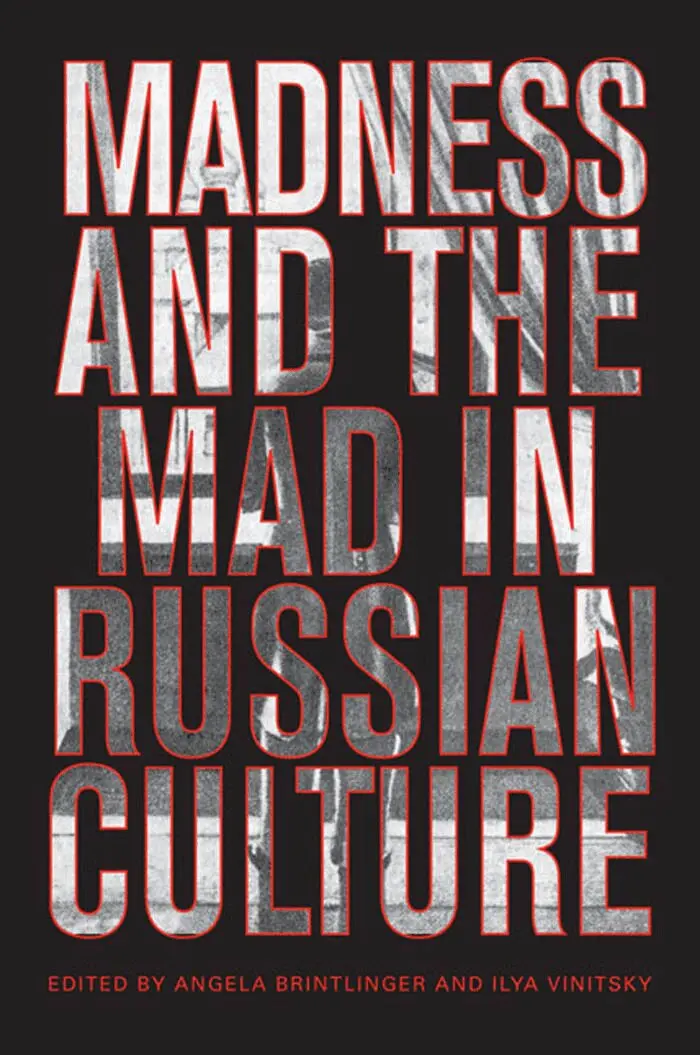
    Madness and the Mad in Russian Culture

    AvAngela Brintlinger,Ilya Vinitsky

    E-bok
    PDF, Engelska, 2006

    520 kr

    Läs direkt i Bokus Reader – eller ladda ned till din enhet (PDF kräver ofta zoom och scroll på små skärmar).

    Beskrivning

    The problem of madness has preoccupied Russian thinkers since the beginning of Russia's troubled history and has been dealt with repeatedly in literature, art, film, and opera, as well as medical, political, and philosophical essays. Madness has been treated not only as a medical or psychological matter, but also as a metaphysical one, encompassing problems of suffering, imagination, history, sex, social and world order, evil, retribution, death, and the afterlife.Madness and the Mad in Russian Culture represents a joint effort by American, British, and Russian scholars - historians, literary scholars, sociologists, cultural theorists, and philosophers - to understand the rich history of madness in the political, literary, and cultural spheres of Russia. Editors Angela Brintlinger and Ilya Vinitsky have brought together essays that cover over 250 years and address a wide variety of ideas related to madness - from the involvement of state and social structures in questions of mental health, to the attitudes of major Russian authors and cultural figures towards insanity and how those attitudes both shape and are shaped by the history, culture, and politics of Russia.

    Produktinformation

    • Utgivningsdatum:2006-12-31
    • Språk:Engelska
    • Antal sidor:304
    • Filformat:PDF
    • Kopieringsskydd:LCP
    • ISBN:9781442684539
    • Förlag:University of Toronto Press

    Utforska kategorier

    • Kulturvetenskap inom Samhälle och politik
    • Socialt arbete och välfärd inom Samhälle och politik
    • Socialhistoria och kulturhistoria inom Historia och arkeologi

    Mer om författaren

    Angela Brintlinger is an associate professor in the Department of Slavic Languages and Literatures at Ohio State University.Ilya Vinitsky is an assistant professor in the Department of Slavic Languages and Literatures at the University of Pennsylvania.

    Recensioner i media

    "This collection is an important contribution to our understanding of the ways in which the shifting discourse of madness offers a rich and varied lens through which to explore Russia's troubled experience of modernity." - D. Beer (Slavonic and East European Review/vvol88:03:10) ‘A series of fascinating essays that approach the problem of insanity in Russian culture from wide-ranging disciplinary angles.’ - Valeria Sobol (The Russian Review) ‘The most comprehensive interdisciplinary survey of its kind.’ - Dmitri Shalin (Russian Journal of Communication) ‘A cornucopia of delights for specialists and generalists alike.’ - Scarlet Marquette (Slavic and East European Journal) ‘The volume is a broad mosaic ... exciting and kaleidoscopic.’ - Elena L. Grigorenko (PsycCRITIQUES) ‘This collection of essays is both an excellent introduction to madness and an opportunity to probe this fascinating terrain in depth.’- Nigel Raab (Left History vol 20:01:2016)

    Innehållsförteckning

    • AcknowledgmentsNote on Translation and TransliterationIntroduction: Approaching Russian MadnessANGELA BRINTLINGERPART ONE: MADNESS, THE STATE, AND SOCIETY1 A Cheerful Empress and Her Gloomy Critics: Catherine the Great and the Eighteenth-Century Melancholy ControversyILYA VINITSKY2 The Osvidetel’stvovanie and Ispytanie of Insanity: Psychiatry in Tsarist RussiaLIA IANGOULOVA3 Madness as an Act of Defence of Personality in Dostoevsky’sThe DoubleELENA DRYZHAKOVA4 Vsevolod Garshin, the Russian Intelligentsia, and Fan HysteriaROBERT D. WESSLING5 On Hostile Ground: Madness and Madhouse in Joseph Brodsky’s‘Gorbunov and Gorchakov'LEV LOSEFFPART TWO: MADNESS, WAR, AND REVOLUTION6 The Concept of Revolutionary Insanity in Russian HistoryMARTIN A. MILLER7 The Politics of Etiology: Shell Shock in the Russian Army, 1914–1918IRINA SIROTKINA8 Lives Out of Balance: The ‘Possible World’ of Soviet Suicide during the 1920sKENNETH PINNOW9 Early Soviet Forensic Psychiatric Approaches to Sex Crime, 1917–1934DAN HEALEYPART THREE: MADNESS AND CREATIVITY10 Writing about Madness: Russian Attitudes toward Psyche and Psychiatry, 1887–1907ANGELA BRINTLINGER11 ‘Let Them Go Crazy’: Madness in the Works of ChekhovMARGARITA ODESSKAYA12 The Genetics of Genius: V.P. Efroimson and the Biosocial Mechanisms of Heightened Intellectual ActivityYVONNE HOWELL13 Madwomen without Attics: The Crazy Creatrix and the Procreative IurodivaiaHELENA GOSCILO14 A ‘New Russian’ Madness? Fedor Mikhailov’s Novel Idiot and Roman Kachanov’s Film Daun KhausANDREI ROGACHEVSKII15 Methods of Madness and Madness as a MethodMIKHAIL EPSTEINAfterwordJULIE V. BROWNBibliographyContributors